




University of California astronomers, including three from UCLA, have resolved a mystery about the early universe and its first galaxies.
Astronomers have known that more than 12 billion years ago, about 1 billion years after the Big Bang, the gas...
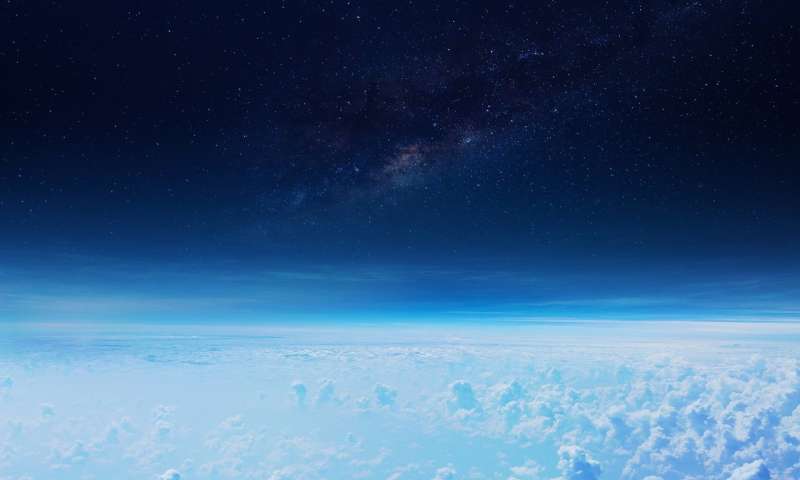
Historic space weather may help us understand what's coming next, according to new research by the University of Warwick.
Professor Sandra Chapman, from Warwick's Centre for Fusion, Space and Astrophysics, led a project which charted the space weather in previous...

A pair of dwarf galaxies closely circling the Milky Way, the Large and Small Magellanic Clouds, were in the throes of merging into one when they fell into our galaxy. The duo is thought to hold enough gas to...

Recent observations by NASA's Hubble and Spitzer space telescopes of ultrahot Jupiter-like planets have perplexed theorists. The spectra of these planets have suggested they have exotic -- and improbable -- compositions.
However, a new study just published by a research...

The solar system was formed from a protoplanetary disk consisting of gas and dust. Since the cumulative mass of all objects beyond Neptune is much smaller than expected and the bodies there mostly have inclined, eccentric orbits, it is...

After nearly 20 years, the record of the most distant radio galaxy ever discovered has been broken. A team led by Ph.D. student Aayush Saxena (Leiden Observatory, the Netherlands) has found a radio galaxy from a time when the...

Forty-four planets in solar systems beyond our own have been discovered in one go, dwarfing the usual number of confirmations from extrasolar surveys, which is typically a dozen or less. The findings will improve existing models of solar systems,...

A glittering host of galaxies populate this rich image taken with ESO's VLT Survey Telescope, a state-of-the-art 2.6-m telescope designed for surveying the sky in visible light. The features of the multitude of galaxies strewn across the image allow...
Listening to electromagnetic waves around the Earth, converted to sound, is almost like listening to singing and chirping birds at dawn with a crackling campfire nearby. Such waves are therefore called chorus waves. They cause the Northern Lights, but...

The origin of organic matter found in meteorites that formed during the birth of the Solar System 4.5 billion years ago may provide key clues to understanding the birth of life here on Earth.
It could also help astronomers investigate...

For almost 10 years, astronomers have been studying a mysterious diffuse radiation coming from the centre of our galaxy. Originally, it was thought that this radiation could originate from the elusive dark matter particles that many researchers are hoping...


