




With an equator diameter of around 143,000 kilometers, Jupiter is the largest planet in the solar system and has 300 times the mass of the Earth. The formation mechanism of giant planets like Jupiter has been a hotly debated...
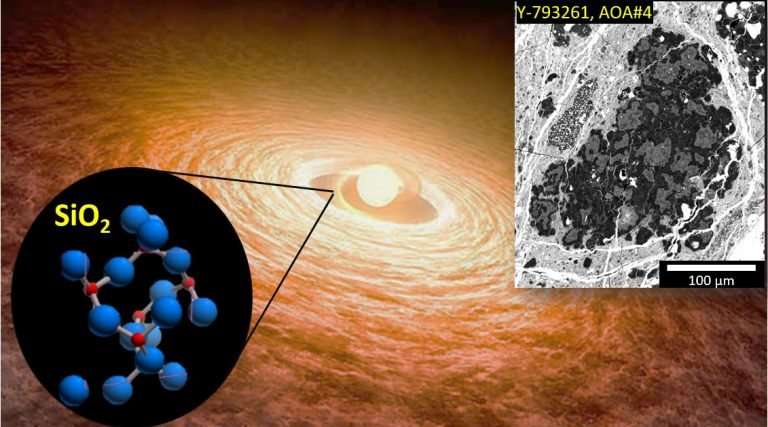
A multi-institutional team of researchers has discovered silica mineral quartz in a primitive meteorite, comprising direct evidence of silica condensation within the solar protoplanetary disk, and offering new clues to understanding solar formation and evolution. Though previous infrared spectroscopic...

The Milky Way galaxy has died once before, and we are now in what is considered its second life. Calculations by Masafumi Noguchi (Tohoku University) have revealed previously unknown details about the Milky Way. These were published in the...

The mass of a very young exoplanet has been revealed for the first time using data from ESA's star mapping spacecraft Gaia and its predecessor, the quarter-century retired Hipparcos satellite.
Astronomers Ignas Snellen and Anthony Brown from Leiden University, the...
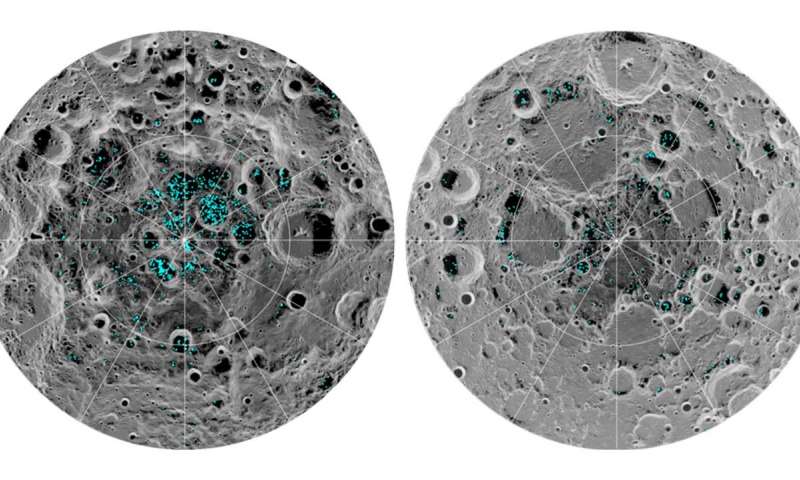
In the darkest and coldest parts of its polar regions, a team of scientists has directly observed definitive evidence of water ice on the Moon's surface. These ice deposits are patchily distributed and could possibly be ancient. At the...

Scientists have shown that water is likely to be a major component of those exoplanets (planets orbiting other stars) which are between two to four times the size of Earth. It will have implications for the search of life...
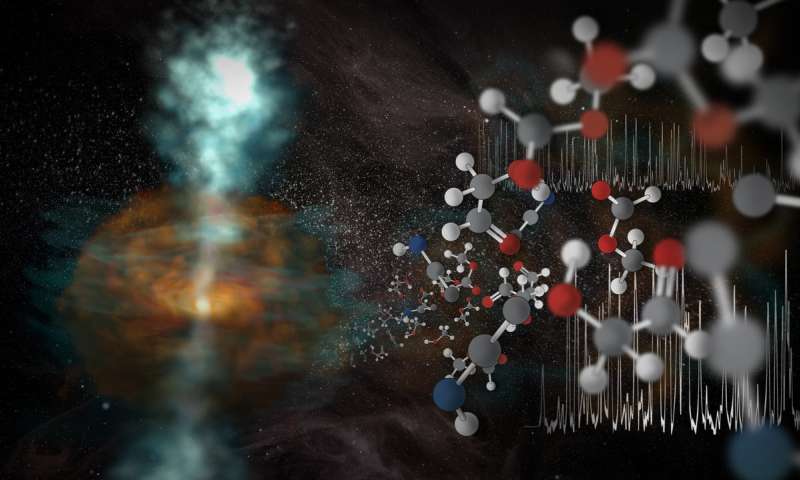
The ALMA telescope in Chile has transformed how we see the universe, showing us otherwise invisible parts of the cosmos. This array of incredibly precise antennas studies a comparatively high-frequency sliver of radio light: waves that range from a...

Are magnetic fields an important guiding force for gas accreting to a supermassive black hole (SMBH) like the one that our Milky Way galaxy hosts? The role of magnetic fields in gas accretion is little understood, and trying to...
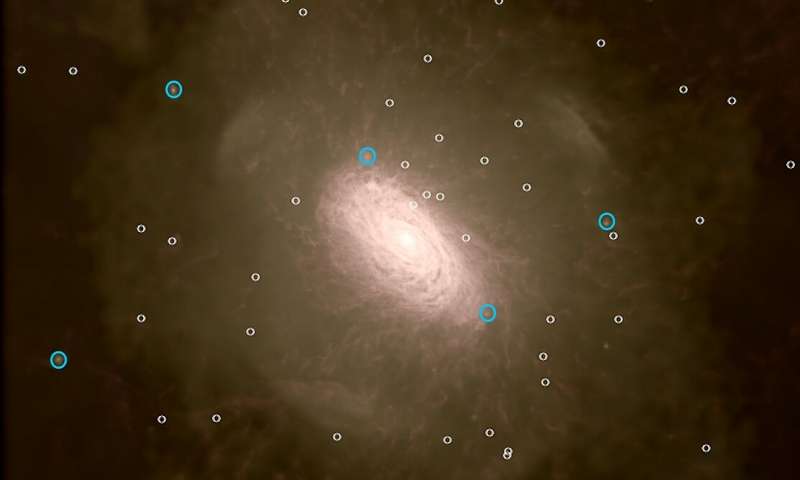
Astronomers have identified some of the earliest galaxies in the Universe.
The team from the Institute for Computational Cosmology at Durham University and the Harvard-Smithsonian Center for Astrophysics, has found evidence that the faintest satellite galaxies orbiting our own Milky...

MIT scientists have uncovered a sprawling new galaxy cluster hiding in plain sight. The cluster, which sits a mere 2.4 billion light years from Earth, is made up of hundreds of individual galaxies and surrounds an extremely active supermassive...

A team of astronomers led by George Becker at the University of California, Riverside, has made a surprising discovery: 12.5 billion years ago, the most opaque place in the universe contained relatively little matter.
It has long been known that...


