




Astronomers using the National Science Foundation's Karl G. Jansky Very Large Array (VLA) have discovered a fast-moving jet of material propelled outward from a type of neutron star previously thought incapable of launching such a jet. The discovery, the...
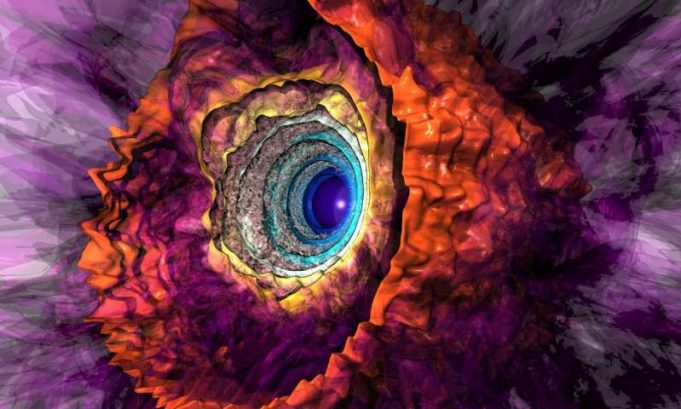
Astrophysicists finally have an explanation for the violent mood swings of some of the biggest, brightest and rarest stars in the universe.
The stars, called luminous blue variables, periodically erupt in dazzling outbursts nicknamed "stellar geysers." These powerful eruptions launch...

Today, an international group of researchers, including Carnegie Mellon University's Rachel Mandelbaum, released the deepest wide field map of the three-dimensional distribution of matter in the universe ever made and increased the precision of constraints for dark energy with...
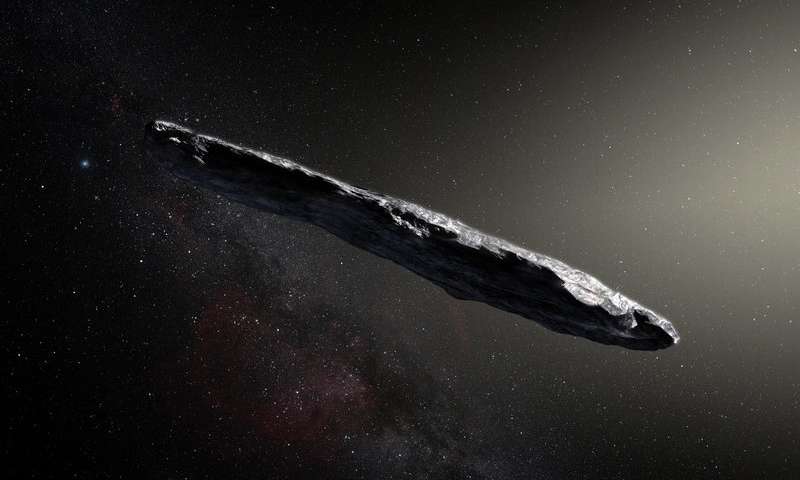
A team of astronomers led by Coryn Bailer-Jones of the Max Planck Institute for Astronomy has tracked the interstellar object 'Oumuamua to several possible home stars. The object was discovered in late 2017 – this was the first time...

Data from NASA's Cassini spacecraft has revealed what appear to be giant dust storms in equatorial regions of Saturn's moon Titan. The discovery, described in a paper published on Sept. 24 in Nature Geoscience, makes Titan the third Solar...
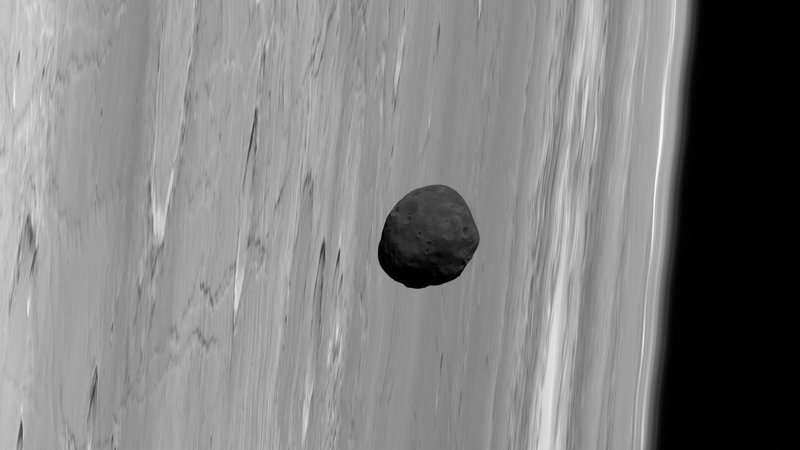
The weird shapes and colors of the tiny Martian moons Phobos and Deimos have inspired a long-standing debate about their origins.
The dark faces of the moons resemble the primitive asteroids of the outer solar system, suggesting the moons might...

A new study shows evidence that ancient Mars probably had an ample supply of chemical energy for microbes to thrive underground.
"We showed, based on basic physics and chemistry calculations, that the ancient Martian subsurface likely had enough dissolved hydrogen...

A UK team of astronomers report the first detection of matter falling into a black hole at 30% of the speed of light, located in the centre of the billion-light year distant galaxy PG211+143. The team, led by Professor...
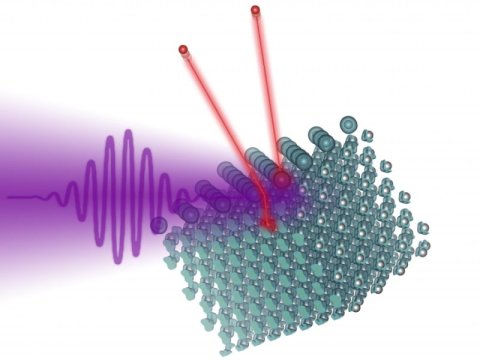
Quantum jumps are usually regarded to be instantaneous. However, new measurement methods are so precise that it has now become possible to observe such a process and to measure its duration precisely -- for example the famous 'photoelectric effect',...

A team led by researchers from the Institute of Cosmos Sciences of the University of Barcelona (ICCUB, UB-IEEC) and the University of Groningen has found, through the analysis of Gaia data, substructures in the Milky Way that were previously...
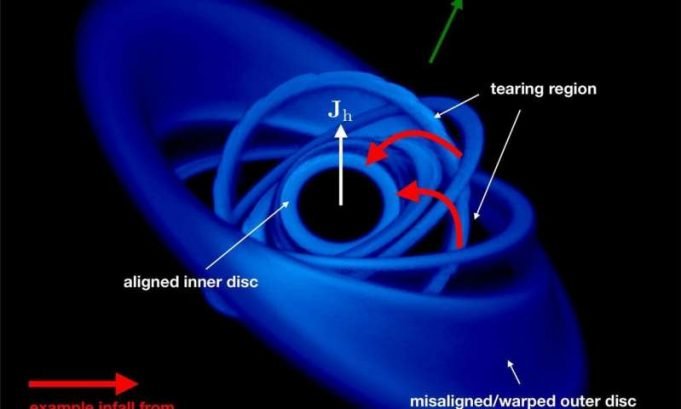
A UK team of astronomers report the first detection of matter falling into a black hole at 30 percent of the speed of light, located in the centre of the billion-light year distant galaxy PG211+143. The team, led by...


