



Black holes form when stars die, allowing the matter in them to collapse into an extremely dense object from which not even light can escape. Astronomers theorize that massive black holes could also form at the birth of a...
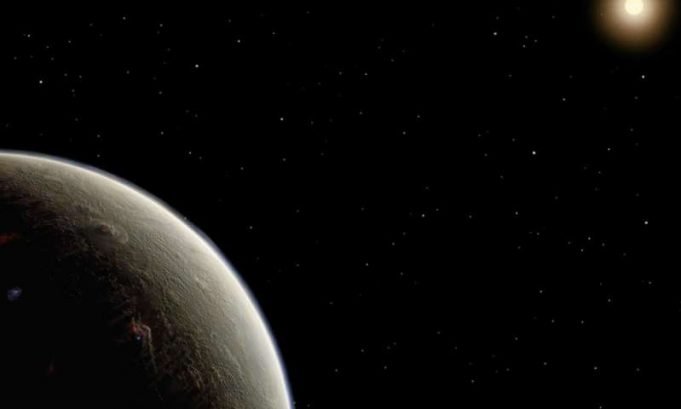
Among the TV series Star Trek's many charms are its rich universe of characters and planets. Now, the Dharma Planet Survey, in a new study led by University of Florida (UF) astronomer Jian Ge and team including Tennessee State...

An unusual infrared light emission from a nearby neutron star detected by NASA's Hubble Space Telescope could indicate new features never before seen. One possibility is that there is a dusty disk surrounding the neutron star; another is that...
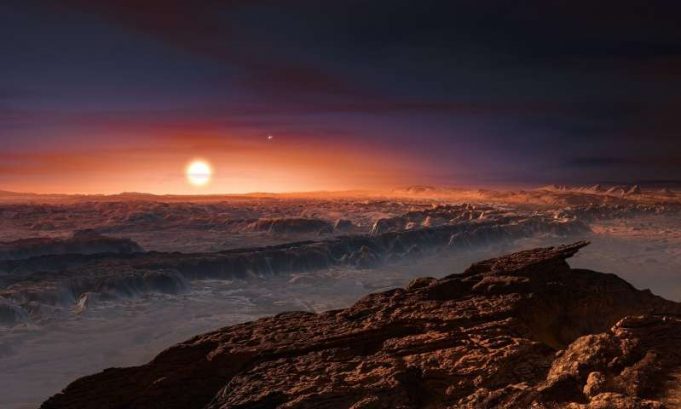
In August of 2016, astronomers from the European Southern Observatory (ESO) confirmed the existence of an Earth-like planet around Proxima Centauri – the closest star to our solar system. In addition, they confirmed that this planet (Proxima b) orbited...

While last year's discovery of gravitational waves from colliding neutron stars was earth-shaking, it won't add extra dimensions to our understanding of the universe—not literal ones, at least.
University of Chicago astronomers found no evidence for extra spatial dimensions to...

An international group of astronomers, including physicists at the University of St Andrews, has revived a previously debunked theory of gravity, arguing that motions within dwarf galaxies would be slower if close to a massive galaxy.
The research team examined...

New research by Stella Offner, assistant professor of astronomy at The University of Texas at Austin, finds that magnetic waves are an important factor driving the process of star formation within the enormous clouds that birth stars. Her research...

Scientists at Southwest Research Institute studied an unusual pair of asteroids and discovered that their existence points to an early planetary rearrangement in our solar system.
These bodies, called Patroclus and Menoetius, are targets of NASA's upcoming Lucy mission. They...

Artificial intelligence is invading many fields, most recently astronomy and the search for intelligent life in the universe, or SETI.
Researchers at Breakthrough Listen, a SETI project led by the University of California, Berkeley, have now used machine learning to...
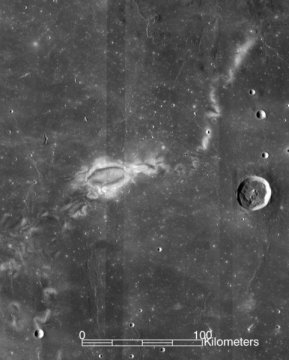
The mystery behind lunar swirls, one of the solar system's most beautiful optical anomalies, may finally be solved thanks to a joint Rutgers University and University of California Berkeley study.
The solution hints at the dynamism of the moon's ancient...
For the first time, a powerful "wind" of molecules has been detected in a galaxy located 12 billion light-years away. Probing a time when the universe was less than 10 percent of its current age, University of Texas at...


