




Astronomers comparing data from an ongoing major survey of the sky using the National Science Foundation's Karl G. Jansky Very Large Array (VLA) to data from earlier surveys likely have made the first discovery of the afterglow of a...
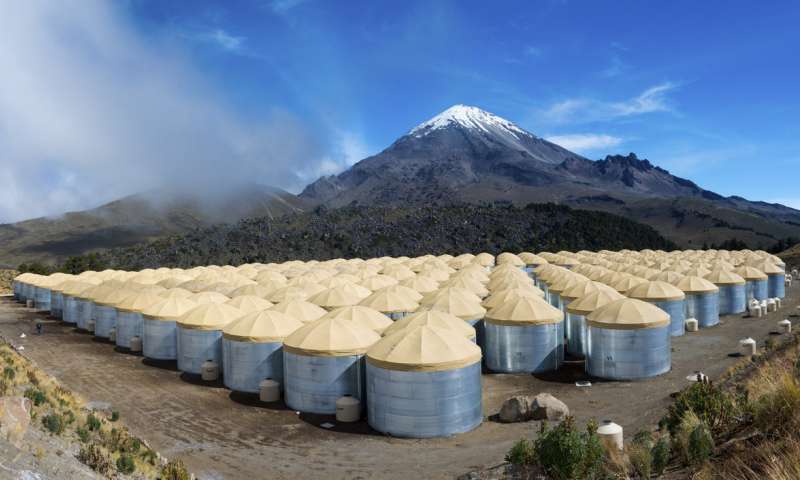
The night sky seems serene, but telescopes tell us that the universe is filled with collisions and explosions. Distant, violent events signal their presence by spewing light and particles in all directions. When these messengers reach Earth, scientists can...

A pair of Columbia University astronomers using NASA's Hubble Space Telescope and Kepler Space Telescope have assembled compelling evidence for the existence of a moon orbiting a gas-giant planet 8,000 light-years away.
In a paper published Oct. 3 in the...
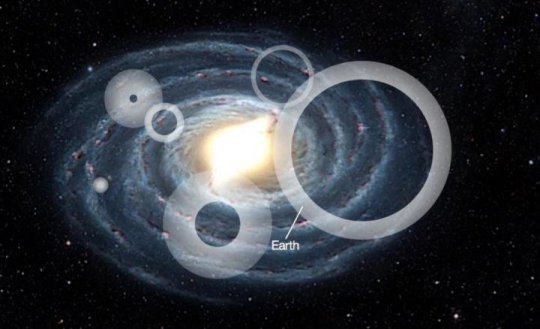
Could there be another planet out there with a society at the same stage of technological advancement as ours? To help find out, EPFL scientist Claudio Grimaldi, working in association with the University of California, Berkeley, has developed a...

For one brief shining moment after the 2015 detection of gravitational waves from colliding black holes, astronomers held out hope that the universe's mysterious dark matter might consist of a plenitude of black holes sprinkled throughout the universe.
University of...

A team of Leiden astronomers used the latest set of data from ESA's Gaia mission to look for high-velocity stars being kicked out of the Milky Way, but were surprised to find stars instead sprinting inwards – perhaps from...

Plant scientists have observed that when levels of carbon dioxide in the atmosphere rise, most plants do something unusual: They thicken their leaves.
And since human activity is raising atmospheric carbon dioxide levels, thick-leafed plants appear to be in our...

Simulations with animal models meant to mirror galactic cosmic radiation exposure to astronauts are raising red flags for investigators at Georgetown University Medical Center (GUMC) about the health of astronauts during long voyages, such as to Mars.
Their most recent...

All living beings need cells and energy to replicate. Without these fundamental building blocks, living organisms on Earth would not be able to reproduce and would simply not exist.
Little was known about a key element in the building blocks,...

Researchers at the University of California, Santa Cruz (UCSC), believe clouds of dust, rather than twin black holes, can explain the features found in active galactic nuclei (AGNs). The team publish their results today (14 June) in a paper...

Sparkling with an exceptional blue-toned brilliance and exhibiting wild variations in both brightness and spectrum, the luminous blue variable (LBV) is a relatively rare and still somewhat mysterious type of star.
Its appearance tends to fluctuate radically over time, and...


