




Astronomers have discovered a planet in orbit around one of the closest stars to the Sun, Barnard's star.
The study was co-led by researchers from Queen Mary University of London, and from the Institut d'Estudis Espacials de Catalunya and the...

For the first time astronomers have detected gravitational waves from a merged, hyper-massive neutron star. The scientists, Maurice van Putten of Sejong University in South Korea, and Massimo della Valle of the Osservatorio Astronomico de Capodimonte in Italy, publish...

Scientists have discovered something amazing.
In a cluster of some of the most massive and luminous stars in our galaxy, about 5,000 light years from Earth, astronomers detected particles being accelerated by a rapidly rotating neutron star as it passed...
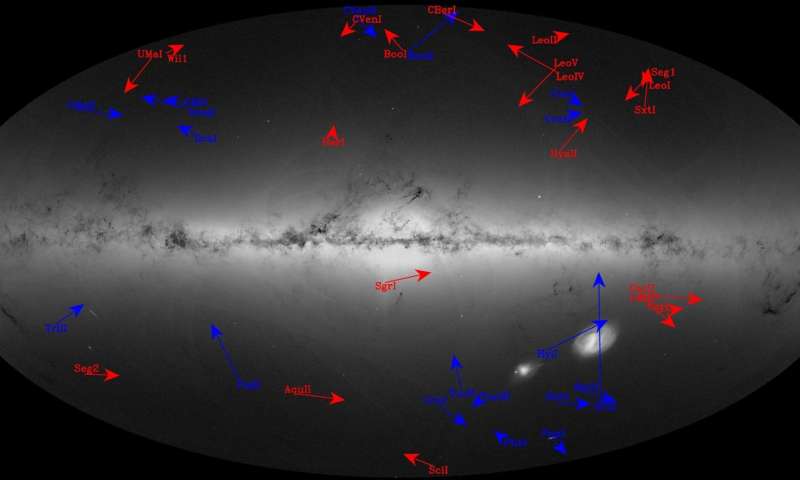
An international team led by researchers from the IAC used data from the ESA satellite Gaia to measure the motion of 39 dwarf galaxies. This data gives information on the dynamics of these galaxies, their histories and their interactions...

The Gaia satellite has spotted an enormous 'ghost' galaxy lurking on the outskirts of the Milky Way.
An international team of astronomers, including from the University of Cambridge, discovered the massive object when trawling through data from the European Space...
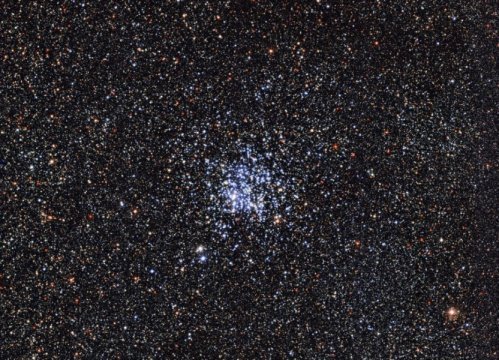
Do star clusters harbor many generations of stars or just one? Scientists have long searched for an answer and, thanks to the University of Arizona's MMT telescope, found one in the Wild Duck Cluster, where stars spin at different...

Scientists at Stanford University have demonstrated for the first time that heat from the sun and coldness from outer space can be collected simultaneously with a single device. Their research, published November 8 in the journal Joule, suggests that...

Solving a decades-old mystery, an international team of astronomers have discovered an extremely hot magnetosphere around a white dwarf, a remnant of a star like our Sun. The work was led by Dr Nicole Reindl, Research Fellow of the...

For the first time, a team of astronomers has observed several pairs of galaxies in the final stages of merging together into single, larger galaxies. Peering through thick walls of gas and dust surrounding the merging galaxies' messy cores,...

Galaxy evolution can be chaotic and messy, but it seems that streams of cold gas spraying out from the region around supermassive black holes may act to calm the storm.
This is according to an international team of scientists who...

Astronomers have found what could be one of the universe's oldest stars, a body almost entirely made of materials spewed from the Big Bang.
The discovery of this approximately 13.5 billion-year-old tiny star means more stars with very low mass...


