




An international team of scientists has discovered a new, massive star system -- one that also challenges existing theories of how large stars eventually die.
"This system is likely the first of its kind ever discovered in our own galaxy,"...

Every school kid knows that Earth has a magnetic field – it's what makes compasses align north-south and lets us navigate the oceans. It also protects the atmosphere, and thus life, from the sun's powerful wind.
But what about other...

A new study led by ANU has investigated the nature of a cosmic phenomenon that slows down star formation, which helps to ensure the universe is a place where life can emerge.
Lead researcher Dr. Roland Crocker from the ANU...
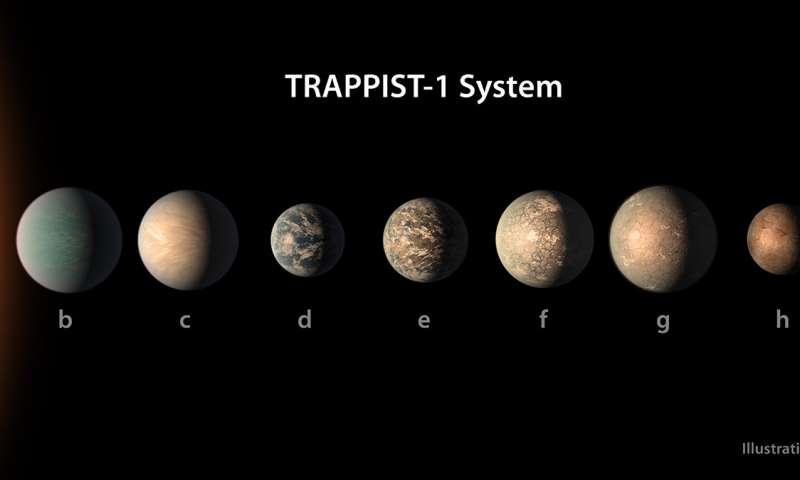
Not all stars are like the sun, so not all planetary systems can be studied with the same expectations. New research from a University of Washington-led team of astronomers gives updated climate models for the seven planets around the...
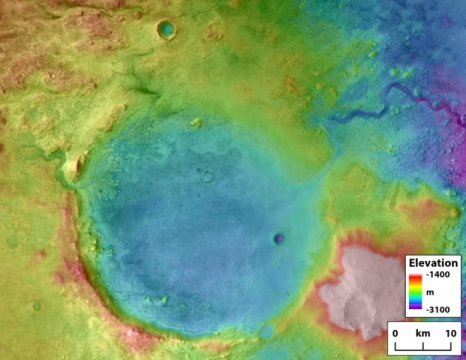
Today, most of the water on Mars is locked away in frozen ice caps. But billions of years ago it flowed freely across the surface, forming rushing rivers that emptied into craters, forming lakes and seas. New research led...

That round-the-globe rolling also explains how some grooves are superposed on top of others. The models show that grooves laid down right after the impact were crossed minutes to hours later by boulders completing their global journeys. In some...

University of Sydney astronomers, working with international colleagues, have found a star system like none seen before in our galaxy.
The scientists believe one of the stars—about 8000 light years from Earth—is the first known candidate in the Milky Way...

Researchers at the University of New Hampshire have captured a difficult-to-view singular event involving "magnetic reconnection" -- the process by which sparse particles and energy around Earth collide producing a quick but mighty explosion -- in the Earth's magnetotail,...

The most luminous galaxy in the universe has been caught in the act of stripping away nearly half the mass from at least three of its smaller neighbors, according to a new study published in the journal Science. The...
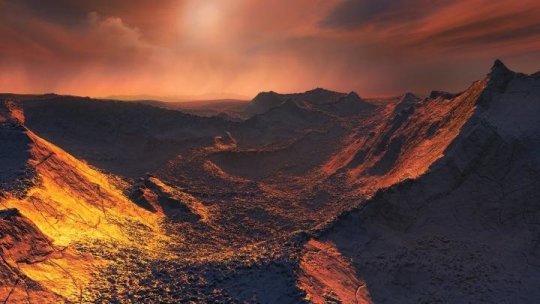
A planet has been detected orbiting Barnard's Star , a mere 6 light-years away. This breakthrough -- announced in a paper published today in the journal Nature -- is a result of the Red Dots and CARMENES projects, whose...

In November 2017, scientists pointed NASA's Spitzer Space Telescope toward the object known as 'Oumuamua—the first known interstellar object to visit our solar system. The infrared Spitzer was one of many telescopes pointed at 'Oumuamua in the weeks after...


