




It is known that gas giants around other stars are often located very near their sun. According to accepted theory, these gas planets were formed far away and subsequently migrated to an orbit closer to the star. Now, researchers...

The center of our galaxy is a frenzy of activity. A behemoth black hole—4 million times as massive as the sun—blasts out energy as it chows down on interstellar detritus while neighboring stars burst to life and subsequently explode.
Now,...
Carbon monoxide detectors in our homes warn of a dangerous buildup of that colorless, odorless gas we normally associate with death. Astronomers, too, have generally assumed that a build-up of carbon monoxide in a planet's atmosphere would be a...
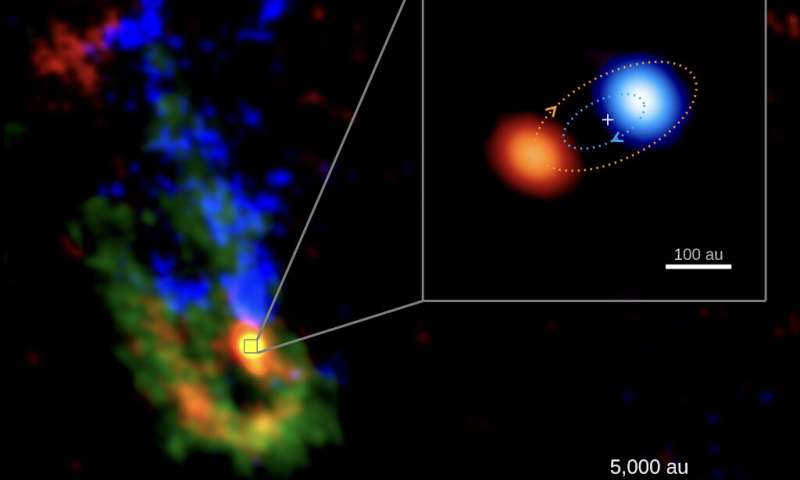
Scientists from the RIKEN Cluster for Pioneering Research in Japan, Chalmers University of Technology in Sweden and the University of Virginia in the USA and collaborators have made observations of a molecular cloud that is collapsing to form two...

This study, which has combined images from the Hubble Space Telescope with spectroscopic observations from the GTC, has confirmed the existence of a new example of a gravitational lens, a phenomenon predicted by Albert Einstein's theory of General Relativity....

ANU scientists have found that Earth is made of the same elements as the Sun but has less of the volatile elements such as hydrogen, helium, oxygen and nitrogen.
Lead author of the study, Dr. Haiyang Wang, said they made...

A new study led by ANU has created a 3D map of the magnetic field in a small wedge of the Milky Way galaxy, paving the way for future discoveries that will improve our understanding of the origin and...

According to Einstein the speed of light is always the same. But according to theoretical models of quantum gravitation, this uniformity of space-time does not apply to particles. Physicists have now tried to detect a change in the uniformity...

Researchers have spotted the formation sites of planets around a young star resembling the sun. Two rings of dust around the star, at distances comparable to the asteroid belt and the orbit of Neptune in the solar system, suggest...

Astronomers from Japan, Taiwan and Princeton University have discovered 83 quasars powered by supermassive black holes in the distant universe, from a time when the universe was less than 10 percent of its present age.
"It is remarkable that such massive...

A fast-moving star may have been ejected from the Milky Way's stellar disk by a cluster of young stars, according to researchers from the University of Michigan who say the star did not originate from the middle of the...


