



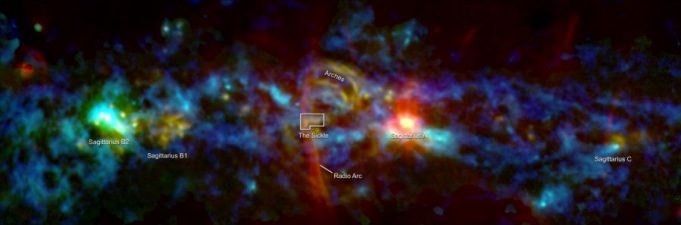
A feature resembling a candy cane appears at the center of this colorful composite image of our Milky Way galaxy's central zone. But this is no cosmic confection. It spans 190 light-years and is one of a set of...
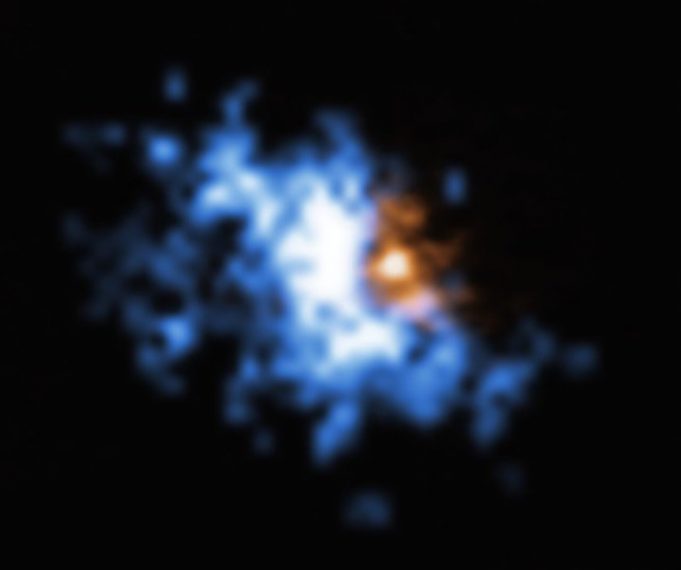
Astronomers using ESO's Very Large Telescope have observed reservoirs of cool gas around some of the earliest galaxies in the Universe. These gas halos are the perfect food for supermassive black holes at the centre of these galaxies, which...

Billions of years ago, in the center of a galaxy cluster far, far away (15 billion light-years, to be exact), a black hole spewed out jets of plasma. As the plasma rushed out of the black hole, it pushed...
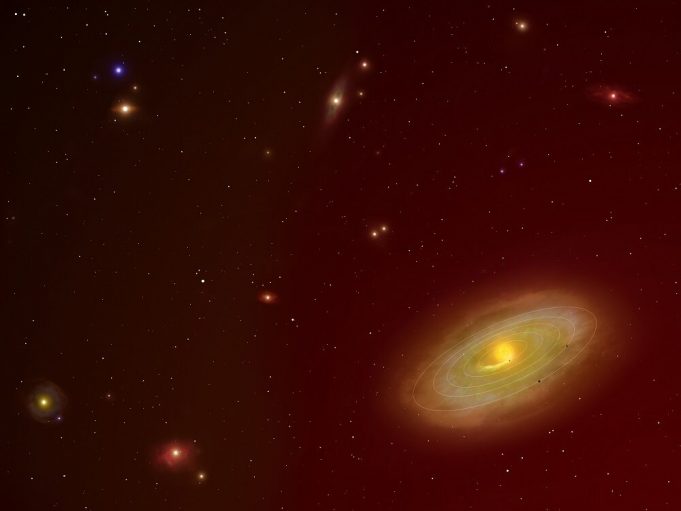
Three OU astronomers today announced groundbreaking discoveries allowing scientists to understand planets outside the solar system. Professor Carole Haswell, Dr. Daniel Staab and Dr. John Barnes discovered three, new, nearby planetary systems.
Research led by Professor Haswell found the exoplanets—planets...
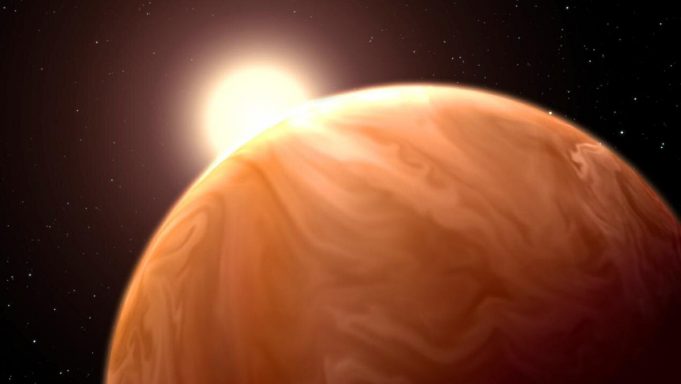
For many years, for all we knew, our solar system was alone in the universe. Then better telescopes began to reveal a treasure trove of planets circling distant stars.
In 2014, NASA's Kepler Space Telescope handed scientists a smorgasbord of...
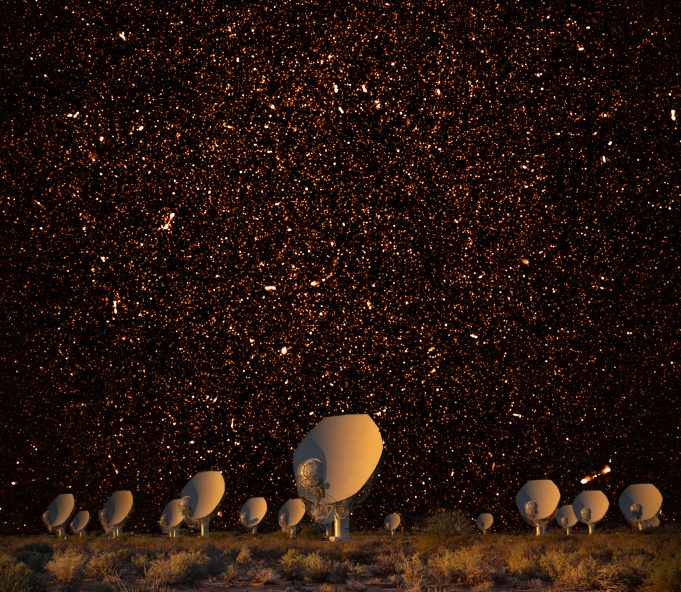
Look at this new radio image covered with dots, each of which is a distant galaxy! The brightest spots are galaxies that are powered by supermassive black holes and shine bright in radio light. But what makes this image...
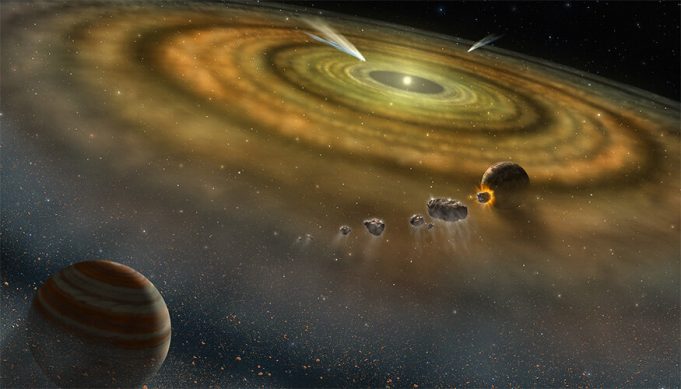
The isotopic composition of meteorites and terrestrial planets holds important clues about the earliest history of the solar system and the processes of planet formation.
Lawrence Livermore National Laboratory (LLNL) scientists and a collaborator from the University of Münster reviewed...

ESO's Very Large Telescope (VLT) has observed the central part of the Milky Way with spectacular resolution and uncovered new details about the history of star birth in our galaxy. Thanks to the new observations, astronomers have found evidence...
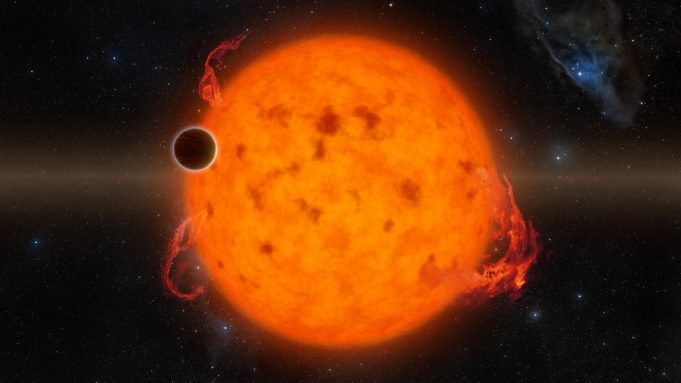
The discovery of terrestrial exoplanets, planets that orbit stars outside the solar system, has been one of the most significant developments in modern astronomy. Several exoplanets lie in the "habitable zones" of stars, where planets are thought to be...
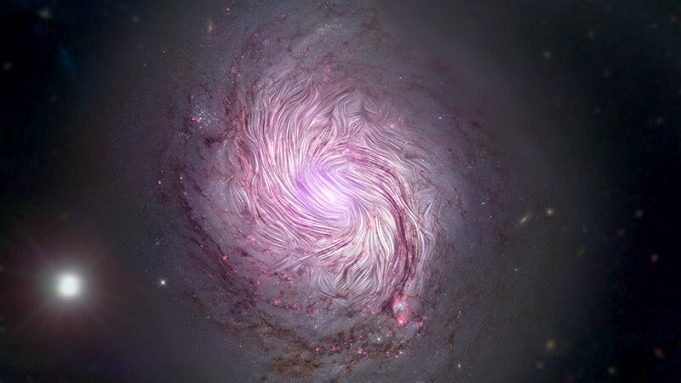
A question that has long puzzled scientists is how our Milky Way galaxy which has an elegant spiral shape with long arms, took this form.
Universities Space Research Association today announced that new observations of another galaxy are shedding light...
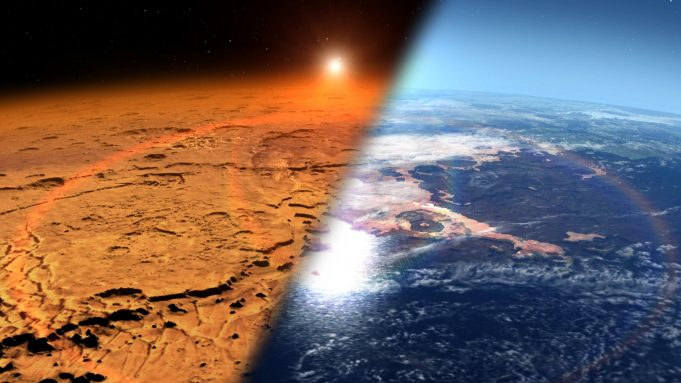
A type of Martian aurora first identified by NASA's MAVEN spacecraft in 2016 is actually the most common form of aurora occurring on the Red Planet, according to new results from the mission. The aurora is known as a...


