




Alex Betts, Craig MacLean and Kayla King from the Department of Zoology, shed light on their recent research published in Science, which addressed the impact that parasite communities have on evolutionary change and diversity.
It has been over 150 years...

The factors that shape the destiny of a cell, like that of a fully formed person, remain something of a mystery. Why, for example, does one stem cell in a human embryo become a neuron rather than a muscle...

The human brain is disproportionately large. And while abundant grey matter confers certain intellectual advantages, sustaining a big brain is costly—consuming a fifth of energy in the human body.
It is an oddity that has long flummoxed scientists: while most...

Why did birds lose their teeth? Was it so they would be lighter in the air? Or are pointy beaks better for worm-eating than the jagged jaws of dinosaur ancestors?
Actually, birds gave up teeth to speed up egg hatching,...

When the malaria-causing Plasmodium parasite first slips into the human bloodstream, injected by the bite of an infected mosquito, it does not immediately target red blood cells.
Instead, it seeks refuge inside the liver and rapidly reproduces, copying itself as...

Believe it or not—it's in our nature to cooperate with one another, even when cheating may be more profitable. Social cooperation is common in every scale of life, from the simplest bacterial films and multicellular tissues to insect colonies...

A team of scientists from Purdue University and the Chinese Academy of Sciences has used CRISPR/Cas9 gene-editing technology to develop a variety of rice that produces 25-31 percent more grain and would have been virtually impossible to create through...
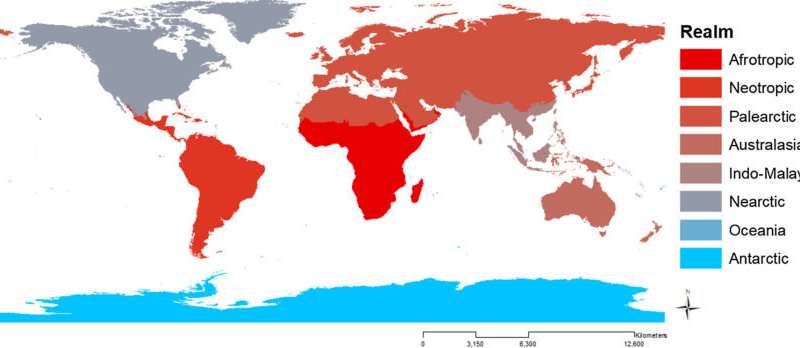
There are probably 303 species of mammals left to be discovered by science, most of which are likely to live in tropical regions, according to a predictive model developed by a team of University of Georgia ecologists. Their research,...

Inhibiting the production of the 'happiness' hormone – serotonin – in rice plants, increases their resistance to two of the world's most destructive and costly insect pests, new research has shown.
The study, published this week in Nature Plants, shows...

Montana State University scientists have found a new lineage of microbes living in Yellowstone National Park's thermal features that sheds light on the origin of life, the evolution of archaeal life and the importance of iron in early life.
Professor...
North America is home to 91 species of oak trees. Astoundingly, the various species rarely, if ever, occur alone. Where one kind of oak is found, invariably at least one more will be found. How can nature support a...


