



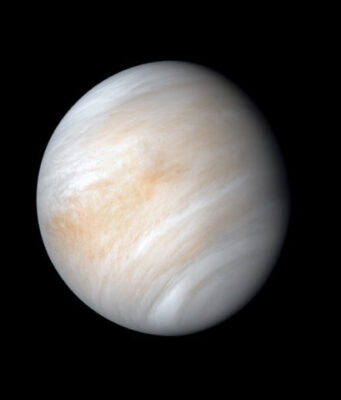


The forthcoming Laser Interferometer Space Antenna (LISA) will be a huge instrument allowing astronomers to study phenomena including black holes colliding and gravitational waves moving through space-time. Researchers from the University of Zurich have now found that LISA could...
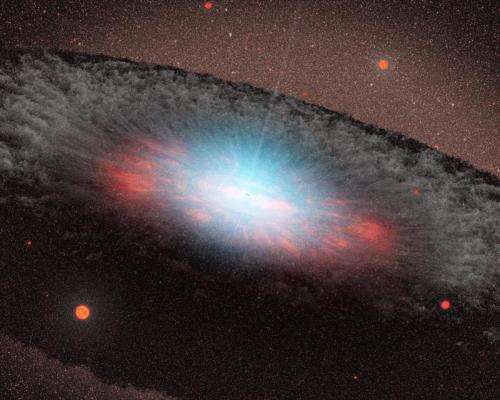
A stellar mass black hole is a compact object with a mass greater than three solar masses. It is so dense and has such a powerful force of attraction that not even light can escape from it. They cannot...

Twenty years ago, scientists were shocked to realize that our universe is not only expanding, but that it's expanding fasterover time.
Pinning down the exact rate of expansion, called the Hubble constant after famed astronomer and UChicago alumnus Edwin Hubble,...

Modern-day Mars may be more hospitable to oxygen-breathing life than previously thought.
A new study suggests that salty water at or near the surface of the red planet could contain enough dissolved O2 to support oxygen-breathing microbes, and even more...

The word "HAZMAT" describes substances that pose a risk to the environment, or even to life itself. Imagine the term being applied to entire planets, where violent flares from the host star may make worlds uninhabitable by affecting their...

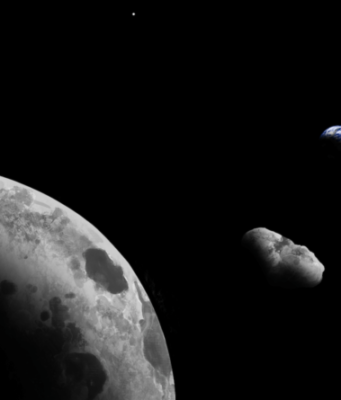
One year ago this week astronomers discovered an unusual object moving through space not too far from the Earth's orbit. In just a few days they realized it could not be a normal asteroid or comet – its path...

Findings recently published by a Southwest Research Institute (SwRI) space scientist shed new light on predicting the thermodynamics of solar flares and other "space weather" events involving hot, fast-moving plasmas.
The science of statistical mechanics is one of the pillars...
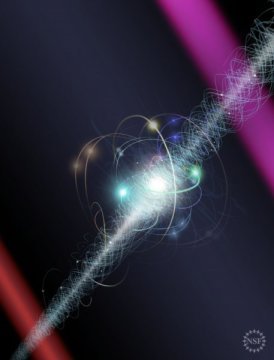
A new study suggests that many theorized heavy particles, if they exist at all, do not have the properties needed to explain the predominance of matter over antimatter in the universe.
If confirmed, the findings would force significant revisions to...
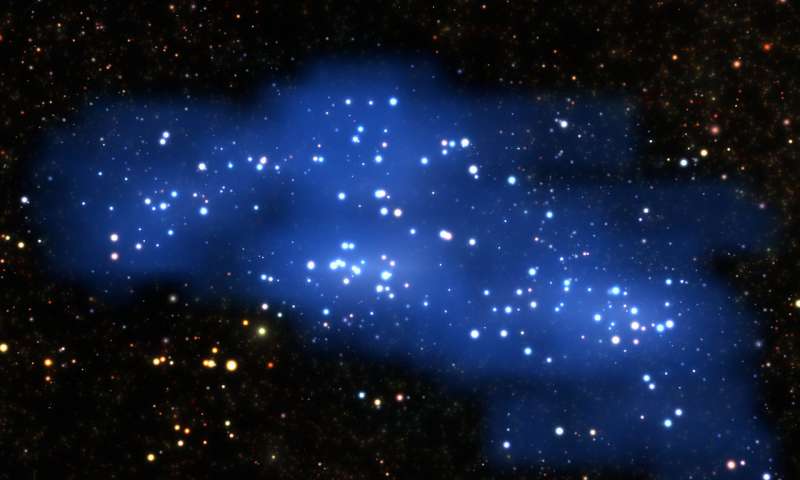
An international team of astronomers has discovered a titanic structure in the early Universe, just two billion years after the Big Bang. This galaxy proto-supercluster, nicknamed Hyperion, is the largest and most massive structure yet found at such a...
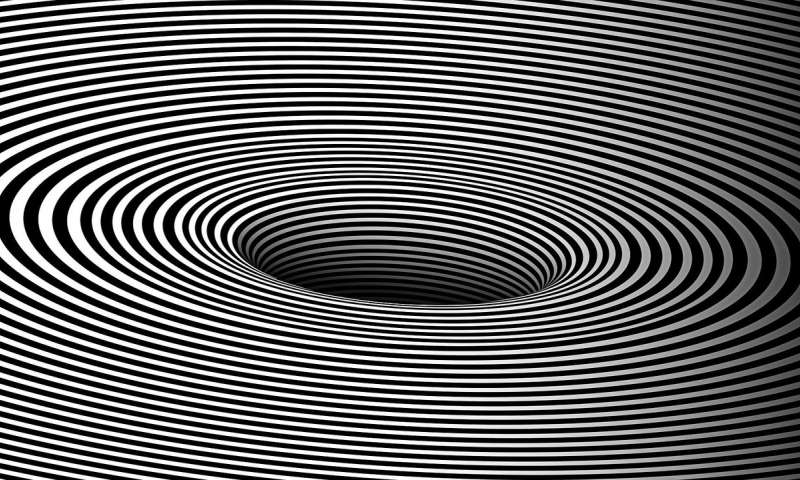
A RUDN physicist demonstrated how to describe the shape of any symmetrical wormhole—a black hole that theoretically can be a kind of a portal between any two points in space and time—based on its wave spectrum. The research would...

An international team of astronomers has discovered a titanic structure in the early Universe, just two billion years after the Big Bang. This galaxy proto-supercluster, nicknamed Hyperion, is the largest and most massive structure yet found at such a...


