



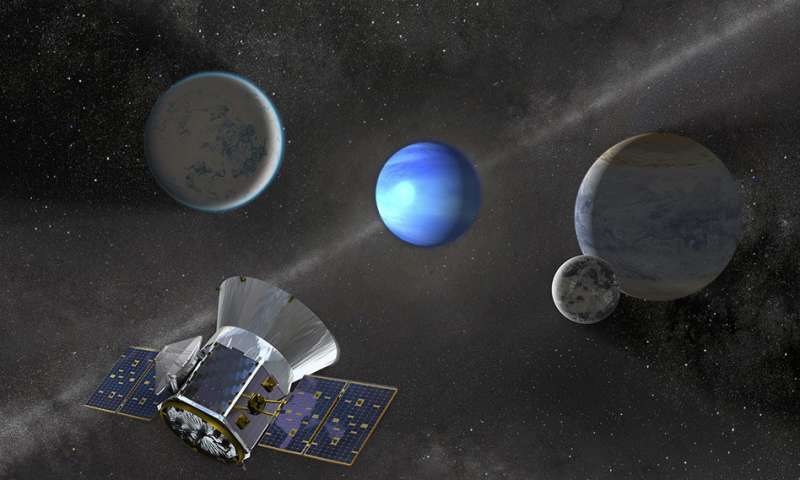
NASA's Transiting Exoplanet Survey Satellite, TESS, has discovered a third small planet outside our solar system, scientists announced this week at the annual American Astronomical Society meeting in Seattle.
The new planet, named HD 21749b, orbits a bright, nearby dwarf...

There are more than 3,900 confirmed planets beyond our solar system. Most of them have been detected because of their "transits"—instances when a planet crosses its star, momentarily blocking its light. These dips in starlight can tell astronomers a...

New research led by astrophysicists at Durham University, UK, predicts that the Large Magellanic Cloud (LMC) could hit the Milky Way in two billion years' time.
The collision could occur much earlier than the predicted impact between the Milky Way...

Scientists from NASA's New Horizons mission released the first detailed images of the most distant object ever explored -- the Kuiper Belt object nicknamed Ultima Thule. Its remarkable appearance, unlike anything we've seen before, illuminates the processes that built...

Scientists have found evidence that dark matter can be heated up and moved around, as a result of star formation in galaxies. The findings provide the first observational evidence for the effect known as 'dark matter heating', and give...

Using observations from the ALMA radio observatory in Chile, researchers have observed, for the first time, a warped disk around an infant protostar that formed just several tens of thousands of years ago. This implies that the misalignment of...
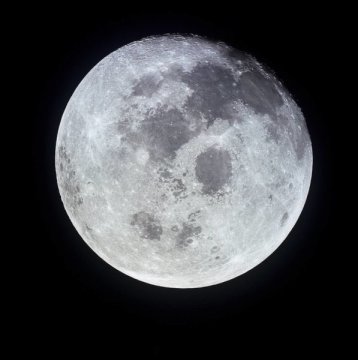
New research from University of Alberta physicists provides the first-ever model of our Moon's rotational dynamics, taking into consideration its solid inner core. Their model helps to explain why, as seen from Earth, the Moon appears to wobble on...
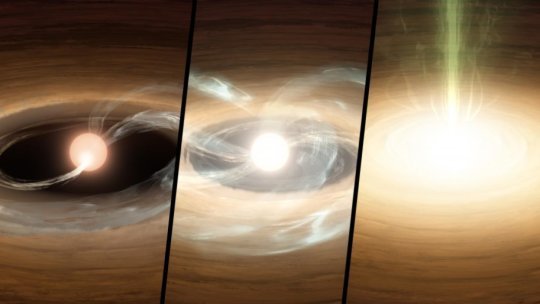
Astronomers have discovered a young star undergoing a rare growth spurt -- giving a fascinating glimpse into the development of these distant stellar objects.
A team of international researchers, including experts from the University of Exeter's Physics and Astronomy department,...

The processes that led to glaciation at the cratered poles of Mercury, the planet closest to the sun, have been modeled by a University of Maine-led research team.
James Fastook, a UMaine professor of computer science and Climate Change Institute...

Astronomers using data from the NASA/ESA Hubble Space Telescope have employed a revolutionary method to detect dark matter in galaxy clusters. The method allows astronomers to "see" the distribution of dark matter more accurately than any other method used...
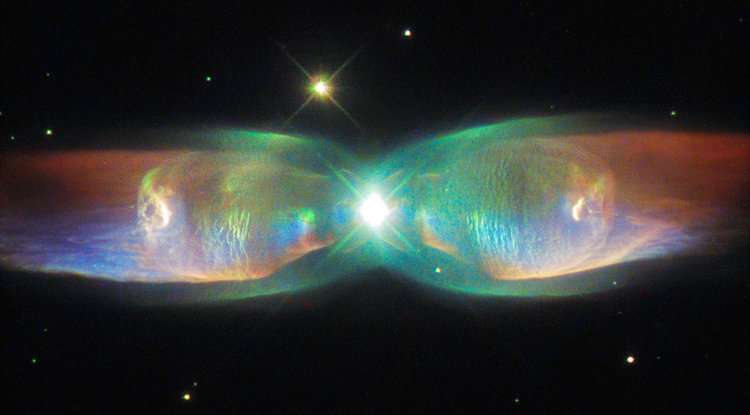
Everything around you – your desk, your laptop, your coffee cup – in fact, even you – is made of stardust, the stuff forged in the fiery furnaces of stars that died before our sun was born. Probing the...


