




Supermassive black holes weigh millions to billions times more than our sun and lie at the center of most galaxies. A supermassive black hole several million times the mass of the sun is situated in the heart of our...

Long ago in a galaxy far, far away, fewer galaxies were born than expected -- and that could create new questions for galaxy physics, according to a new University of Michigan study.
The study examined the satellite galaxies of Messier...

New research led by an astronomer at the University of Warwick has found the first confirmed example of a double star system that has flipped its surrounding disc to a position that leaps over the orbital plane of those...

A brief and unusual flash spotted in the night sky on June 16, 2018, puzzled astronomers and astrophysicists across the globe. The event—called AT2018cow and nicknamed "the Cow" after the coincidental final letters in its official name—is unlike any...

On Nov. 22, 2014, astronomers spotted a rare event in the night sky: A supermassive black hole at the center of a galaxy, nearly 300 million light years from Earth, ripping apart a passing star. The event, known as...
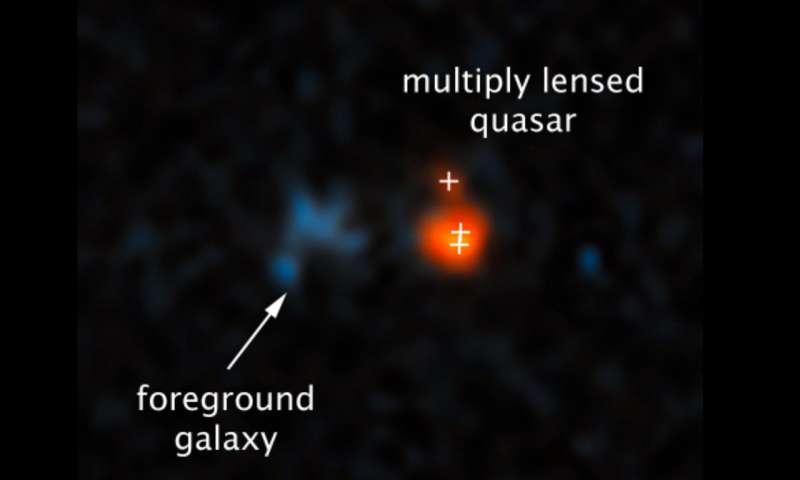
Observations from Gemini Observatory identify a key fingerprint of an extremely distant quasar, allowing astronomers to sample light emitted from the dawn of time. Astronomers happened upon this deep glimpse into space and time thanks to an unremarkable foreground...

A team of European scientists has deliberately triggered electrical activity in thunderclouds for the first time, according to a new paper in the latest issue of Optics Express, the Optical Society's (OSA) open-access journal. They did this by aiming...
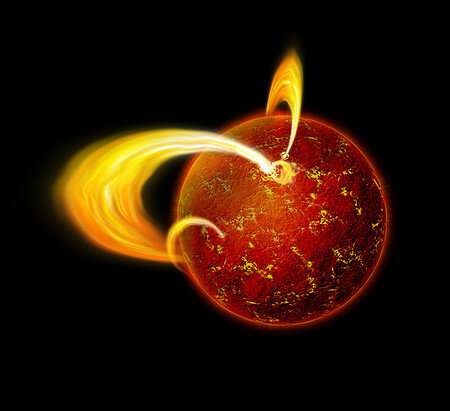
In a new Caltech-led study, researchers from campus and the Jet Propulsion Laboratory (JPL) have analyzed pulses of radio waves coming from a magnetar—a rotating, dense, dead star with a strong magnetic field—that is located near the supermassive black...

The first direct evidence of white dwarf stars solidifying into crystals has been discovered by astronomers at the University of Warwick, and our skies are filled with them.
Observations have revealed that dead remnants of stars like our Sun, called...

Astrophysicists have found the first ever evidence of gigantic remains being formed from repeated explosions on the surface of a dead star in the Andromeda Galaxy, 2.5 million light years from Earth. The remains or "super-remnant" measures almost 400...

Using data from NASA's Kepler space telescope, citizen scientists have discovered a planet roughly twice the size of Earth located within its star's habitable zone, the range of orbital distances where liquid water may exist on the planet's surface....


