







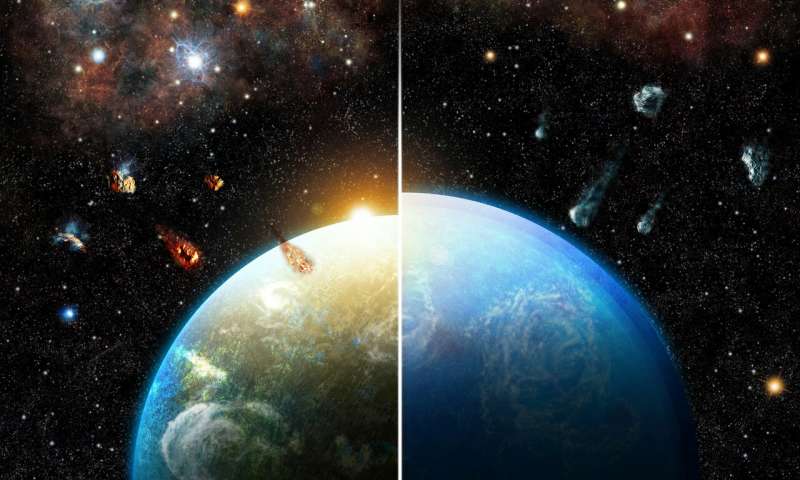
Earth's solid surface and moderate climate may be due, in part, to a massive star in the birth environment of the Sun, according to new computer simulations of planet formation.
Without the star's radioactive elements injected into the early solar...

A team of Japanese and American scientists has visualized meteorite components at resolution powers much higher than ever before. Their efforts resulted in a much better look at -- and enhanced understanding of -- substances inside carbonaceous chondrites, the...
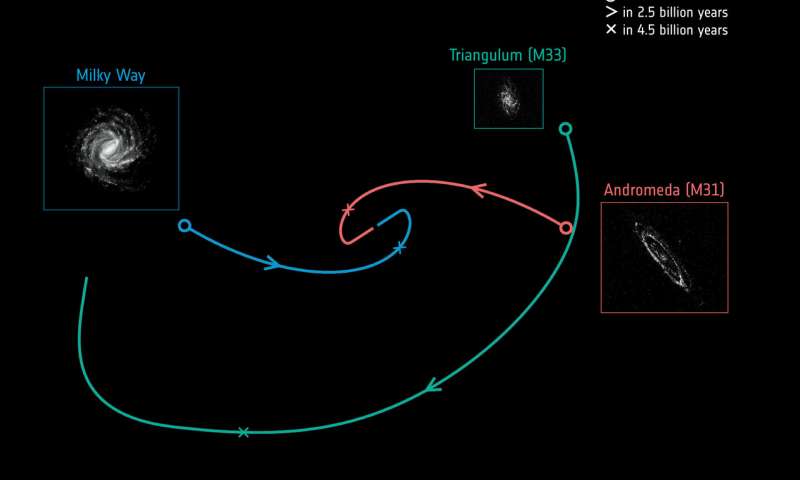
ESA's Gaia satellite has looked beyond our Galaxy and explored two nearby galaxies to reveal the stellar motions within them and how they will one day interact and collide with the Milky Way – with surprising results.
Our Milky Way...

New research undertaken at Northumbria University, Newcastle shows that the sun's magnetic waves behave differently than currently believed.
Their findings have been reported in Nature Astronomy.
After examining data gathered over a 10-year period, the team from Northumbria's Department of Mathematics,...

Just like the mythical creation stories that depict the formation of the world as the story of order from chaos, the early Earth was home to a chaotic clutter of organic molecules from which, somehow, more complex biological structures...

When we think of life on Earth, we might think of individual examples ranging from animals to bacteria. When astrobiologists study life, however, they have to consider not only individual organisms, but also ecosystems, and the biosphere as a...
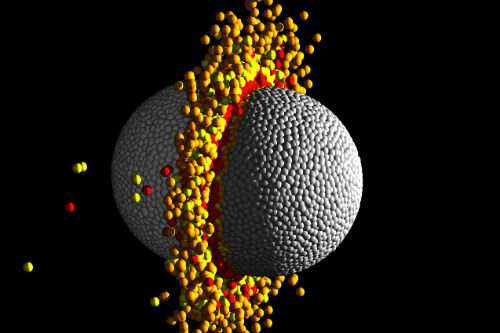
Astronomers have found fresh evidence for significant planetary diversity within a single exoplanet system, suggesting that giant high-speed collisions are partly responsible for planetary evolution.
An international team of scientists led by Italy's National Institute for Astrophysics (INAF) and involving...

The Milky Way galaxy's disk of stars is anything but stable and flat. Instead, it becomes increasingly warped and twisted far away from the Milky Way's center, according to astronomers from National Astronomical Observatories of Chinese Academy of Sciences...

Researchers have found that certain ultra-thin magnetic materials can switch from insulator to conductor under high pressure, a phenomenon that could be used in the development of next-generation electronics and memory storage devices.
The international team of researchers, led by...

The composition of the universe—the elements that are the building blocks for every bit of matter—is ever-changing and ever-evolving, thanks to the lives and deaths of stars.
An outline of how those elements form as stars grow and explode and...
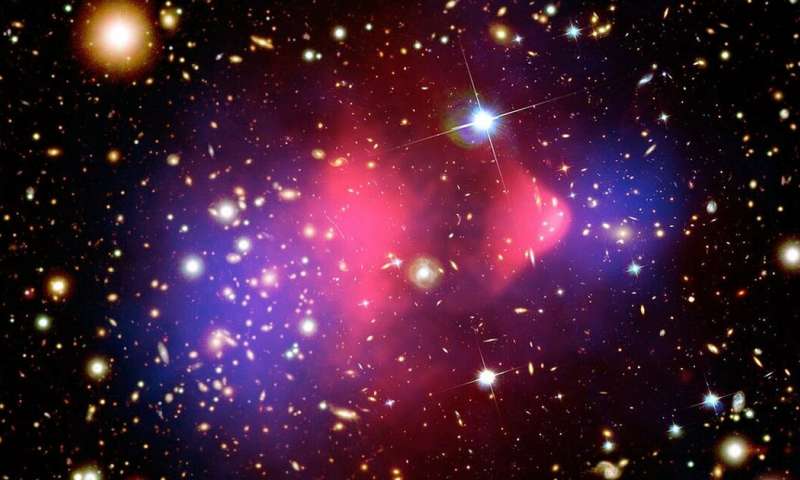
Scientists have been searching for "dark matter" – an unknown and invisible substance thought to make up the vast majority of matter in the universe – for nearly a century. The reason for this persistence is that dark matter...


