



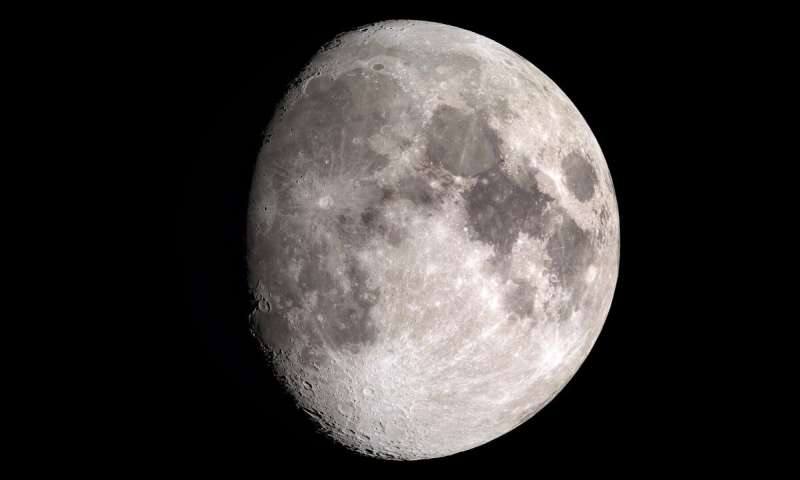
When a stream of charged particles known as the solar wind careens onto the Moon's surface at 450 kilometers per second (or nearly 1 million miles per hour), they enrich the Moon's surface in ingredients that could make water,...

Astronomers call it "the moon that shouldn't be there."
After several years of analysis, a team of planetary scientists using NASA's Hubble Space Telescope has at last come up with an explanation for a mysterious moon around Neptune that they...

The gaseous layer that wraps around Earth reaches up to 630,000 kilometers away, or 50 times the diameter of our planet, according to a new study based on observations by the ESA/NASA Solar and Heliospheric Observatory, SOHO, and published...

An international team of more than 200 astronomers from 18 countries has published the first phase of a major new radio sky survey at unprecedented sensitivity using the Low Frequency Array (LOFAR) telescope. The survey reveals hundreds of thousands...
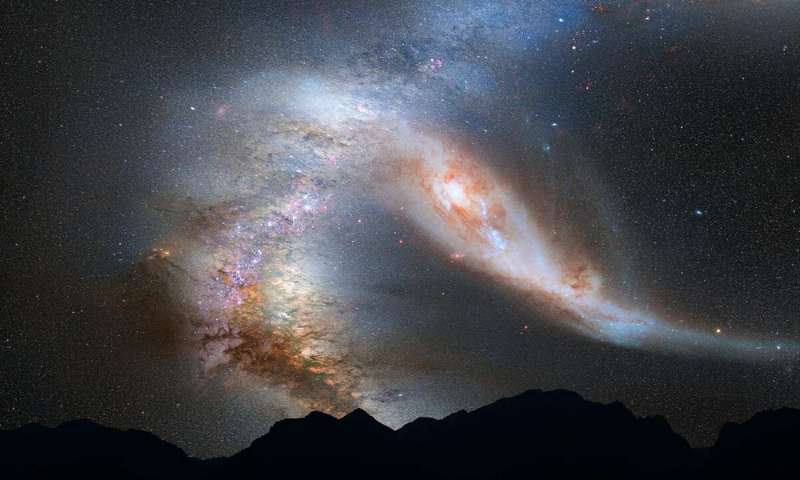
A San Diego State University astrophysicist has helped discover evidence of a gigantic remnant surrounding an exploding star—a shell of material so huge, it must have been erupting on a regular basis for millions of years.
When a white dwarf,...

Astronomy & Astrophysics publishes the work of researchers from the University of Vienna, who have found a river of stars, a stellar stream in astronomical parlance, covering most of the southern sky. The stream is relatively nearby and contains...

Astronomers have spent decades looking for something that sounds like it would be hard to miss: about a third of the "normal" matter in the Universe. New results from NASA's Chandra X-ray Observatory may have helped them locate this...
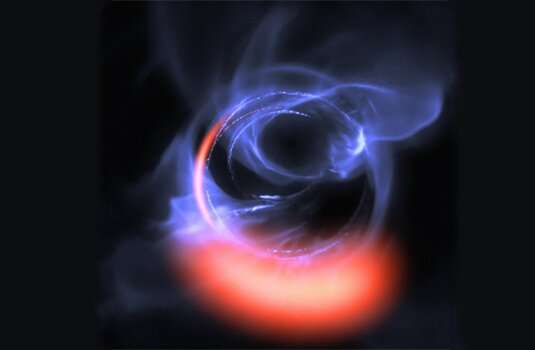
What is a black hole? In an article that has just appeared in the journal Nature Astronomy, LMU philosopher Erik Curiel shows that physicists use different definitions of the concept, depending on their own particular fields of interest.
A black...

The Hawaii-based James Clerk Maxwell Telescope (JCMT) has discovered a stellar flare 10 billion times more powerful than the Sun's solar flares, a history-making discovery that could unlock decades-old questions about the origin of our own Sun and planets,...

The Earth's magnetic shield booms like a drum when it is hit by strong impulses, according to new research from Queen Mary University of London.
As an impulse strikes the outer boundary of the shield, known as the magnetopause, ripples...
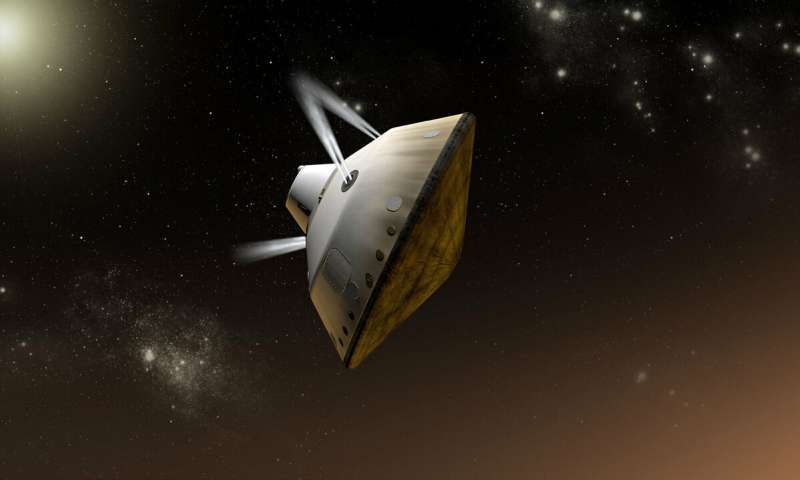
The heaviest vehicle to successfully land on Mars is the Curiosity Rover at 1 metric ton, about 2,200 pounds. Sending more ambitious robotic missions to the surface of Mars, and eventually humans, will require landed payload masses in the...


