




A gassy insulating layer beneath the icy surfaces of distant celestial objects could mean there are more oceans in the universe than previously thought.
Computer simulations provide compelling evidence that an insulating layer of gas hydrates could keep a subsurface...

A team of international scientists—including researchers at the University of St. Andrews, Syracuse University and Royal Holloway, University of London—have demonstrated a new source of food for early life on the planet.
Life on Earth relies on the availability of...

The Earth is unique in our solar system: It is the only terrestrial planet with a large amount of water and a relatively large moon, which stabilizes the Earth's axis. Both were essential for Earth to develop life. Planetologists...
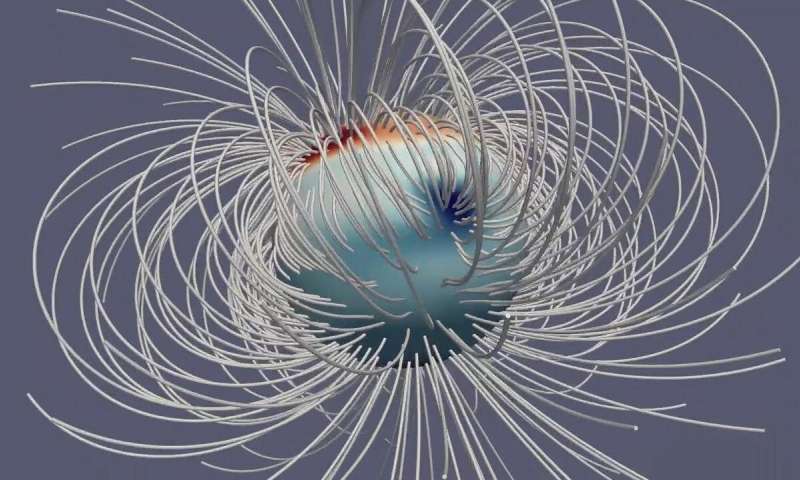
NASA's Juno mission to Jupiter made the first definitive detection beyond our world of an internal magnetic field that changes over time, a phenomenon called secular variation. Juno determined the gas giant's secular variation is most likely driven by...
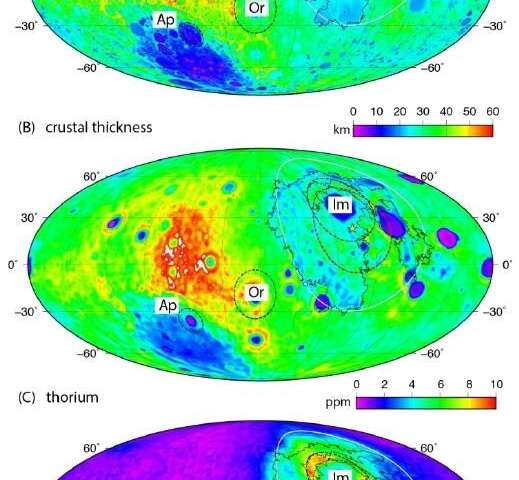
The stark difference between the Moon's heavily-cratered farside and the lower-lying open basins of the Earth-facing nearside has puzzled scientists for decades.
Now, new evidence about the Moon's crust suggests the differences were caused by a wayward dwarf planet colliding...

What is dark matter made of? It's one of the most perplexing questions of modern astronomy. We know that dark matter is out there, since we can see its obvious gravitational influence on everything from galaxies to the evolution...

NASA's New Horizons mission team has published the first profile of the farthest world ever explored, a planetary building block and Kuiper Belt object called 2014 MU69.
Analyzing just the first sets of data gathered during the New Horizons spacecraft's...

A lunar lander named for the Chinese goddess of the moon may have lessened the mystery of the far side of the moon. The fourth Chang'E probe (CE-4) was the first mission to land on the far side of...

Small, hardy planets packed with dense elements have the best chance of avoiding being crushed and swallowed up when their host star dies, new research from the University of Warwick has found. The new research is published in the...
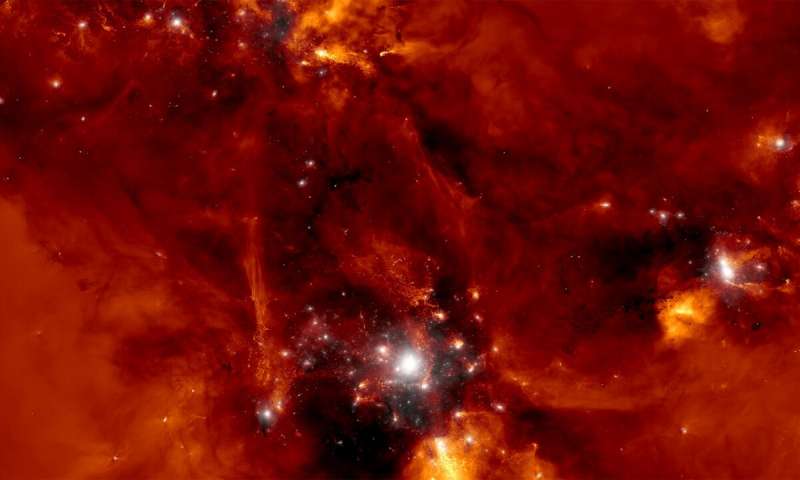
It is believed that the formation and growth of most galaxies across the history of the universe has been fueled by supermassive black holes growing together with their host galaxy as they collect matter to attain millions of solar...

A 2010 analysis of imagery from NASA's Lunar Reconnaissance Orbiter (LRO) found that the moon shriveled like a raisin as its interior cooled, leaving behind thousands of cliffs called thrust faults on the moon's surface.
A new analysis suggests that...


