





A new study published in Scientific Reports reveals that asteroid impact sites in the ocean may possess a crucial link in explaining the formation of the essential molecules for life. The researchers discovered the emergence of amino acids that serve as...

By Earthly standards, Saturn's moon Titan is a strange place. Larger than the planet Mercury, Titan is swaddled in a thick atmosphere (it is the only moon in the solar system to have one) and covered in rivers and...

Infrared dark clouds (IRDCs) are dark patches of cold dust and gas seen in the sky against the bright diffuse infrared glow of warm dust in our galaxy. These IRDCs, massive and rich in molecules, are natural sites for...
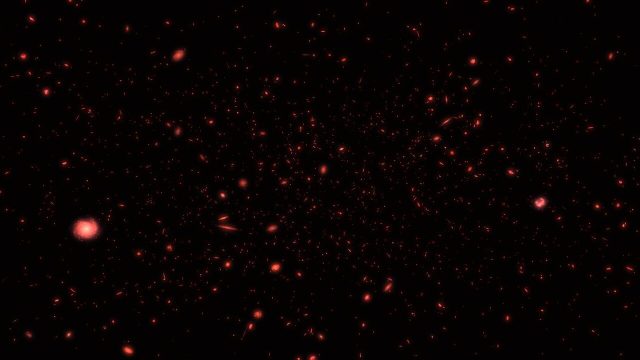
New results from the NASA/ESA Hubble Space Telescope suggest the formation of the first stars and galaxies in the early Universe took place sooner than previously thought. A European team of astronomers have found no evidence of the first...

Astronomers announced the discovery of a ghostly, almost perfectly circular, arc of ultraviolet emission centered on the handle of the Big Dipper and stretching 30 degrees across the Northern sky. If the arc were extended, it would completely encircle...

The aliens came on Oct. 19, 2017.
That was the day telescopes picked up a strange object with an odd, elongated shape that moved like a comet—but had no apparent tail. The object, which baffled astronomers and led some to...
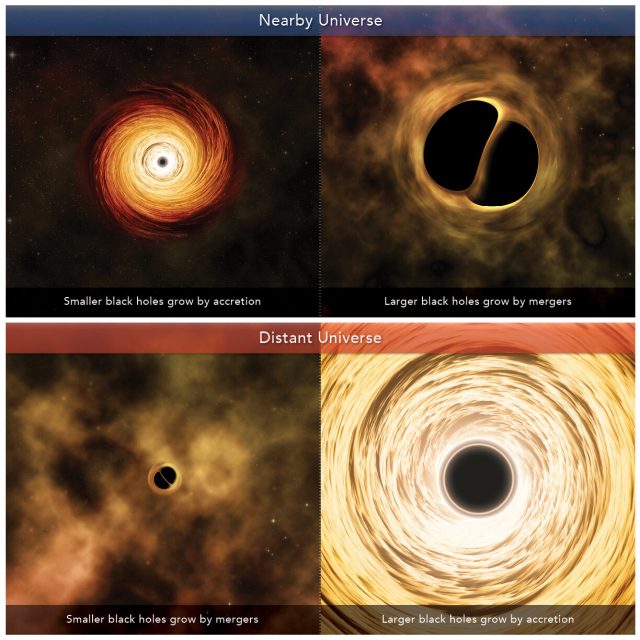
Scientists at the Center for Astrophysics | Harvard & Smithsonian, and the Black Hole Initiative (BHI), have shed light on how black holes grow over time by developing a new model to predict if growth by accretion or by...

A team of researchers, led by astrophysicist Sumner Starrfield of Arizona State University, has combined theory with both observations and laboratory studies and determined that a class of stellar explosions, called classical novae, are responsible for most of the...

ESA's Solar Orbiter will cross through the tails of Comet ATLAS during the next few days. Although the recently launched spacecraft was not due to be taking science data at this time, mission experts have worked to ensure that...

Move aside, AT2018COW. There is a new astronomical transient in the universe, and it is faster, heavier and brighter at radio wavelengths than its mysterious predecessors.
After astronomers visually spotted a bright burst in a tiny galaxy 500 million lightyears...
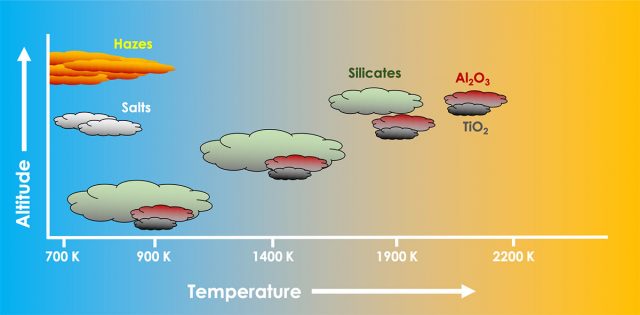
Giant planets in our solar system and circling other stars have exotic clouds unlike anything on Earth, and the gas giants orbiting close to their stars—so-called hot Jupiters—boast the most extreme.
A team of astronomers from the United States, Canada...


