


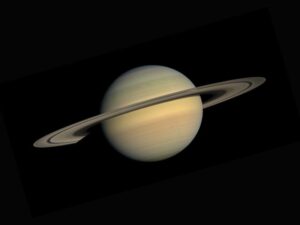


This artistic rendering shows the distant view from Planet Nine back towards the sun. The planet is thought to be gaseous, similar to Uranus and Neptune. Hypothetical lightning lights up the night side.Credit: Caltech/R. Hurt (IPAC)
Planet Nine—the undiscovered planet...

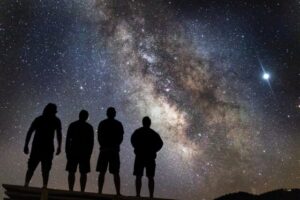
This HI4PI map was produced using data from the 100 meter Max-Planck radio telescope in Effelsberg, Germany and the 64 meter CSIRO radio telescope in Parkes, Australia. The image colors reflect gas at differing velocities. The plane of the...

Credit: NASA/CXC/UA/J.Irwin et al.
This image shows the location of a remarkable source that dramatically flares in X-rays unlike any ever seen. Along with another similar source found in a different galaxy, these objects may represent an entirely new phenomenon,...

Artist's impression of NASA’s New Horizons spacecraft encountering a Kuiper Belt object, as part of an extended mission after the spacecraft’s July 2015 Pluto flyby. New Horizons is set to fly past 2014 MU69 – a KBO currently about...

This image shows atomic hydrogen scattering sunlight in the upper atmosphere of Mars, as seen by the Imaging Ultraviolet Spectrograph on NASA's Mars Atmosphere and Volatile Evolution mission. About 400,000 observations, taken over the course of four days shortly...

This mosaic shows the Carina Nebula (left part of the image), home of the Eta Carinae star system. This part was observed with the Wide Field Imager on the MPG/ESO 2.2-metre telescope at ESO's La Silla Observatory. The middle...

This illustration represents how hot Jupiters of different temperatures and different cloud compositions might appear to a person flying over the dayside of these planets on a spaceship, based on computer modeling. Cooler planets are entirely cloudy, whereas hotter...

Using statistical analysis and scientific computing, astronomers at Western University have charted a path that most likely pinpoints the very origins of comet 67P/Churyumov-Gerasimenko, which is vital information in discovering what kind of material it is made from and...

This image of the Mars night side shows ultraviolet emission from nitric oxide (abbreviated NO). The emission is shown in false color with black as low values, green as medium, and white as high. These emissions track the recombination...

ExoMars at the Red Planet.Credit: ESA
Next week, ESA's ExoMars has just a single chance to get captured by Mars' gravity. The spacecraft and the mission controllers who will make it so are ready for arrival.
The ExoMars Trace Gas Orbiter...

A plot of the light intensity versus time (the light curve) for the star EPIC 204278916. The star was observed for over 78.8 days with a 29.4 minute cadence. The first 15 days are plotted here, and show the...


