



University of Otago palaeontologists are rewriting the history of New Zealand's ancient whales by describing a previously unknown genus of baleen whale, alive more than 27.5 million years ago and found in the Hakataramea Valley.
The new genus and species...
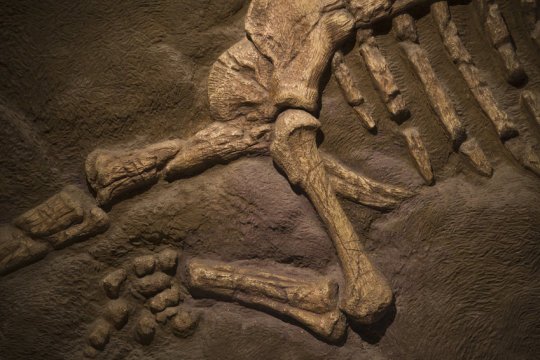
It is commonly understood that the dinosaurs disappeared with a bang -- wiped out by a great meteorite impact on the Earth 66 million years ago.
But their origins have been less understood. In a new study, scientists from MUSE...
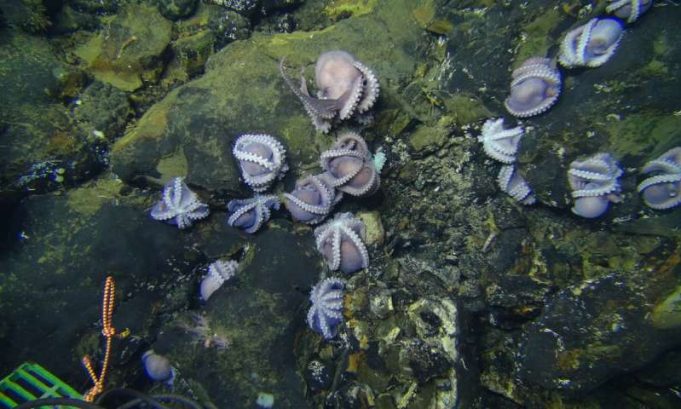
We know more about the surface of the moon that we do about the bottom of the ocean. The sea floor is an alien landscape, with crushing pressure, near-total darkness, and fluids wafting from cracks in the Earth's crust....

A fossil slab discovered in Kansas 70 years ago and twice misidentified -- first as a green alga and then as a cephalopod -- has been reinterpreted as the preserved remains of a large cartilaginous fish, the group that...

In the world of Costa's hummingbirds, it's not size that matters -- it's sound. During breeding season, male Costa's perform a high-speed dive during which they "sing" to potential mates using their tail feathers.
Unlike related hummingbird species, Costa's perform...

Research published today in Nature has found that many of the viruses infecting us today have ancient evolutionary histories that date back to the first vertebrates and perhaps the first animals in existence.
The study, a collaboration between the University...

Researchers at the RIKEN Center for Sustainable Resource Science (CSRS) in Japan have discovered a small hormone that helps plants retain water when none is available in the soil. Published in the journal Nature on April 4, the study...

Forty million miles of major roads crisscross the Earth's continents -- enough to circle the planet 1,600 times. For humans, these thoroughfares are a boon, enabling them to move with ease from place to place. But for migrating animals...

Anyone who has witnessed majestic whales or lumbering elephant seals in person would be forgiven for associating ocean life with unlimited size in mammals, but new research reveals that mammal growth is actually more constrained in water than on...
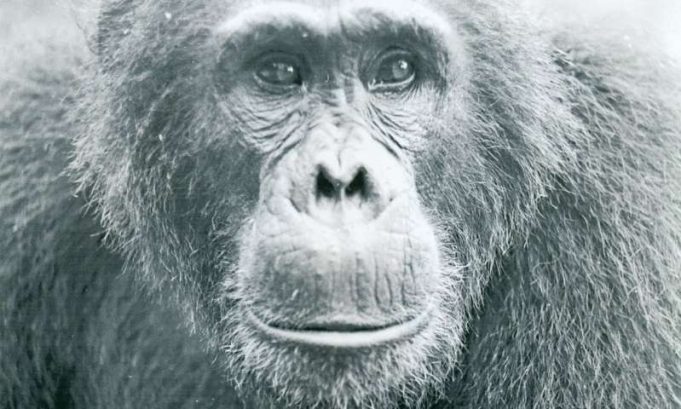
Power. Ambition. Jealousy. According to a new study, the same things that fuel deadly clashes in humans can also tear apart chimpanzees, our closest animal relatives.
In the early 1970s, primatologist Jane Goodall and colleagues studying chimpanzees in Gombe National...

As we get older, our endurance declines, in part because our blood vessels lose some of their capacity to deliver oxygen and nutrients to muscle tissue. An MIT-led research team has now found that it can reverse this age-related...


