



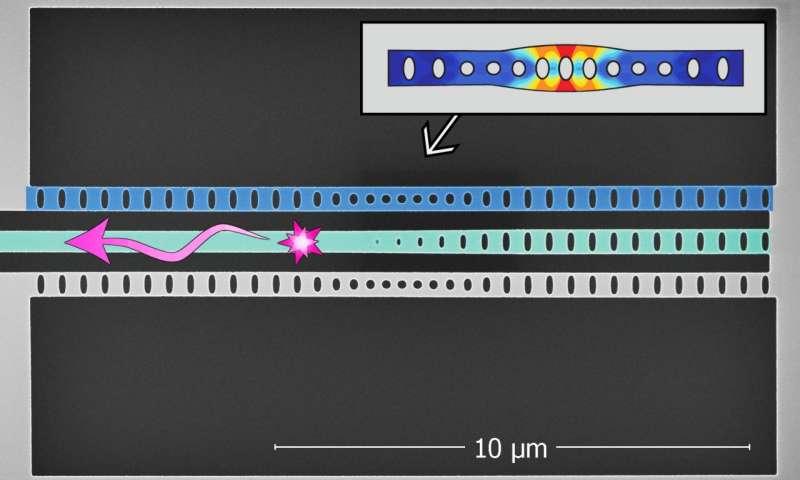
Why does quantum mechanics work so well for microscopic objects, yet macroscopic objects are described by classical physics? This question has bothered physicists since the development of quantum theory more than 100 years ago. Researchers at Delft University of...

By essentially turning down the pitch of sound waves, University of Michigan engineering researchers have devised a way to unlock greater amounts of data from acoustic fields than ever before.
That additional information could boost performance of passive sonar and...

USC scientists have demonstrated a theoretical method to enhance the performance of quantum computers, an important step to scale a technology with potential to solve some of society's biggest challenges.
The method addresses a weakness that bedevils performance of the...

When tiny particles strike a metal surface at high speed—for example, as coatings being sprayed or as micrometeorites pummeling a space station—the moment of impact happens so fast that the details of process haven't been clearly understood, until now.
A...

Scientists from the Max Born Institute (MBI) have developed the first refractive lens that focuses extreme ultraviolet beams. Instead of using a glass lens, which is non-transparent in the extreme-ultraviolet region, the researchers have demonstrated a lens that is...
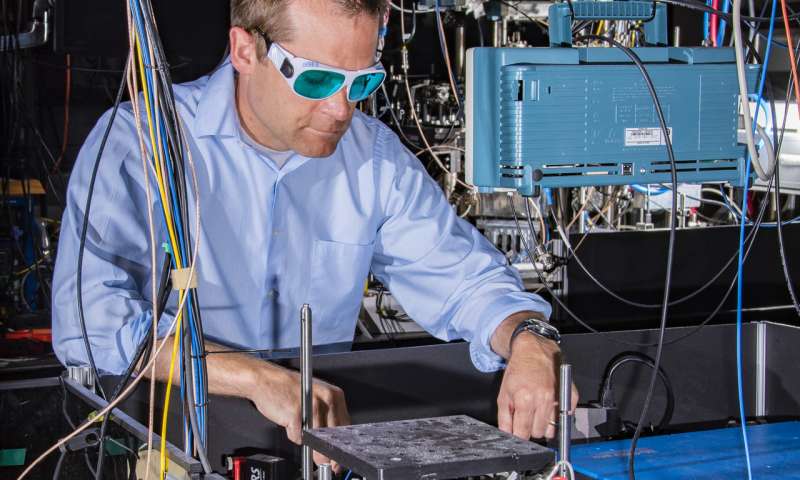
Experimental atomic clocks at the National Institute of Standards and Technology (NIST) have achieved three new performance records, now ticking precisely enough to not only improve timekeeping and navigation, but also detect faint signals from gravity, the early universe...

Complex systems theory is usually used to study things like the immune system, global climate, ecosystems, transportation or communications systems.
But with global politics becoming more unpredictable—highlighted by the UK's vote for Brexit and the presidential elections of Donald Trump...

Electrical engineers in the accelerator physics group at TU Darmstadt have developed a design for a laser-driven electron accelerator so small it could be produced on a silicon chip. It would be inexpensive and with multiple applications. The design,...

a, Doublet emission following photo- and electrical excitation. The illustration on the right indicates the electron spin vector representation for doublets. b, Chemical structures of TTM, TTM-3NCz and TTM-3PCz. Credit: Nature, DOI: 10.1038/s41586-018-0695-9
Scientists have discovered that semiconducting molecules with...
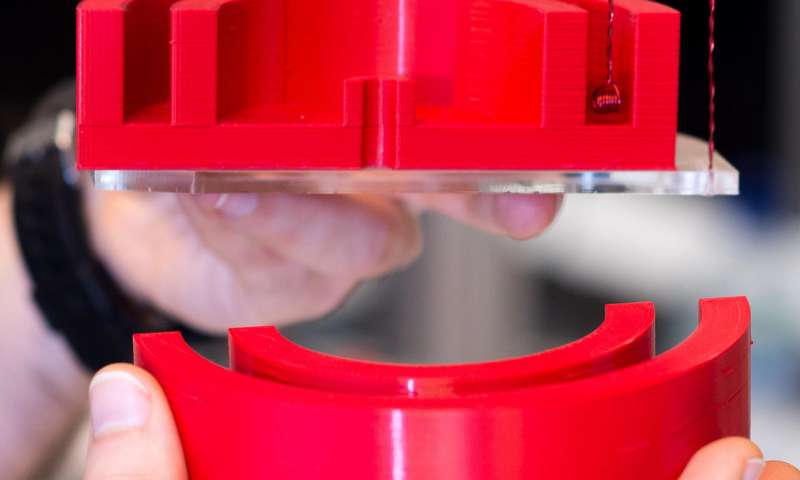
Research led by a University of Sussex scientist has turned a 156-year-old law of physics on its head in a development which could lead to more efficient recharging of batteries in cars and mobile phones.
Dr. Jordi Prat-Camps, a research...

Wok tossing is essential for making a good fried rice—or so claim a group of researchers presenting new work at the American Physical Society's Division of Fluid Dynamics 71st Annual Meeting, which will take place Nov. 18-20 at the...


