



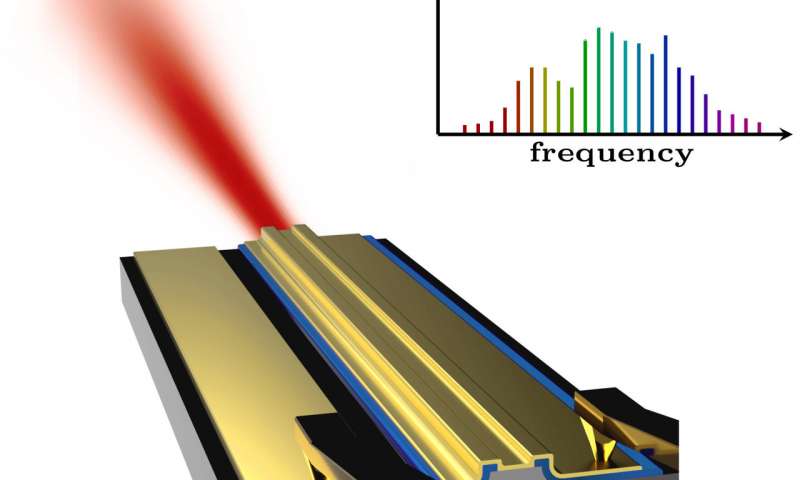
Most lasers emit photons of exactly the same wavelength, producing a single color. However, there are also lasers that consist of many frequencies, with equal intervals in between, as in the teeth of a comb; thus, they are referred...

A terahertz laser designed by MIT researchers is the first to reach three key performance goals at once—high constant power, tight beam pattern, and broad electric frequency tuning—and could thus be valuable for a wide range of applications in...

How atoms arrange themselves at the smallest scale was thought to follow a 'drum-skin' rule, but mathematicians have now found a simpler solution.
Atomic arrangements in different materials can provide a lot of information about the properties of materials, and...
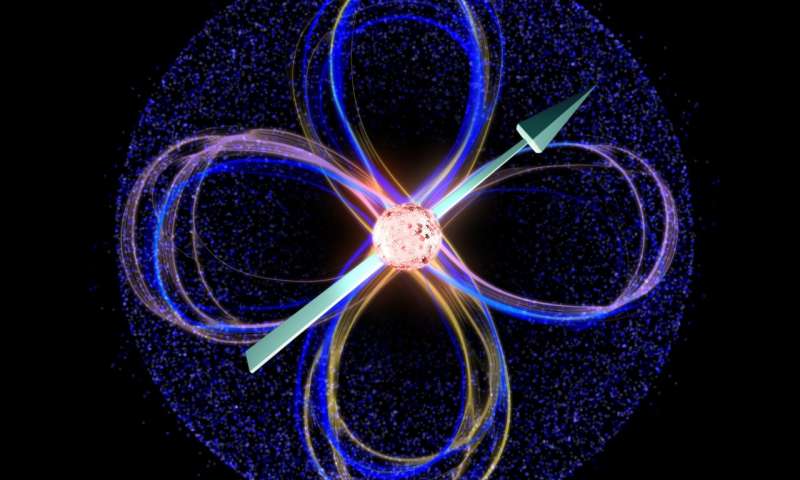
Australian scientists have investigated new directions to scale up qubits—utilising the spin-orbit coupling of atom qubits—adding a new suite of tools to the armory.
Spin-orbit coupling, the coupling of the qubits' orbital and spin degree of freedom, allows the manipulation...

High-temperature superconductors have the potential to transform everything from electricity transmission and power generation to transportation.
The materials, in which electron pairs travel without friction—meaning no energy is lost as they move—could dramatically improve the energy efficiency of electrical systems.
Understanding...
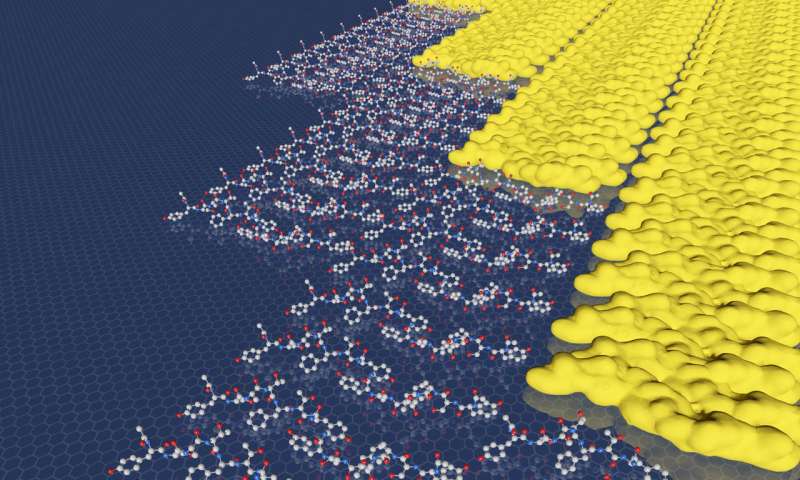
A new collaborative study led by a research team at the Department of Energy's Pacific Northwest National Laboratory, University of California, Los Angeles and the University of Washington could provide engineers new design rules for creating microelectronics, membranes and...
The production of chlorofluorocarbons, which damage the ozone layer, has been banned as far as possible. However, other substances can also tear holes in the ozone layer in combination with ice particles, such as those found in clouds. Researchers...

In the world of quantum computing, interaction is everything.
For computers to work at all, bits—the ones and zeros that make up digital information—must be able to interact and hand off data for processing. The same goes for the quantum...
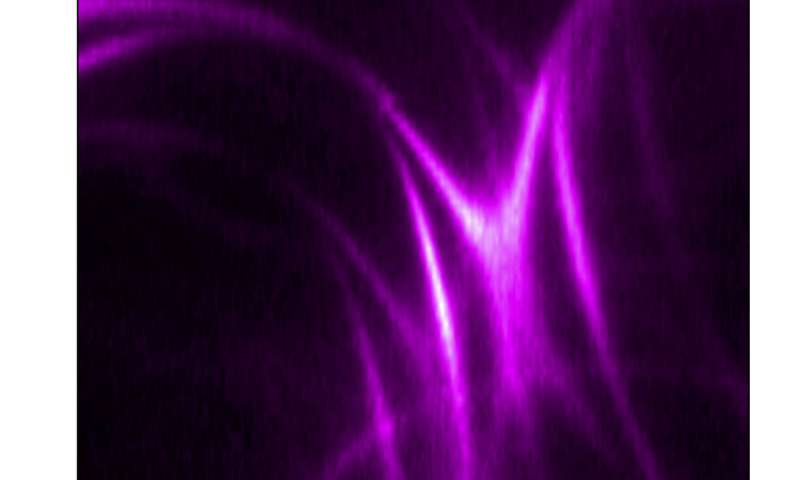
Scientists mapping out the quantum characteristics of superconductors—materials that conduct electricity with no energy loss—have entered a new regime. Using newly connected tools named OASIS at the U.S. Department of Energy's Brookhaven National Laboratory, they've uncovered previously inaccessible details...

Researchers from Intel Corp. and the University of California, Berkeley, are looking beyond current transistor technology and preparing the way for a new type of memory and logic circuit that could someday be in every computer on the planet.
In...

Scientists from the Theory Department of the Max Planck Institute for the Structure and Dynamics of Matter (MPSD) at the Center for Free-Electron Laser Science (CFEL) in Hamburg, Germany have shown through theoretical calculations and computer simulations that the...


