



Scientists have long known that synthetic materials—called metamaterials—can manipulate electromagnetic waves such as visible light to make them behave in ways that cannot be found in nature. That has led to breakthroughs such as super-high resolution imaging. Now, UMass...

The world has one official kilogram against which all other country's kilograms are measured and scales calibrated.
It lives in France, where the world's official metre, now retired, was also located.
But what if that kilogram was no longer accurate? What...

A new laser-pointing platform developed at MIT may help launch miniature satellites into the high-rate data game.
Since 1998, almost 2,000 shoebox-sized satellites known as CubeSats have been launched into space. Due to their petite frame and the fact that...

A RUDN employee and Brazilian colleagues have called into question the concept of using stable wormholes as portals to different points of space-time. The results of the studies were published in Physical Review D.
Wormholes are a recurring motif in...
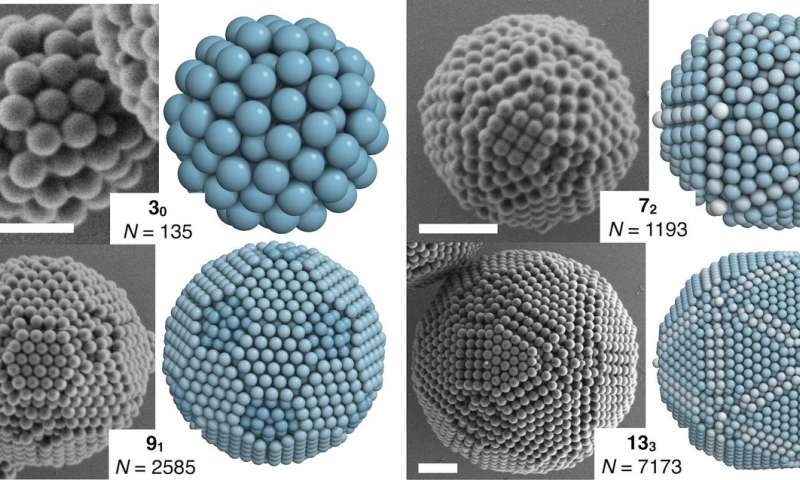
Complexity in nature often results from self-assembly, and is considered particularly robust. Compact clusters of elemental particles can be shown to be of practical relevance, and are found in atomic nuclei, nanoparticles or viruses. An interdisciplinary team of researchers...

Magnetic field lines tangled like spaghetti in a bowl might be behind the most powerful particle accelerators in the universe. That's the result of a new computational study by researchers from the Department of Energy's SLAC National Accelerator Laboratory,...
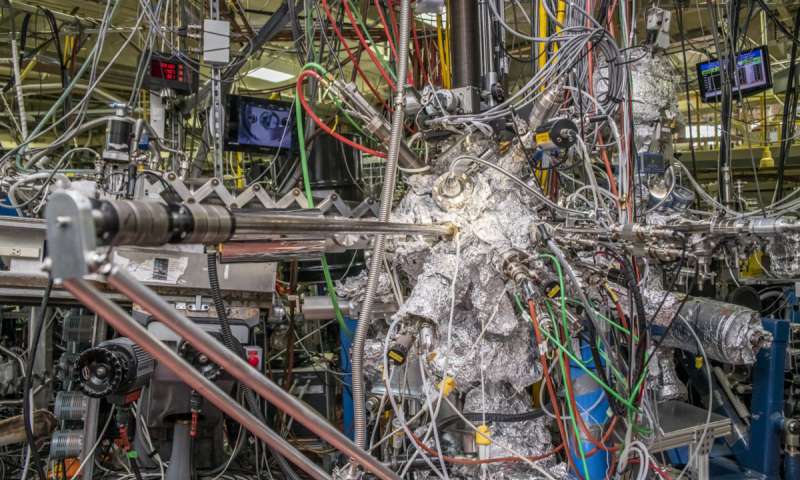
Billions of tiny transistors supply the processing power in modern smartphones, controlling the flow of electrons with rapid on-and-off switching.
But continual progress in packing more transistors into smaller devices is pushing toward the physical limits of conventional materials. Common...

By studying ultracold atoms trapped in artificial crystals of light, Guillaume Salomon, a postdoc at the Max-Planck-Institute of Quantum Optics and a team of scientists have been able to directly observe a fundamental effect of one-dimensional quantum systems. By...

Australian scientists have investigated new directions to scale up qubits—utilising the spin-orbit coupling of atom qubits—adding a new suite of tools to the armory.
Spin-orbit coupling, the coupling of the qubits' orbital and spin degree of freedom, allows the manipulation...

Lawrence Livermore National Laboratory (LLNL) researchers have discovered an unusual new type of phase transformation in the transition metal zirconium. The mechanism underlying this new type of phase transition is the first of its kind that has ever been...

Researchers have developed a new device that can measure and control a nanoparticle trapped in a laser beam with unprecedented sensitivity. The new technology could help scientists study a macroscopic particle's motion with subatomic resolution, a scale governed by...


