



Synchronization, in which two different systems oscillate in an identical way, underlies numerous collective phenomena observed in nature, providing an example for emergent behaviors ranging from the acoustic unison of cricket choruses to the behavior of the human brain.
Can...
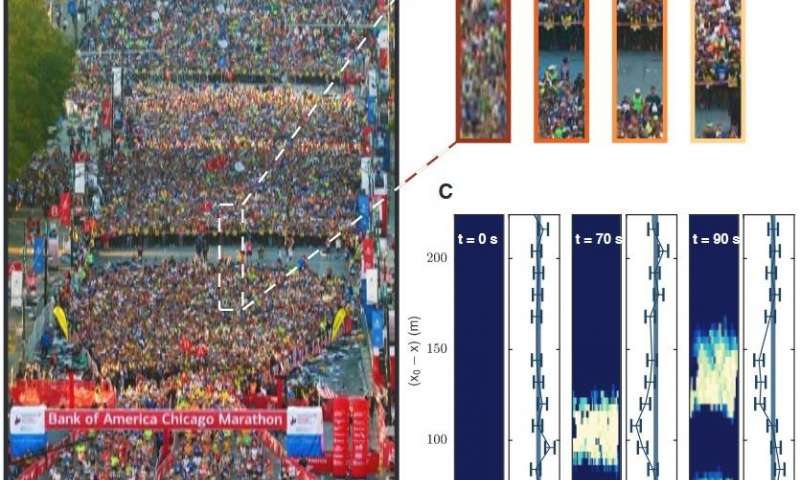
Precise simulations of the movement and behavior of crowds can be vital to the production of digital sequences or the creation of large structures for crowd management. However, the ability to quantitatively predict the collective dynamic of a group...

After developing a method to control exciton flows at room temperature, EPFL scientists have discovered new properties of these quasiparticles that can lead to more energy-efficient electronic devices.
They were the first to control exciton flows at room temperature. And...

In the 1980s, the discovery of high-temperature superconductors known as cuprates upended a widely held theory that superconductor materials carry electrical current without resistance only at very low temperatures of around 30 Kelvin (or minus 406 degrees Fahrenheit). For...

For many modern technical applications, such as superconducting wires for magnetic resonance imaging, engineers want as much as possible to get rid of electrical resistance and its accompanying production of heat.
It turns out, however, that a bit of heat...

Ben-Gurion University researchers have developed a new satellite imaging system that could revolutionize the economics and imagery available from space-based cameras and even earth-based telescopes.
"This is an invention that completely changes the costs of space exploration, astronomy, aerial photography,...

A team of experimentalists at the U.S. Department of Energy's Ames Laboratory and theoreticians at University of Alabama Birmingham discovered a remarkably long-lived new state of matter in an iron pnictide superconductor, which reveals a laser-induced formation of collective...

Quantum computing and quantum information processing technology have attracted attention in recently emerging fields. Among many important and fundamental issues in science, solving the Schroedinger equation (SE) of atoms and molecules is one of the ultimate goals in chemistry,...

Why is water densest at around 4 degrees Celsius? Why does ice float? Why does heavy water have a different melting point compared to normal water? Why do snowflakes have a six-fold symmetry? A collaborative study of researchers from...
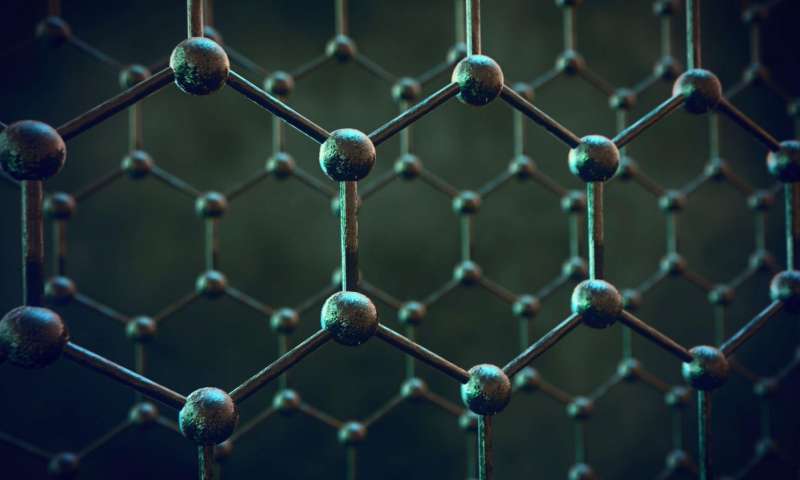
Researchers from MIT and elsewhere have recorded, for the first time, the "temporal coherence" of a graphene qubit—meaning how long it can maintain a special state that allows it to represent two logical states simultaneously. The demonstration, which used...
Researchers at the Advanced Science Research Center (ASRC) at The Graduate Center of The City University of New York and at the City College of New York (CCNY) have developed a metamaterial that can transport sound in unusually robust...


