



Quantum physics sets the laws that dominate the universe at a small scale. The ability to harness quantum phenomena could lead to machines like quantum computers, which are predicted to perform certain calculations much faster than conventional computers. One...

This year marks the 150th anniversary of the Periodic Table, and the principles that drove Dmitri Mendeleev to construct his table are still influencing today's research advances.
In a special issue of Science, which celebrates this sesquicentennial anniversary, a Michigan...

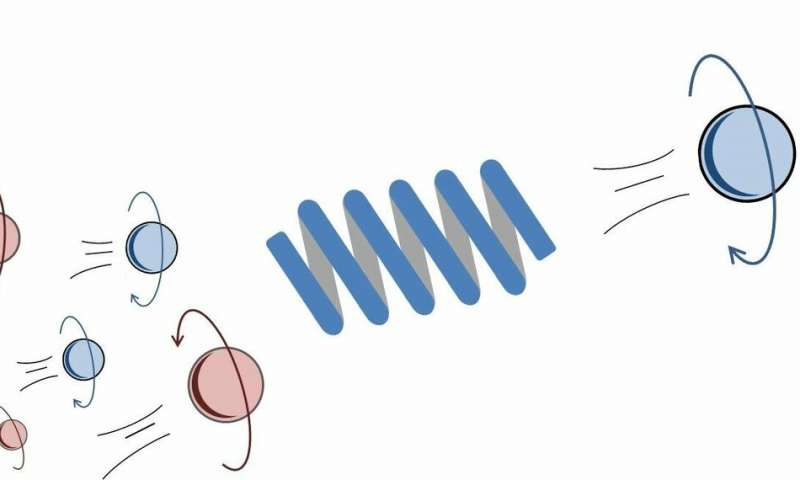
Some theories that go beyond the Standard Model of particle physics predict the existence of new ultralight particles, with masses far below the lightest known particles in nature. These particles have such very weak interactions with ordinary matter that...

A team of scientists has discovered the first robust example of a new type of magnet—one that holds promise for enhancing the performance of data storage technologies.
This "singlet-based" magnet differs from conventional magnets, in which small magnetic constituents align...

A new physical effect has been demonstrated at the University of Bath after 40 years of pursuit by physicists around the world, which could lead to advancements in chemical manufacturing efficiency, miniaturisation and quality control in personalised pharmaceuticals.
For the...

Scientists at Tokyo Institute of Technology have extended an existing mathematical model so that it can be used to more accurately predict the products of fission reactions.
Nuclear fission is a process by which the nucleus of an atom is...
Spintronics is promising for future low-power electronic devices. Spin is a quantum-mechanical property of electrons that can best be imagined as electrons spinning around their own axes, causing them to behave like small compass needles. A current of electron...

How have stars and planets developed from the clouds of dust and gas that once filled the cosmos? A novel experiment at the U.S. Department of Energy's (DOE) Princeton Plasma Physics Laboratory (PPPL) has demonstrated the validity of a...

In a recent issue of Physical Review A, Argonne researchers reported a new method for alleviating the effects of "noise" in quantum information systems, a challenge scientists around the globe are working to meet in the race toward a...

In work that provides insights for several areas of wave physics, including Maxwell electromagnetism, topological quantum states, and plasmonics/metamaterials, scientists have shown that the well-known surface electromagnetic waves at interfaces between homogeneous isotropic media, obtained within classical Maxwell's electromagnetism,...

By bombarding an ultrathin semiconductor sandwich with powerful laser pulses, physicists at the University of California, Riverside, have created the first "electron liquid" at room temperature.
The achievement opens a pathway for development of the first practical and efficient devices...


