



Researchers from the Moscow Institute of Physics and Technology teamed up with colleagues from the U.S. and Switzerland and returned the state of a quantum computer a fraction of a second into the past. They also calculated the probability...

Under the direction of Mobileye founder Amnon Shashua, a research group at Hebrew University of Jerusalem's School of Engineering and Computer Science has proven that artificial intelligence (AI) can help us understand the world on an infinitesimally small scale...
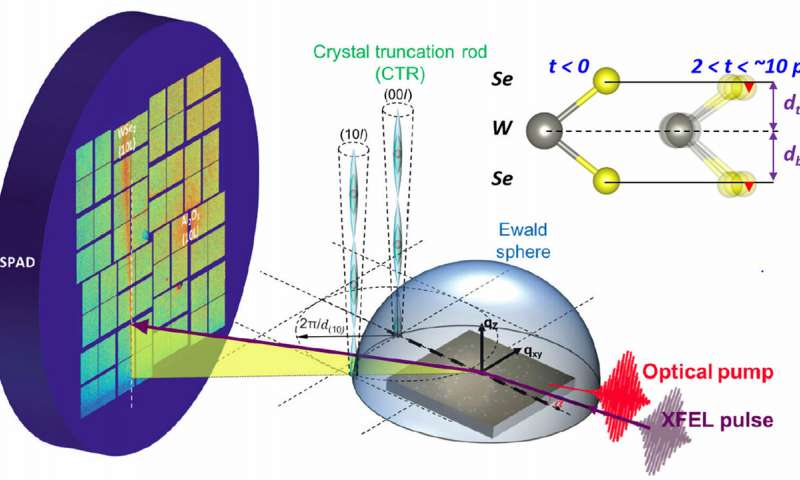
Discovery allows scientists to look at how 2-D materials move with ultrafast precision.
Using a never-before-seen technique, scientists have found a new way to use some of the world's most powerful X-rays to uncover how atoms move in a single atomic sheet at ultrafast...

Scientists in the Emergent Photonics Lab (EPic Lab) at the University of Sussex have made a breakthrough to a crucial element of an atomic clock—devices which could reduce our reliance on satellite mapping in the future—using cutting-edge laser beam...

Quantum computers need to preserve quantum information for a long time to be able to crack important problems faster than a normal computer. Energy losses take the state of the qubit from one to zero, destroying stored quantum information...

An international collaboration including scientists at the Department of Energy's (DOE's) Oak Ridge National Laboratory (ORNL) solved a 50-year-old puzzle that explains why beta decays of atomic nuclei are slower than what is expected based on the beta decays...

Researchers at Delft University of Technology have created a quantum circuit to listen to the weakest radio signal allowed by quantum mechanics. This new quantum circuit opens the door to possible future applications in areas such as radio astronomy...
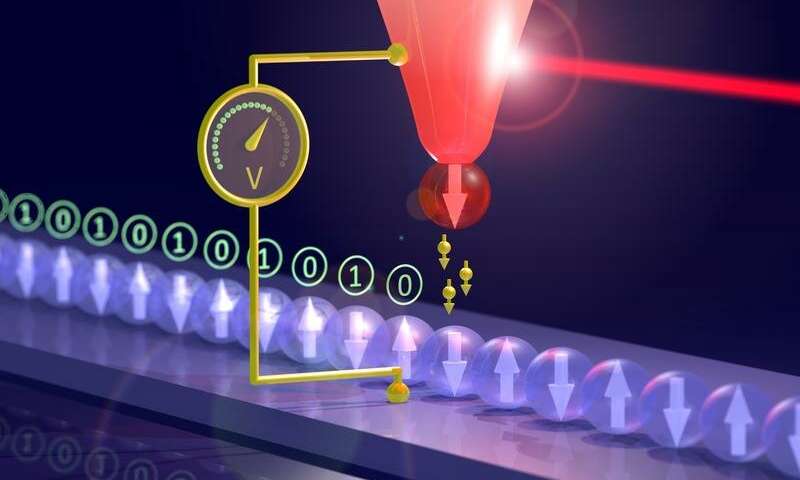
Scientists of the Department of Physics at the University of Hamburg, Germany, detected the magnetic states of atoms on a surface using only heat. The respective study is published in a recent volume of Science. A magnetic needle heated by...

Fireflies, heart cells, clocks, and power grids all do it—they can spontaneously sync up, sending signals out in unison. For centuries, scientists have been perplexed by this self-organizing behavior, coming up with theories and experiments that make up the...

Boston University researchers, Xin Zhang, a professor at the College of Engineering, and Reza Ghaffarivardavagh, a Ph.D. student in the Department of Mechanical Engineering, released a paper in Physical Review B demonstrating it's possible to silence noise using an open, ringlike...

Most laypersons are familiar with the three states of matter as solids, liquids, and gases. But there are other forms that exist. Plasmas, for example, are the most abundant form of matter in the universe, found throughout our solar...


