



A new method allows the quantum state of atomic "qubits"—the basic unit of information in quantum computers—to be measured with twenty times less error than was previously possible, without losing any atoms. Accurately measuring qubit states, which are analogous...

Light-by-light scattering is a very rare phenomenon in which two photons interact, producing another pair of photons. This process was among the earliest predictions of quantum electrodynamics (QED), the quantum theory of electromagnetism, and is forbidden by classical physics theories (such...
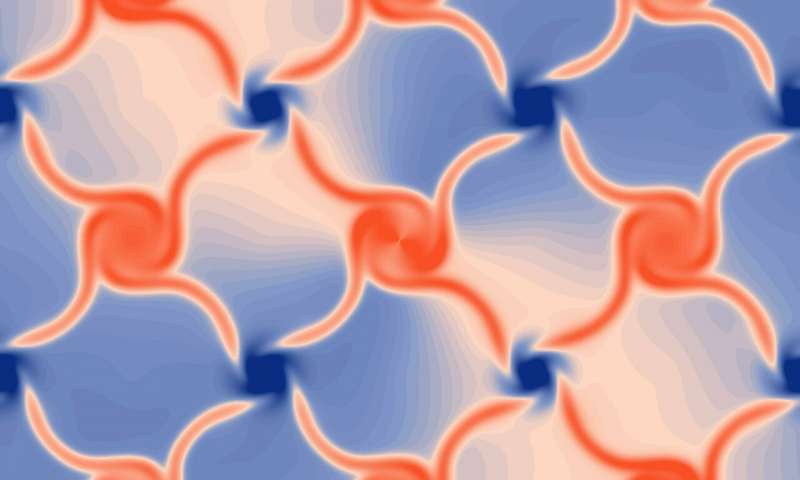
The realization of so-called topological materials—which exhibit exotic, defect-resistant properties and are expected to have applications in electronics, optics, quantum computing, and other fields—has opened up a new realm in materials discovery.
Several of the hotly studied topological materials to...

A new computer program that spots when information in a quantum computer is escaping to unwanted states will give users of this promising technology the ability to check its reliability without any technical knowledge for the first time.
Researchers from...

Researchers at Caltech have designed a way to levitate and propel objects using only light, by creating specific nanoscale patterning on the objects' surfaces.
Though still theoretical, the work is a step toward developing a spacecraft that could reach the...

Lasers play a vital role in everything from modern communications and connectivity to bio-medicine and manufacturing. Many applications, however, require lasers that can emit multiple frequencies—colors of light—simultaneously, each precisely separated like the tooth on a comb.
Optical frequency combs...
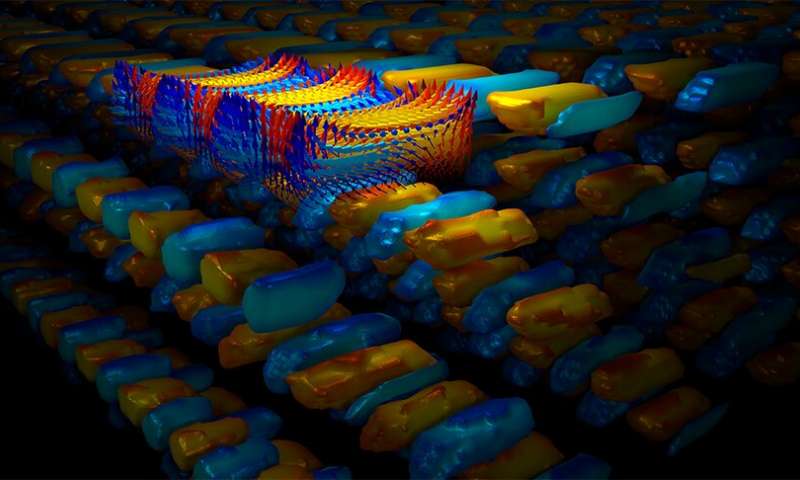
This is one of the first examples of a new state of matter with long-term stability transfigured by the energy from a sub-pico-second laser pulse. The team's goal, supported by the Department of Energy, is to discover interesting states...

Tiny, easy-to-produce particles, called quantum dots, may soon take the place of more expensive single crystal semiconductors in advanced electronics found in solar panels, camera sensors and medical imaging tools. Although quantum dots have begun to break into the...

New data from the STAR experiment at the Relativistic Heavy Ion Collider (RHIC) add detail—and complexity—to an intriguing puzzle that scientists have been seeking to solve: how the building blocks that make up a proton contribute to its spin....

There are high hopes that quantum computing's tremendous processing power will someday unleash exponential advances in artificial intelligence. AI systems thrive when the machine learning algorithms used to train them are given massive amounts of data to ingest, classify...

We all mark days with clocks and calendars, but perhaps no timepiece is more immediate than a mirror. The changes we notice over the years vividly illustrate science's "arrow of time" -- the likely progression from order to disorder....


