



Maxwell's demon is a machine proposed by James Clerk Maxwell in 1867. The hypothetical machine would use thermal fluctuations to obtain energy, apparently violating the second principle of thermodynamics. Now, researchers at the University of Barcelona have presented the...

Now that they've identified the Higgs boson, scientists at the Large Hadron Collider have set their sights on an even more elusive target.
All around us is dark matter and dark energy—the invisible stuff that binds the galaxy together, but which no one...
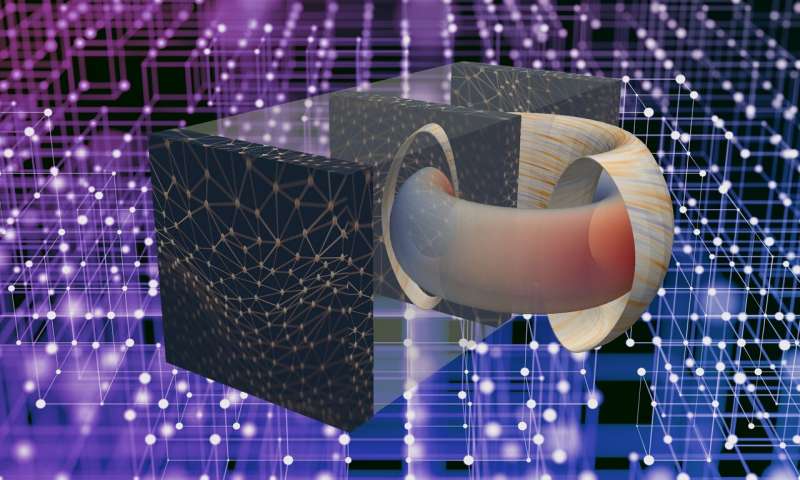
Artificial intelligence (AI), a branch of computer science that is transforming scientific inquiry and industry, could now speed the development of safe, clean and virtually limitless fusion energy for generating electricity. A major step in this direction is under...

For years, researchers have pursued a strange phenomenon: When you hit an ultra-thin magnet with a laser, it suddenly de-magnetizes. Imagine the magnet on your refrigerator falling off.
Now, scientists at CU Boulder are digging into how magnets recover from...
The optical laser has grown to a $10 billion global technology market since it was invented in 1960, and has led to Nobel prizes for Art Ashkin for developing optical tweezing and Gerard Mourou and Donna Strickland for work...

Humans need to be wary of breaching a 'point of no return' that leads to ecological disaster such as loss of rainforests or irreversible climate change, according to the most detailed study of its kind.
The thin line separating the...

Gravitational echoes may be caused by the collision of two black holes, and may indicate that these objects have completely new physical properties. This conclusion was made by RUDN physicists after a series of mathematical calculations. The scientists state...

Scientists believe that time is continuous, not discrete—roughly speaking, they believe that it does not progress in "chunks," but rather "flows," smoothly and continuously. So they often model the dynamics of physical systems as continuous-time "Markov processes," named after...

A Harvard physicist has shown that wormholes can exist: tunnels in curved space-time, connecting two distant places, through which travel is possible.
But don't pack your bags for a trip to other side of the galaxy yet; although it's theoretically...

A localization phenomenon boosts the accuracy of solving quantum many-body problems with quantum computers. These problems are otherwise challenging for conventional computers. This brings such digital quantum simulation within reach using quantum devices available today.
Quantum computers promise to solve...

A new type of pocket-sized antenna, developed at the Department of Energy's SLAC National Accelerator Laboratory, could enable mobile communication in situations where conventional radios don't work, such as under water, through the ground and over very long distances...


