



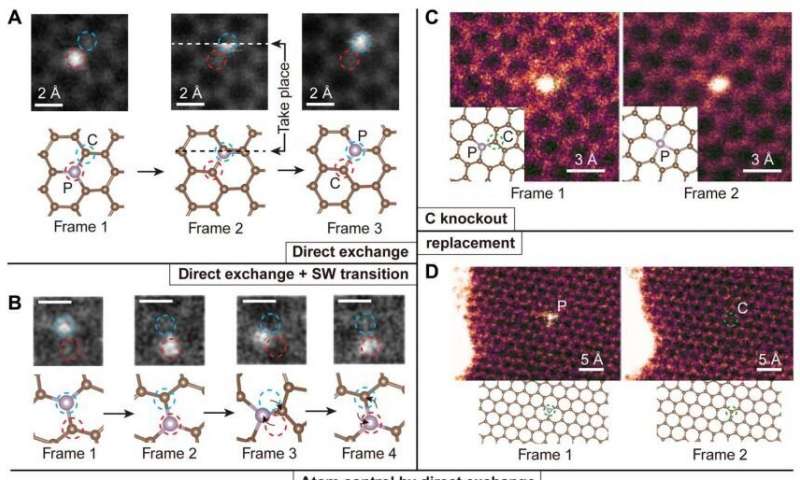
The ultimate degree of control for engineering would be the ability to create and manipulate materials at the most basic level, fabricating devices atom by atom with precise control.
Now, scientists at MIT, the University of Vienna, and several other...

Physicists have demonstrated a new way to obtain the essential details that describe an isolated quantum system, such as a gas of atoms, through direct observation. The new method gives information about the likelihood of finding atoms at specific...

To a patient, the analysis of a tissue biopsy sample to check for something like cancer may seem like a relatively simple process, even if it does mean giving up a small piece of flesh to be tested. The...

Superfast data processing using light pulses instead of electricity has been created by scientists.
The invention uses magnets to record computer data which consume virtually zero energy, solving the dilemma of how to create faster data processing speeds without the accompanying...

Quantum optics, where light and matter interactions are examined at the microscopic level, has earned Nobel prizes—including three awarded since 2001—for some of science's biggest names. However, even in this mature field, some interesting physics remains largely unexplored. An...

MIT researchers have designed a way to generate, at room temperature, more single photons for carrying quantum information. The design, they say, holds promise for the development of practical quantum computers.
Quantum emitters generate photons that can be detected one...

Research funded in part by the U.S. Army identified properties in materials that could one day lead to applications such as more powerful data storage devices that continue to hold information even after a device has been powered off.
A...
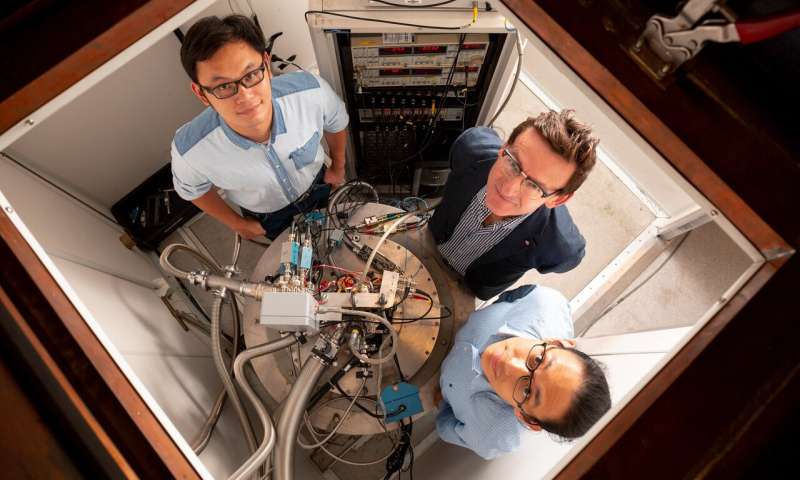
For the first time ever, researchers have measured the fidelity—that is, the accuracy—of two-qubit logic operations in silicon, with highly promising results that will enable scaling up to a full-scale quantum processor.
The research, carried out by Professor Andrew Dzurak's...
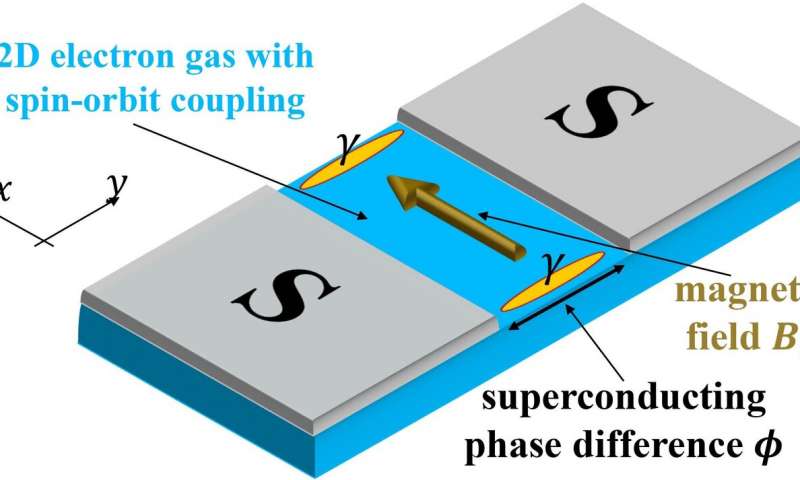
Majorana particles are very peculiar members of the family of elementary particles. First predicted in 1937 by the Italian physicist Ettore Majorana, these particles belong to the group of so-called fermions, a group that also includes electrons, neutrons and...
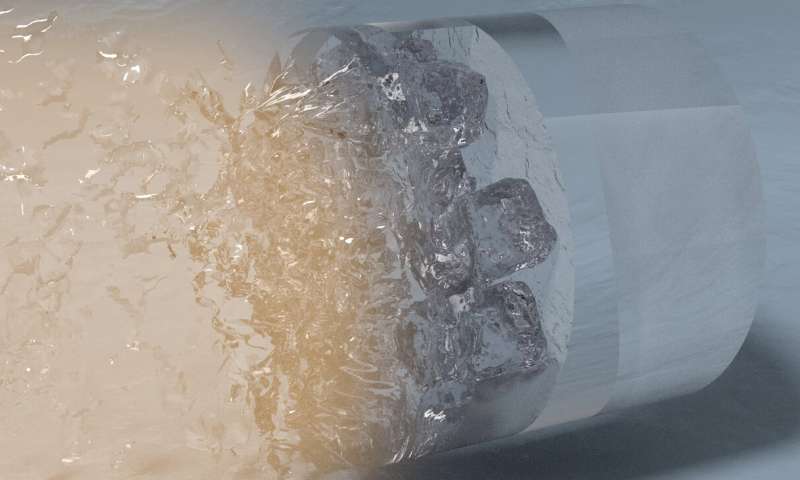
Scientists from Lawrence Livermore National Laboratory (LLNL) used giant lasers to flash-freeze water into its exotic superionic phase and record X-ray diffraction patterns to identify its atomic structure for the very first time—all in just a few billionths of...

A team of researchers from Osaka University and Kirin Holdings Company, Limited demonstrated that the texture formation in a pint glass of Guinness beer is induced by flow of a bubble-free fluid film flowing down along the wall of...


