



Researchers at the Center for Quantum Nanoscience (QNS) within the Institute for Basic Science (IBS) at Ewha Womans University have made a major scientific breakthrough by performing the world's smallest magnetic resonance imaging (MRI). In an international collaboration with...

A University of Colorado Boulder physicist is one step closer to solving a string theory puzzle 20 years in the making.
Paul Romatschke, an associate professor of physics at CU Boulder, has devised an alternative set of tools to those...

Scientists from the University of Bristol and the Technical University of Denmark have found a promising new way to build the next generation of quantum simulators combining light and silicon micro-chips.
In the roadmap to develop quantum machines able to compete...

Jigang Wang patiently explained his latest discovery in quantum control that could lead to superfast computing based on quantum mechanics: He mentioned light-induced superconductivity without energy gap. He brought up forbidden supercurrent quantum beats. And he mentioned terahertz-speed symmetry...
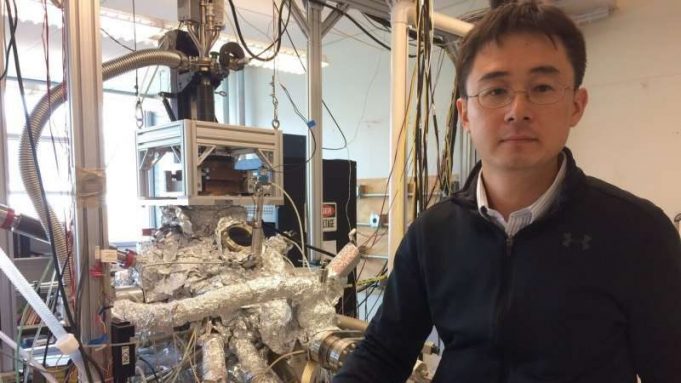
A joint team of scientists at the University of California, Riverside, and the Massachusetts Institute of Technology is getting closer to confirming the existence of an exotic quantum particle called Majorana fermion, crucial for fault-tolerant quantum computing—the kind of...

Turbulence can be found in places large and small, from exploding supernovae and sprawling ocean currents, to the unstable plasmas that form within tiny fusion fuel cells bombarded with lasers.
And yet, as seemingly chaotic turbulence unfolds in a cascade...
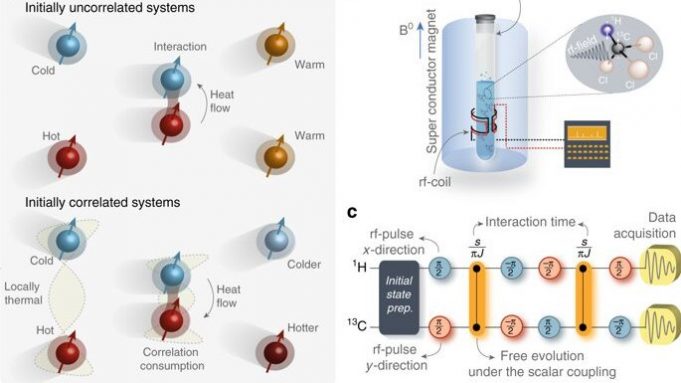
Heat flows from hot to cold objects. When a hot and a cold body are in thermal contact, they exchange heat energy until they reach thermal equilibrium, with the hot body cooling down and the cold body warming up....

Nature has a way of finding optimal solutions to complex problems. For example, despite the billions of ways for a single protein to fold, proteins always fold in a way that minimizes potential energy. Slime mold, a brainless organism,...
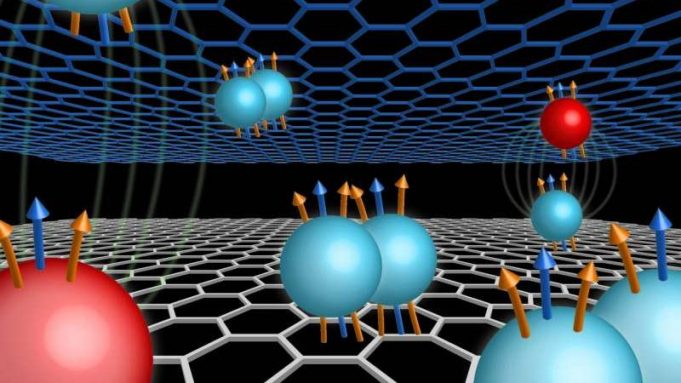
Researchers from Brown and Columbia Universities have demonstrated previously unknown states of matter that arise in double-layer stacks of graphene, a two-dimensional nanomaterial. These new states, known as the fractional quantum Hall effect, arise from the complex interactions of...

One of the essential features required for the realization of a quantum computer is quantum entanglement. A team of physicists from the University of Vienna and the Austrian Academy of Sciences (ÖAW) introduces a novel technique to detect entanglement...
Quantum computers, which use light particles (photons) instead of electrons to transmit and process data, hold the promise of a new era of research in which the time needed to realize lifesaving drugs and new technologies will be significantly...


