



A few millionths of a second after the Big Bang, the universe was so dense and hot that the quarks and gluons that make up protons, neutrons and other hadrons existed freely in what is known as the quark–gluon...

A photonic chip with no less than 128 tunable components proves to be a true computing "Swiss army knife" with a variety of applications. During her research on measuring light wavelengths using this photonic chip, Caterina Taballione of the...

A group of scientists led by 2018 Australian of the Year Professor Michelle Simmons have achieved the first two-qubit gate between atom qubits in silicon—a major milestone on the team's quest to build an atom-scale quantum computer. The pivotal...
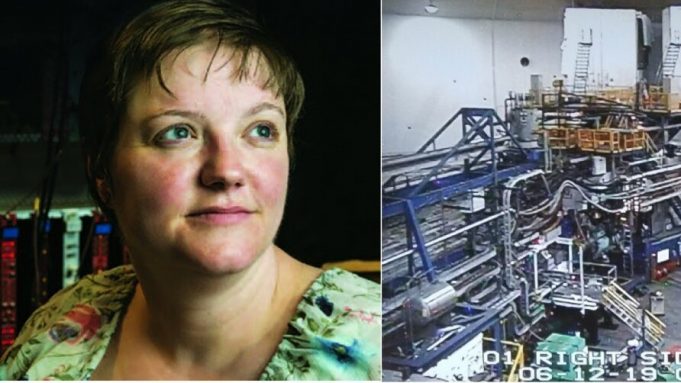
Neutron stars were recently in the news because the gravitational wave observatory, LIGO, detected a neutron star merger. Neutron stars are very interesting objects. A teaspoon of neutron star matter is so dense it would weigh about 10 million...

Quantum computers promise to perform operations of great importance believed to be impossible for our technology today. Current computers process information via transistors carrying one of two units of information, either a 1 or a 0. Quantum computing is...
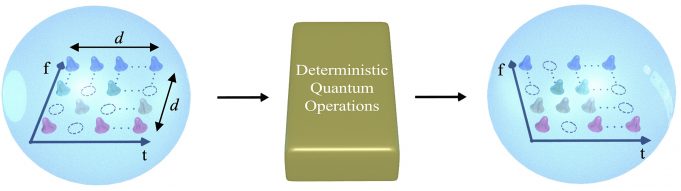
Quantum information processing promises to be much faster and more secure than what today's supercomputers can achieve, but doesn't exist yet because its building blocks, qubits, are notoriously unstable.
Purdue University researchers are among the first to build a gate—what...
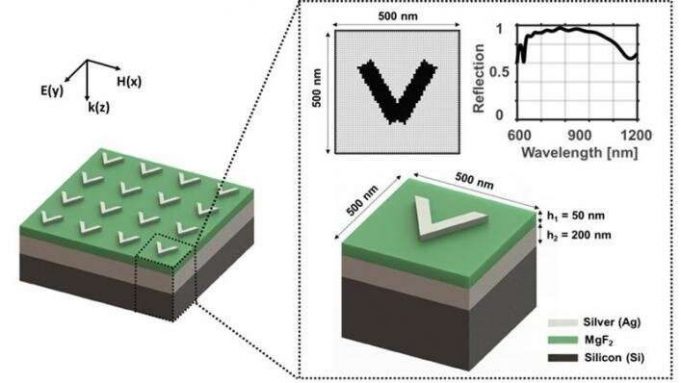
Metamaterials are artificial materials engineered to have properties not found in naturally occurring materials, and they are best known as materials for invisibility cloaks often featured in sci-fi novels or games. By precisely designing artificial atoms smaller than the...
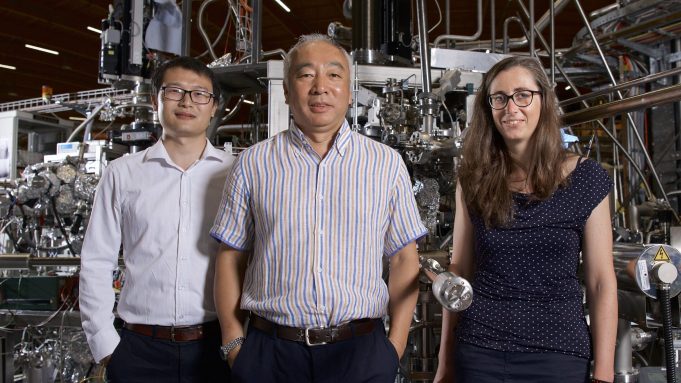
A particular kind of elementary particle, the Weyl fermions, were first discovered a few years ago. Their specialty: they move through a material in a well ordered manner that practically never lets them collide with each other and is...
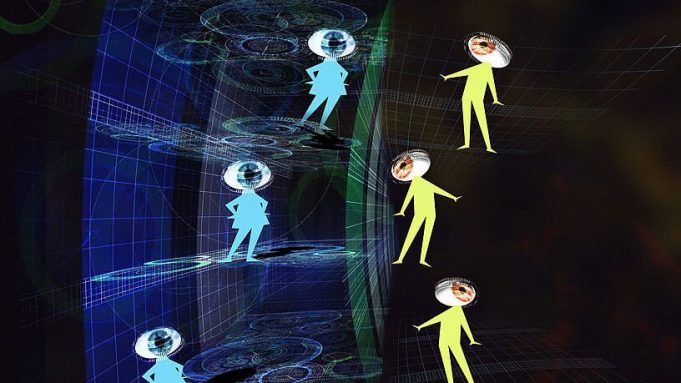
Researchers of the Academy explore the consequences of locality for measurements distributed in spacetime. Their article has now been published in the Nature journal Quantum Information.
Locality is a fundamental principle behind all physical interactions. It says that each physical system...

Atomic interactions in everyday solids and liquids are so complex that some of these materials' properties continue to elude physicists' understanding. Solving the problems mathematically is beyond the capabilities of modern computers, so scientists at Princeton University have turned...
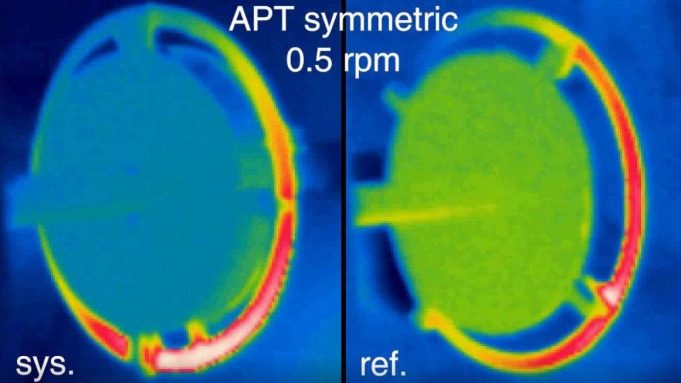
A ground-breaking study conducted by researchers from the National University of Singapore (NUS) has revealed a method of using quantum mechanical wave theories to "lock" heat into a fixed position.
Ordinarily, a source of heat diffuses through a conductive material until it...


