




More than 100 years after Albert Einstein published his iconic theory of general relativity, it is beginning to fray at the edges, said Andrea Ghez, UCLA professor of physics and astronomy. Now, in the most comprehensive test of general...

The large, error-correcting quantum computers envisioned today could be decades away, yet experts are vigorously trying to come up with ways to use existing and near-term quantum processors to solve useful problems despite limitations due to errors or "noise."
A...

Advanced simulations have solved a problem in turbulent fluid flow that could lead to more efficient turbines and engines.
When a fluid, such as water or air, flows fast enough, it will experience turbulence—seemingly random changes in velocity and pressure within...
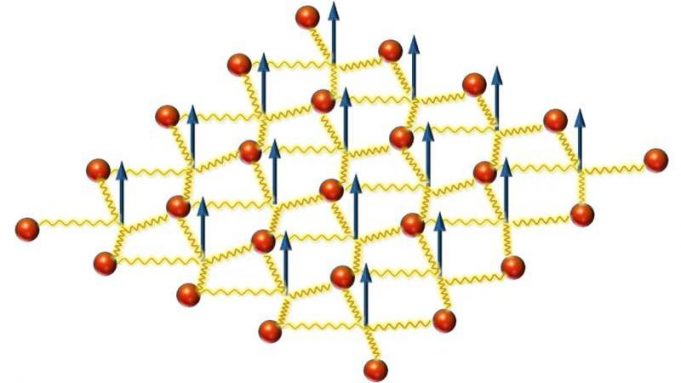
Controlling how electrons zip through a material is of central importance to build novel electronic devices. How the electronic motion is affected by magnetic fields is an old problem that has not been fully resolved, yet has already led...

Researchers at the Center for Theoretical Physics of Complex Systems (PCS), within the Institute for Basic Science (IBS, South Korea), and colleagues have reported a novel phenomenon, called Valley Acoustoelectric Effect, which takes place in 2-D materials, similar to...

A new study, "Wavelength-encoded laser particles for massively multiplexed cell tagging," by scientists in the Wellman Center for Photomedicine has been published in Nature Photonics.
According to the study's researchers, "We have developed a new class of probes, laser particles, which are...

Physicists at the University of Illinois at Urbana-Champaign have observed a magnetic phenomenon called the "anomalous spin-orbit torque" (ASOT) for the first time. Professor Virginia Lorenz and graduate student Wenrui Wang, now graduated and employed as an industry scientist,...
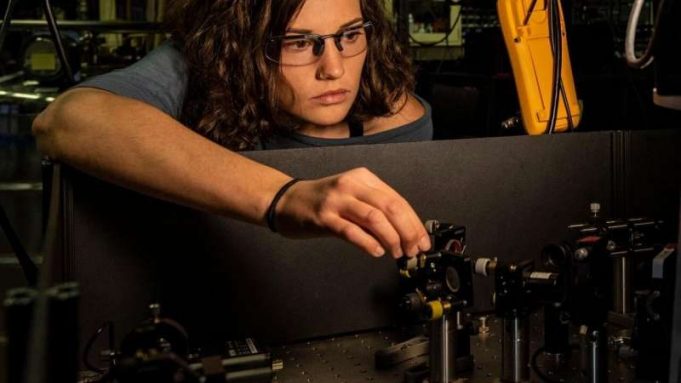
Showcasing precise control at the quantum level, physicists at the National Institute of Standards and Technology (NIST) have developed a method for making an ion (electrically charged atom) display exact quantities of quantum-level motion—any specific amount up to 100...

Scientists from the Faculty of Physics, University of Warsaw, in collaboration with the University of Oxford and NIST, have shown that quantum interference enables processing of large sets of data faster and more accurately than with standard methods. Their...

Heat transfer through a single molecule has been measured for the first time by an international team of researchers led by the University of Michigan.
This could be a step toward molecular computing—building circuits up from molecules rather than carving them out...

Inventors of centuries past and scientists of today have found ingenious ways to make our lives better with magnets—from the magnetic needle on a compass to magnetic data storage devices and even MRI (magnetic resonance imaging) body scan machines.
All...


