



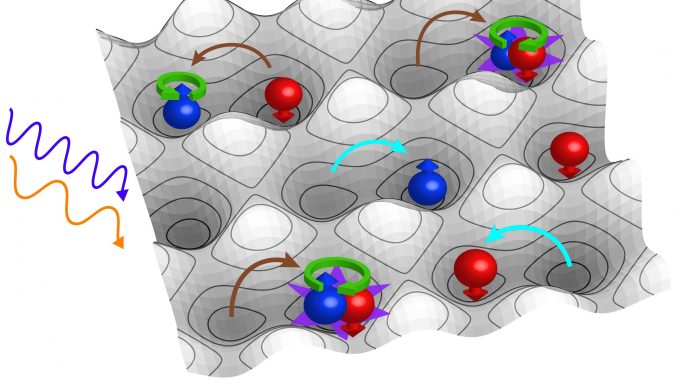
Physicists at ETH Zurich have developed a new approach to couple quantized gauge fields to ultracold matter. The method might be the basis for a versatile platform to tackle problems ranging from condensed-matter to high-energy physics.
The interaction between fields...
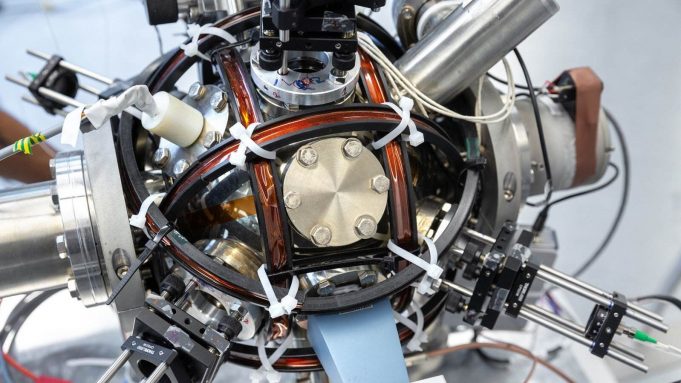
An experiment to test a popular theory of dark energy has found no evidence of new forces, placing strong constraints on related theories.
Dark energy is the name given to an unknown force that is causing the universe to expand at an...

Optical fibres are our global nervous system, transporting terabytes of data across the planet in the blink of an eye.
As that information travels at the speed of light across the globe, the energy of the lightwaves bouncing around inside the silica and...

The Landau-level laser is an exciting concept for an unusual radiation source. It could efficiently generate so-called terahertz waves, which can be used to penetrate materials, with possible applications in data transmission. So far, however, nearly all attempts to...

The quantum Hall effect (QHE), which was previously known for two-dimensional (2-D) systems, was predicted to be possible for three-dimensional (3-D) systems by Bertrand Halperin in 1987, but the theory was not proven until recently by researchers from the...
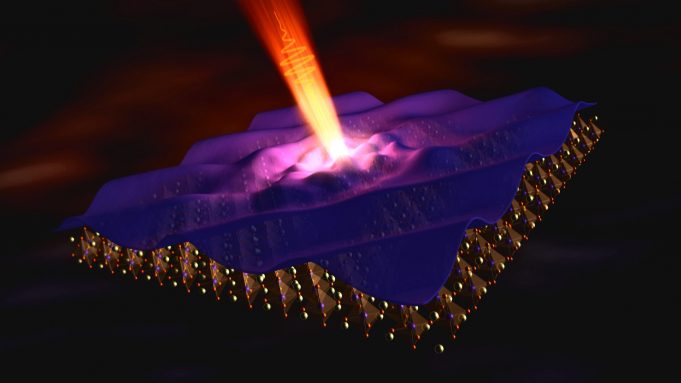
One of the greatest mysteries in condensed matter physics is the exact relationship between charge order and superconductivity in cuprate superconductors. In superconductors, electrons move freely through the material—there is zero resistance when it's cooled below its critical temperature....
Excess heat given off by smartphones, laptops and other electronic devices can be annoying, but beyond that it contributes to malfunctions and, in extreme cases, can even cause lithium batteries to explode.
To guard against such ills, engineers often insert...

Discovered more than 100 years ago, superconductivity continues to captivate scientists who seek to develop components for highly efficient energy transmission, ultrafast electronics or quantum bits for next-generation computation. However, determining what causes substances to become—or stop being—superconductors remains...

A potentially useful material for building quantum computers has been unearthed at the National Institute of Standards and Technology (NIST), whose scientists have found a superconductor that could sidestep one of the primary obstacles standing in the way of...

A team of physicists has uncovered a new state of matter—a breakthrough that offers promise for increasing storage capabilities in electronic devices and enhancing quantum computing.
"Our research has succeeded in revealing experimental evidence for a new state of matter—topological superconductivity," says...

A breakthrough in understanding how the quasi-particles known as magnetic monopoles behave could lead to the development of new technologies to replace electric charges.
Researchers at the University of Kent applied a combination of quantum and classic physics to investigate...


