



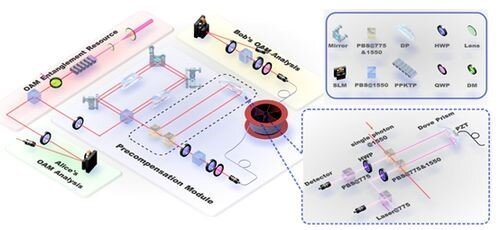
A team led by Prof. Guo Guangcan from University of Science and Technology of China (USTC) of the Chinese Academy of Sciences (CAS) and collaborators first realized distribution of high-dimensional orbital angular momentum entanglement over a 1 km few-mode...

Modern society relies on technologies with electronic integrated circuits (IC) at their heart, but these may prove to be less suitable in future applications such as quantum computing and environmental sensing. Photonic integrated circuits (PICs), the light-based equivalent of...
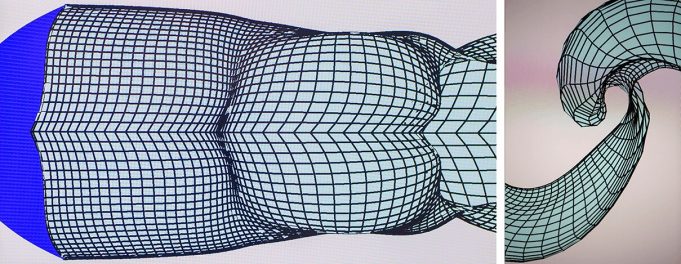
Someday, underwater robots may so closely mimic creatures like fish that they'll fool not only the real animals themselves but humans as well. That ability could yield information ranging from the health of fish stocks to the location of...

Researchers have designed a new camera that could allow hypertelescopes to image multiple stars at once. The enhanced telescope design holds the potential to obtain extremely high-resolution images of objects outside our solar system, such as planets, pulsars, globular...
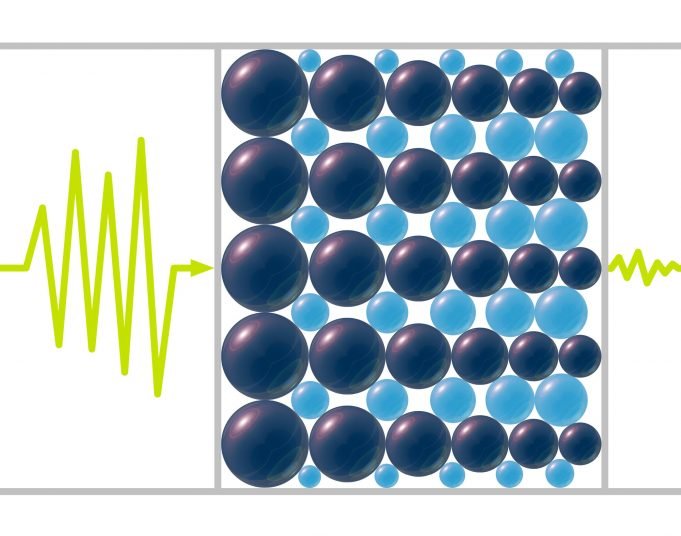
Need to reduce high-pitched noises? Science may have an answer.
In a new study, theoretical physicists report that materials made from tapered chains of spherical beads could help dampen sounds that lie at the upper range of human hearing or...
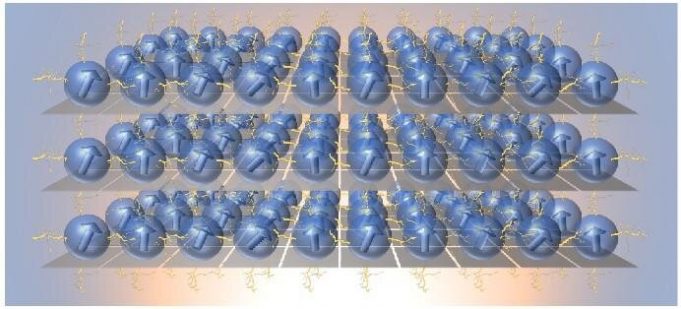
The race toward the first practical quantum computer is in full stride. Companies, countries, collaborators, and competitors worldwide are vying for quantum supremacy. Google says it's already there. But what does that mean? How will the world know when...

Using a single lens that is about one-thousandth of an inch thick, researchers have created a camera that does not require focusing. The technology offers considerable benefits over traditional cameras such as the ones in most smartphones, which require...
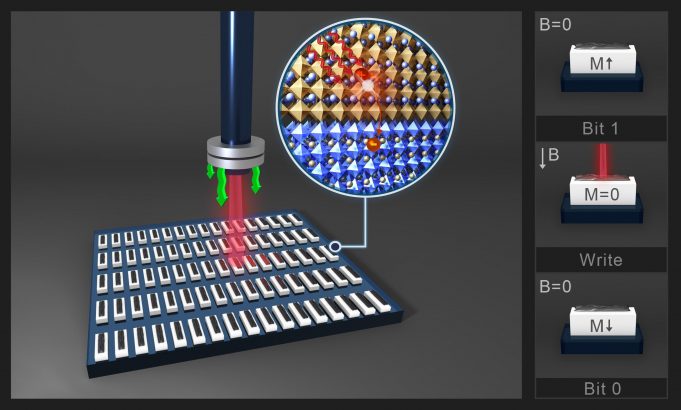
What do you get when you place a thin film of perovskite material used in solar cells on top of a magnetic substrate? More efficient hard drive technology. EPFL physicist László Forró and his team pave the way for...
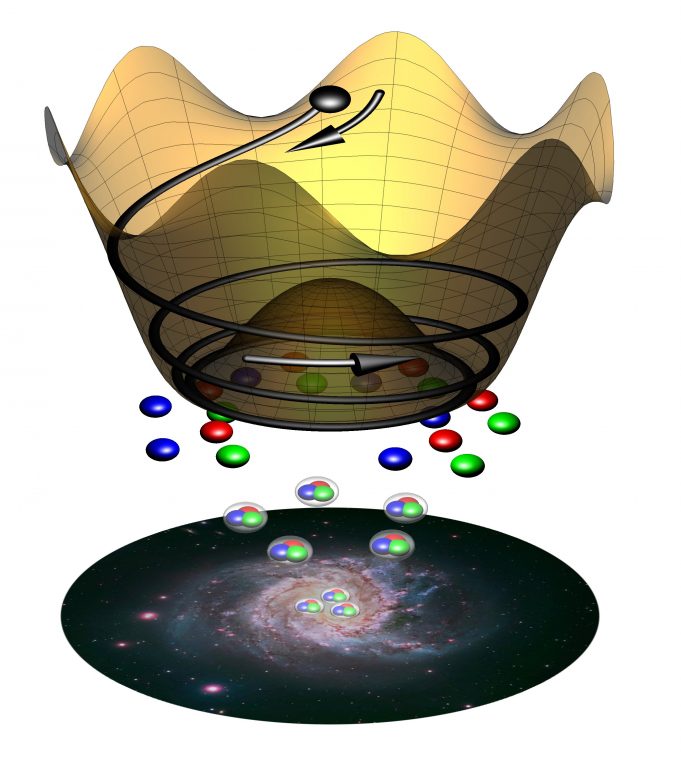
A new study, conducted to better understand the origin of the universe, has provided insight into some of the most enduring questions in fundamental physics: How can the Standard Model of particle physics be extended to explain the cosmological...

Researchers have generated a wide range of colors from a single laser after discovering a new process for achieving so-called "supercontinuum generation."
Supercontinuum generation is when intense laser light of one color travels within a material, like glass, and broadens into a spectrum...

Extreme temperature can do strange things to metals. In severe heat, iron ceases to be magnetic. In devastating cold, lead becomes a superconductor.
For the last 30 years, physicists have been stumped by what exactly happens to uranium ruthenium silicide...


