




For years, scientists have looked for ways to cool molecules down to ultracold temperatures, at which point the molecules should slow to a crawl, allowing scientists to precisely control their quantum behavior. This could enable researchers to use molecules...
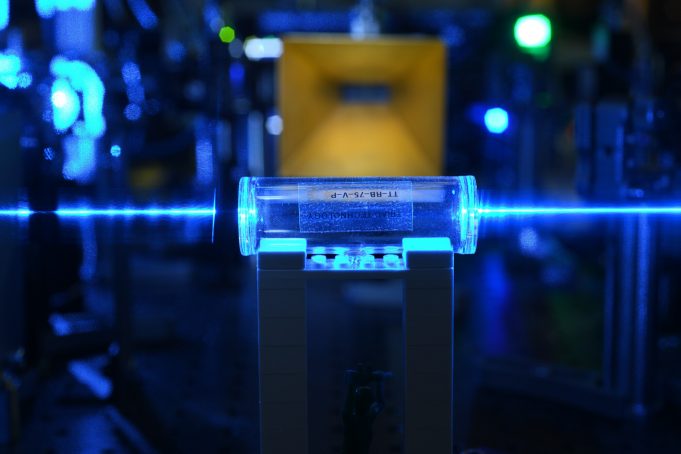
A quantum sensor could give Soldiers a way to detect communication signals over the entire radio frequency spectrum, from 0 to 100 GHz, said researchers from the Army.
Such wide spectral coverage by a single antenna is impossible with a...

The Casimir Force is a well-known effect originating from the quantum fluctuation of electromagnetic fields in a vacuum. Now an international group of researchers have reported a counterpoint to that theory, adding to the understanding of energy fluctuations within...
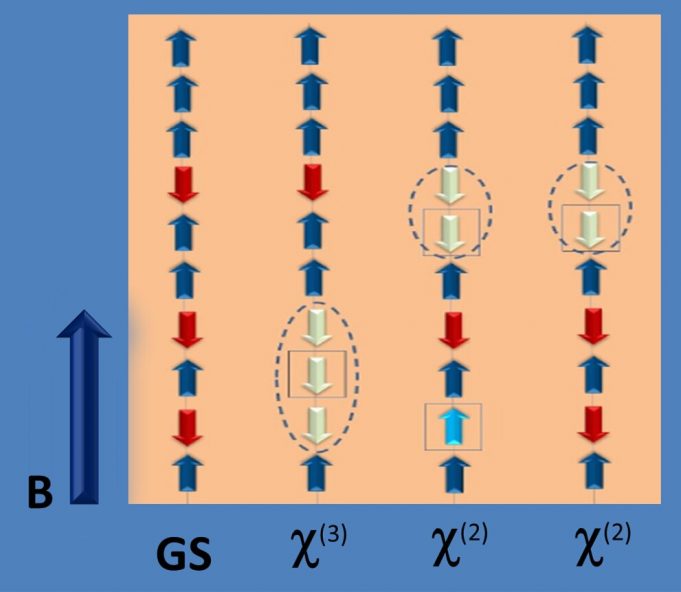
Ninety years ago, the physicist Hans Bethe postulated that unusual patterns, so-called Bethe strings, appear in certain magnetic solids. Now, an international team has succeeded in experimentally detecting such Bethe strings for the first time. They used neutron scattering...

The Belle II experiment has been collecting data from physical measurements for about one year. After several years of rebuilding work, both the SuperKEKB electron–positron accelerator and the Belle II detector have been improved compared with their predecessors in...
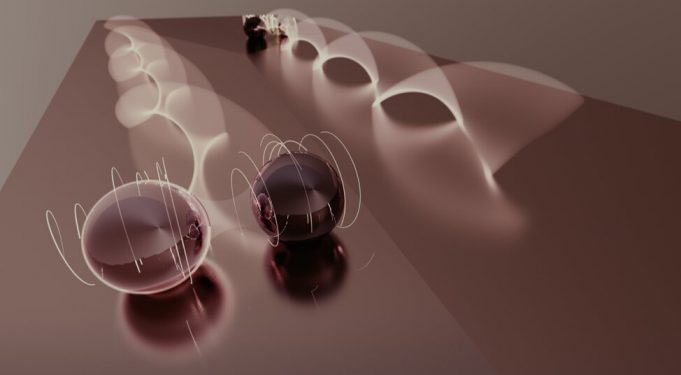
Particle chasing—it's a game that so many physicists play. Sometimes the hunt takes place inside large supercolliders, where spectacular collisions are necessary to find hidden particles and new physics. For physicists studying solids, the game occurs in a much...
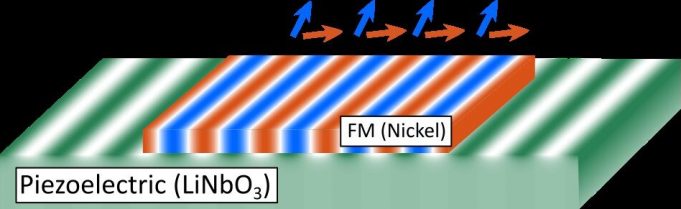
Researchers have observed directly and for the first time magnetoacoustic waves (sound-driven spin waves), which are considered as potential information carriers for novel computation schemes. These waves have been generated and observed on hybrid magnetic/piezoelectric devices. The experiments were...

By observing electrons that have been accelerated to extremely high energies, scientists are able to unlock clues about the particles that make up our universe.
Accelerating electrons to such high energies in a laboratory setting, however, is challenging: typically, the...

Researchers at the University of Southampton have transformed optical fibers into photocatalytic microreactors that convert water into hydrogen fuel using solar energy.
The ground-breaking technology coats the inside of microstructured optical fiber canes (MOFCs) with a photocatalyst which—with light—generates hydrogen...

Since its beginnings, quantum mechanics hasn't ceased to amaze us with its peculiarity, so difficult to understand. Why does one particle seem to pass through two slits simultaneously? Why, instead of specific predictions, can we only talk about evolution...

A discovery by a team of researchers led by UMass Lowell nuclear physicists could change how atoms are understood by scientists and help explain extreme phenomena in outer space.
The breakthrough by the researchers revealed that a symmetry that exists...


