



Today's computers use the presence or absence of charge (0s and 1s) to encode information, where the physical motion of charges consume energy and cause heat. A novel alternative is to utilize the wave quantum number of electrons by...

Before there were animals, bacteria or even DNA on Earth, self-replicating molecules were slowly evolving their way from simple matter to life beneath a constant shower of energetic particles from space.
In a new paper, a Stanford professor and a...

A team of physicists at the University of Bristol has developed the first integrated photon source with the potential to deliver large-scale quantum photonics.
The development of quantum technologies promises to have a profound impact across science, engineering and society....

Scientists have discovered that the transport of electronic charge in a metallic superconductor containing strontium, ruthenium, and oxygen breaks the rotational symmetry of the underlying crystal lattice. The strontium ruthenate crystal has fourfold rotational symmetry like a square, meaning...

Physicists at the National Institute of Standards and Technology have boosted their control of the fundamental properties of molecules at the quantum level by linking or "entangling" an electrically charged atom and an electrically charged molecule, showcasing a way...

The universe mainly consists of a novel substance and an energy form that are not yet understood. This 'dark matter' and 'dark energy' are not directly visible to the naked eye or through telescopes. Astronomers can only provide proof...

It sounds like a riddle: What do you get if you take two small diamonds, put a small magnetic crystal between them and squeeze them together very slowly?
The answer is a magnetic liquid, which seems counterintuitive. Liquids become solids...
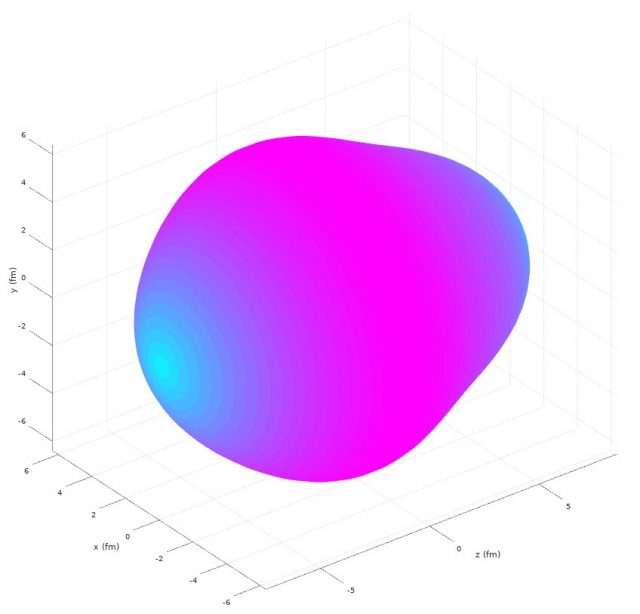
An element which could hold the key to the long-standing mystery around why there is much more matter than antimatter in our Universe has been discovered by a University of the West of Scotland (UWS)-led team of physicists.
The UWS...
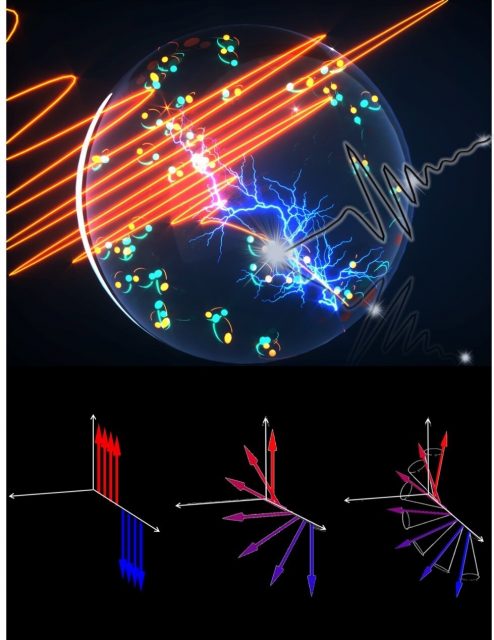
Scientists are using light waves to accelerate supercurrents and access the unique properties of the quantum world, including forbidden light emissions that one day could be applied to high-speed, quantum computers, communications and other technologies.
The scientists have seen unexpected...
A team of researchers at UCLA has set a new record for preparing and measuring the quantum bits, or qubits, inside of a quantum computer without error. The techniques they have developed make it easier to build quantum computers...

As our smartphones, laptops, and computers get smaller and faster, so do the transistors inside them that control the flow of electricity and store information. But traditional transistors can only shrink so much. Now, researchers at Stevens Institute of...


