



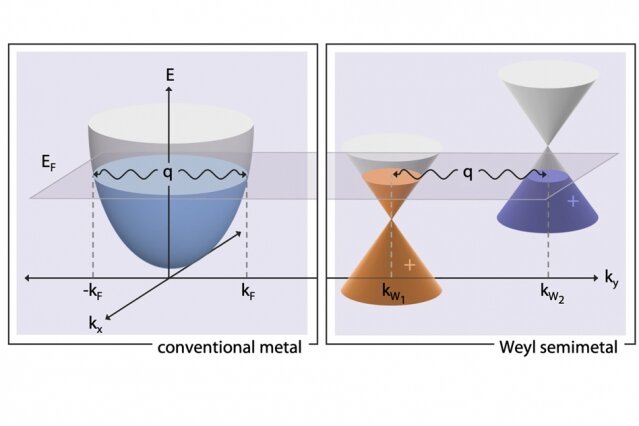
An exotic physical phenomenon known as a Kohn anomaly has been found for the first time in an unexpected type of material by researchers at MIT and elsewhere. They say the finding could provide new insights into certain fundamental...

The exchange of a secret key for encrypting and decrypting messages over a distance of 1,120 kilometers is reported in Nature this week. This achievement is made using entanglement-based quantum key distribution, a theoretically secure communication technique. Previous attempts to directly...
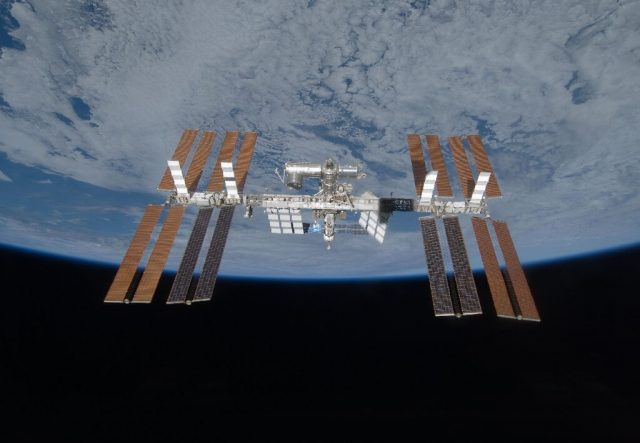
Scientists have observed the fifth state of matter in space for the first time, offering unprecedented insight that could help solve some of the quantum universe's most intractable conundrums, research showed Thursday.
Bose-Einstein condensates (BECs)—the existence of which was predicted...
Electrons are very much at the mercy of magnetic fields, which scientists can manipulate to control the electrons and their angular momentum—i.e. their "spin."
A Cornell team led by Greg Fuchs, assistant professor of applied and engineering physics in the...
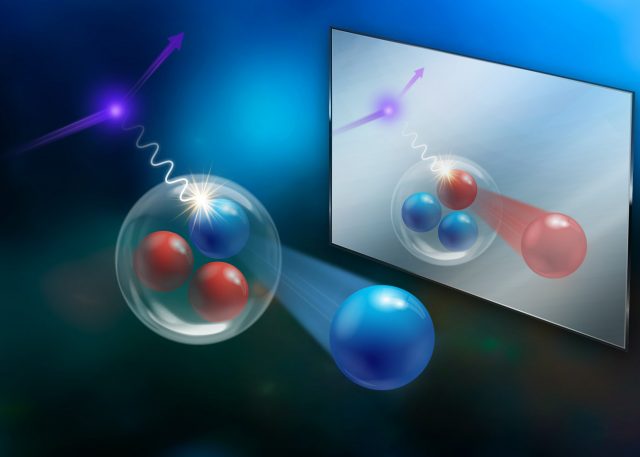
It's not often in nuclear physics that you can clearly get both sides of the story, but a recent experiment allowed researchers to do just that. They compared very similar nuclei to each other to get a clearer view...
The charge of a single electron, e, is defined as the basic unit of electric charge. Because electrons—the subatomic particles that carry electricity—are elementary particles and cannot be split, fractions of electronic charge are not normally encountered. Despite this,...

A new research paper co-authored by a Virginia Tech assistant professor of physics provides a new explanation for two recent strange events that occurred in Antarctica—high-energy neutrinos appearing to come up out of the Earth on their own accord...

A team of Brown University physicists has developed a new type of compact, ultra-sensitive magnetometer. The new device could be useful in a variety of applications involving weak magnetic fields, the researchers say.
"Nearly everything around us generates a magnetic field—from...

When stars explode as supernovas, they produce shock waves in the plasma surrounding them. So powerful are these shock waves, they can act as particle accelerators that blast streams of particles, called cosmic rays, out into the universe at...

Researchers from the Moscow Institute of Physics and Technology, joined by a colleague from Argonne National Laboratory, U.S., have implemented an advanced quantum algorithm for measuring physical quantities using simple optical tools. Published in Scientific Reports, their study takes us...

Researchers at UC Santa Cruz have developed a theoretical foundation and new computational tools for predicting a material's spin dynamics, a key property for building solid-state quantum computing platforms and other applications of spintronics.
Spin is a fundamental property of...


