



Physicists at MIT have designed a quantum "light squeezer" that reduces quantum noise in an incoming laser beam by 15 percent. It is the first system of its kind to work at room temperature, making it amenable to a...

Researchers at CRANN and Trinity's School of Physics have created an innovative new device that will emit single particles of light, or photons, from quantum dots that are the key to practical quantum computers, quantum communications, and other quantum...

It images single atoms. It maps atomic-scale hills and valleys on metal and insulating surfaces. And it records the flow of current across atom-thin materials subject to giant magnetic fields. Scientists at the National Institute of Standards and Technology...

What makes ships mysteriously slow down or even stop as they travel, even though their engines are working properly? This was first observed in 1893 and was described experimentally in 1904 without all the secrets of this 'dead water'...

Last year, Google produced a 53-qubit quantum computer that could perform a specific calculation significantly faster than the world's fastest supercomputer. Like most of today's largest quantum computers, this system boasts tens of qubits—the quantum counterparts to bits, which...

Scientists have made a pivotal breakthrough in the important, emerging field of spintronics—which could lead to a new high speed energy efficient data technology.
An international team of researchers, including the University of Exeter, has made a revolutionary discovery that...

In a paper that made the cover of the journal Applied Physics Letters, an international team of researchers has demonstrated an innovative technique for increasing the intensity of lasers. This approach, based on the compression of light pulses, would make...

A team of researchers from the Technion – Israel Institute of Technology has observed branched flow of light for the very first time. The findings are published in Nature and are featured on the cover of the July 2, 2020 issue.
The...
The universe, as seen through the lens of quantum mechanics, is a noisy, crackling space where particles blink constantly in and out of existence, creating a background of quantum noise whose effects are normally far too subtle to detect...
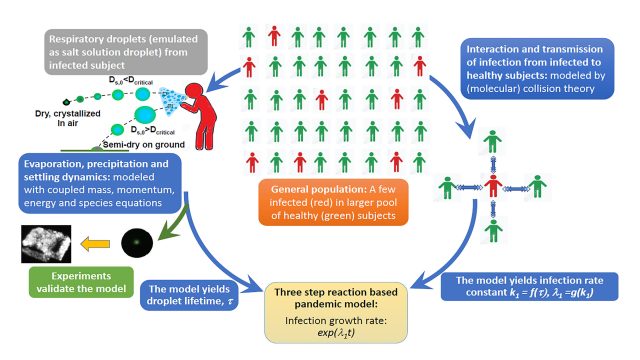
It is well established that the SARS-CoV-2 virus responsible for the COVID-19 disease is transmitted via respiratory droplets that infected people eject when they cough, sneeze or talk. Consequently, much research targets better understanding droplet motion and evaporation to...

Currently, there are no specific guidelines on the most effective materials and designs for facemasks to minimize the spread of droplets from coughs or sneezes to mitigate the transmission of COVID-19. While there have been prior studies on how...


