



Things can always be done faster, but can anything beat light? Computing with light instead of electricity is seen as a breakthrough to boost computer speeds. Transistors, the building blocks of data circuits, are required to switch electrical signals...
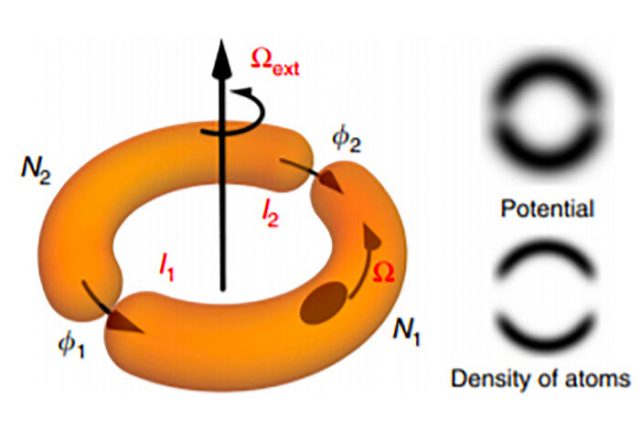
A new device that relies on flowing clouds of ultracold atoms promises potential tests of the intersection between the weirdness of the quantum world and the familiarity of the macroscopic world we experience every day. The atomtronic Superconducting QUantum...

In a breakthrough for physics and engineering, researchers from the Photonics Initiative at the Advanced Science Research Center at The Graduate Center, CUNY (CUNY ASRC) and from Georgia Tech have presented the first demonstration of topological order based on...

Researchers at Columbia Engineering and Montana State University report today that they have found that placing sufficient strain in a 2-D material—tungsten diselenide (WSe2)—creates localized states that can yield single-photon emitters. Using sophisticated optical microscopy techniques developed at Columbia...

Researchers from the Peter the Great St.Petersburg Polytechnic University (SPbPU) have discovered and theoretically explained a new physical effect: amplitude of mechanical vibrations can grow without external influence. The scientific group offered their explanation on how to eliminate the...

Physicists at the Max Planck Institute of Quantum Optics (MPQ) have engineered the lightest optical mirror imaginable. The novel metamaterial is made of a single structured layer that consists only of a few hundred identical atoms. The atoms are...

Terahertz radiation, or T-rays, has barely been exploited compared to most of the rest of the electromagnetic spectrum. Yet T-rays potentially have applications in next-generation wireless communications (6G/7G), security systems, biomedicine, and even art history. A new device for...

Electrons can interfere in the same manner as water, acoustical or light waves do. When exploited in solid-state materials, such effects promise novel functionality for electronic devices, in which elements such as interferometers, lenses or collimators could be integrated...

New ground-breaking research from the University of Surrey could change the way scientists understand and describe lasers—establishing a new relationship between classical and quantum physics.
In a comprehensive study published by the journal Progress in Quantum Electronics, a researcher from Surrey,...

In a new study, a group of researchers led by Prof. Lior Klein, from the physics department and the Institute of Nanotechnology and Advanced Materials at Bar-Ilan University, has shown that relatively simple structures can support an exponential number...

Aside from the deep understanding of the natural world that quantum physics theory offers, scientists worldwide are striving to bring forth a technological revolution by leveraging this newfound knowledge in engineering applications. Spintronics is an emerging field that aims...


