



Researchers at CRANN and Trinity's School of Physics have discovered that a new material can act as a super-fast magnetic switch.
When struck by successive ultra-short laser pulses it exhibits "toggle switching" that could increase the capacity of the global...

An infinite chain of hydrogen atoms is just about the simplest bulk material imaginable—a never-ending single-file line of protons surrounded by electrons. Yet a new computational study combining four cutting-edge methods finds that the modest material boasts fantastic and...

Scientists have discovered an elegant way of manipulating light using a 'synthetic' Lorentz force—which in nature is responsible for many fascinating phenomena including the Aurora Borealis.
A team of theoretical physicists from the University of Exeter has pioneered a new...

There they were, in all their weird quantum glory: ultracold lithium atoms in the optical trap operated by UC Santa Barbara undergraduate student Alec Cao and his colleagues in David Weld's atomic physics group. Held by lasers in a...

Mechanical engineers at Duke University have demonstrated a set of prototypes for manipulating particles and cells in a Petri dish using sound waves. The devices, known in the scientific community as "acoustic tweezers," are the first foray into making...

Dense metallic hydrogen—a phase of hydrogen which behaves like an electrical conductor—makes up the interior of giant planets, but it is difficult to study and poorly understood. By combining artificial intelligence and quantum mechanics, researchers have found how hydrogen...

Like a comic book come to life, researchers at Stanford University have developed a kind of X-ray vision—only without the X-rays. Working with hardware similar to what enables autonomous cars to "see" the world around them, the researchers enhanced...
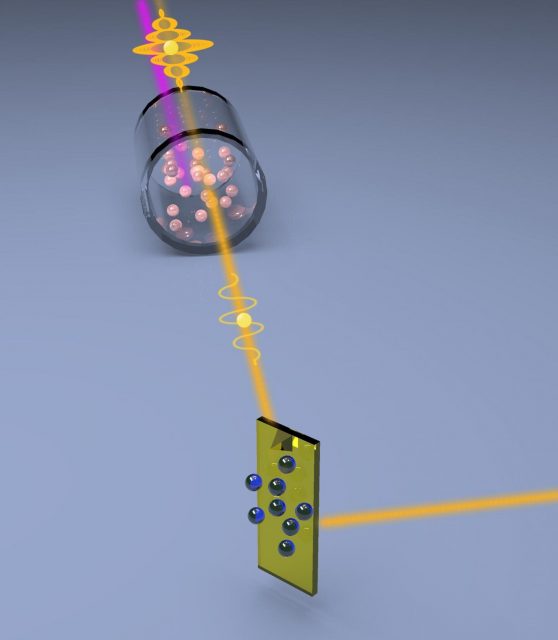
Researchers at the Department of Energy's Oak Ridge National Laboratory used quantum optics to advance state-of-the-art microscopy and illuminate a path to detecting material properties with greater sensitivity than is possible with traditional tools.
"We showed how to use squeezed...
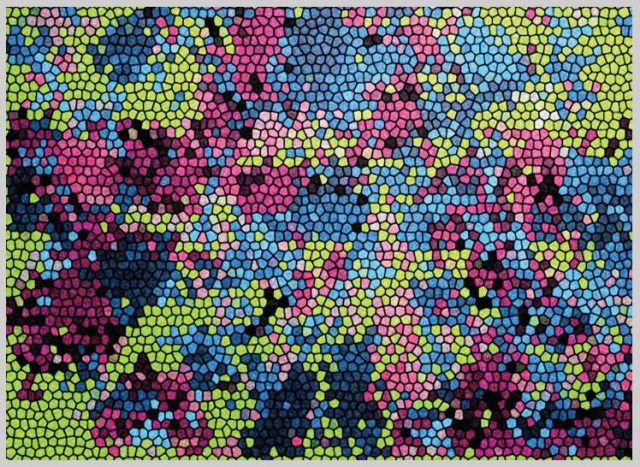
Glass is amorphous in nature—its atomic structure does not involve the repetitive arrangement seen in crystalline materials. But occasionally, it undergoes a process called devitrification, which is the transformation of a glass into a crystal—often an unwanted process in...
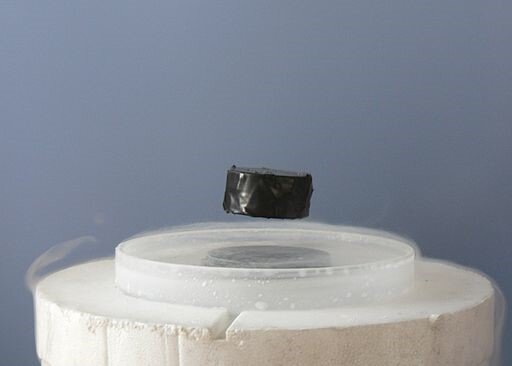
A researcher at the University of Tsukuba has offered a new explanation for how superconductors exposed to a magnetic field can recover, without loss of energy, to their previous state after the field is removed. This work may lead...

Nine seconds. An eternity in some scientific experiments; an unimaginably small amount in the grand scheme of the universe. And just long enough to confound nuclear physicists studying the lifetime of the neutron.
The neutron is one of the building blocks of...


