



Applying a temperature gradient and a charge current to an electrical conductor leads to the release and absorbtion of heat. This is called the Thomson effect. In a first, NIMS and AIST have directly observing the magneto-Thomson effect, which...

A team of University of Arkansas physicists has successfully developed a circuit capable of capturing graphene's thermal motion and converting it into an electrical current.
"An energy-harvesting circuit based on graphene could be incorporated into a chip to provide clean, limitless, low-voltage...

Einstein's theory of general relativity—the idea that gravity is matter warping spacetime—has withstood over 100 years of scrutiny and testing, including the newest test from the Event Horizon Telescope collaboration, published today in the latest issue of Physical Review Letters.
According...
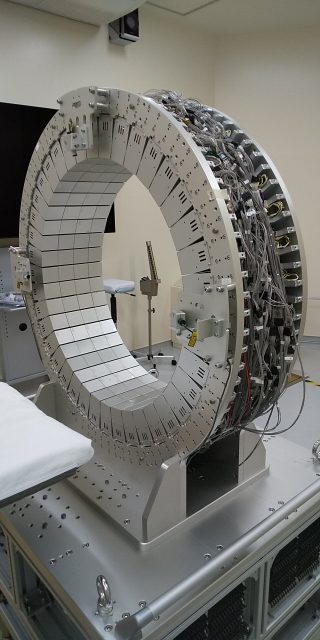
Experts in Japan have devised a simple way to glean more detailed information out of standard medical imaging scans. A research team made up of atomic physicists and nuclear medicine experts at the University of Tokyo and the National...

When the brightness of the star Betelgeuse dropped dramatically a few months ago, some observers suspected an impending supernova—a stellar explosion that could also cause damage on Earth. While Betelgeuse has returned to normal, physicists from the Technical University...
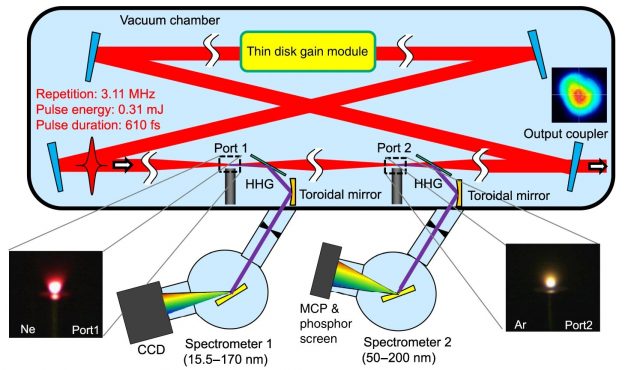
Researchers have established a novel high-frequency laser facility at the University of Tokyo. The coherent extreme ultraviolet light source can reveal details of biological or physical samples with unprecedented clarity. It also allows for investigation of time-dependent phenomena such...

Physicists at Aalto University and VTT Technical Research Center of Finland have developed a new detector for measuring energy quanta at unprecedented resolution. This discovery could help bring quantum computing out of the laboratory and into real-world applications. The...

Gravitational wave detectors have opened a new window to the universe by measuring the ripples in spacetime produced by colliding black holes and neutron stars, but they are ultimately limited by quantum fluctuations induced by light reflecting off of...
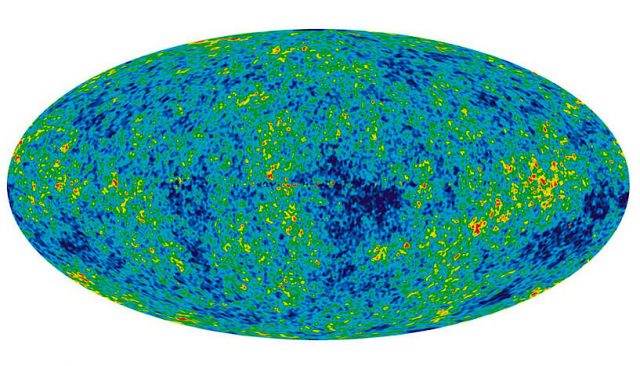
Gravity can accelerate the homogenization of space-time as the universe evolves. This insight is based on theoretical studies of the physicist David Fajman of the University of Vienna. The mathematical methods developed within the research project allow to investigate...

UO researchers have discovered that molecules in glass materials behave just like particles in sand and rocks as they jam together, a mechanism that could boost explorations of condensed matter and complex systems.
The work shows that glassy materials change their organizational...
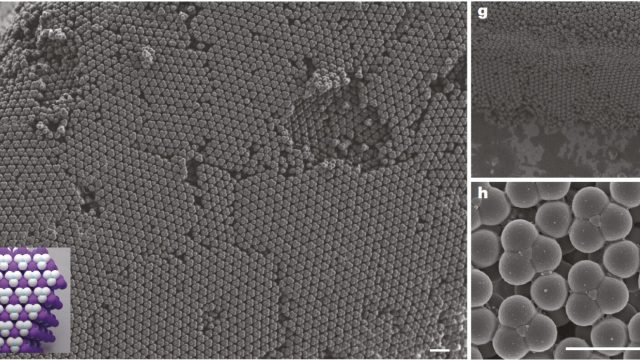
The colloidal diamond has been a dream of researchers since the 1990s. These structures—stable, self-assembled formations of miniscule materials—have the potential to make light waves as useful as electrons in computing, and hold promise for a host of other...


