



Almost all truly intriguing systems are ones that are far away from equilibrium—such as stars, planetary atmospheres, and even digital circuits. But, until now, systems far from thermal equilibrium couldn't be analyzed with conventional thermodynamics and statistical physics.
When physicists...

Bristol researchers have developed a tiny device that paves the way for higher performance quantum computers and quantum communications, making them significantly faster than the current state-of-the-art.
Researchers from the University of Bristol's Quantum Engineering Technology Labs (QET Labs) and...

Superconductivity is a phenomenon in which an electric circuit loses its resistance and becomes extremely efficient under certain conditions. There are different ways in which this can happen, which were thought to be incompatible. For the first time, researchers...

Physicists at CERN's Large Hadron Collider (LHC) are on the hunt for physics phenomena beyond the standard model. Some theories predict an as-yet undiscovered particle could be found in the form of a new resonance (a narrow peak) similar...

Researchers at the University of Rochester and Cornell University have taken an important step toward developing a communications network that exchanges information across long distances by using photons, mass-less measures of light that are key elements of quantum computing...

The ongoing COVID-19 pandemic has led many researchers to study airborne droplet transmission in different conditions and environments. The latest studies are starting to incorporate important aspects of fluid physics to deepen our understanding of viral transmission.
In a new...

Researchers at MIT and the University of Waterloo have developed a high-power, portable version of a device called a quantum cascade laser, which can generate terahertz radiation outside of a laboratory setting. The laser could potentially be used in...

Systems which can emit a stream of single photons, referred to as quantum light sources, are critical hardware components for emerging technologies such as quantum computing, the quantum internet, and quantum communications.
In many cases the ability to generate quantum...

When atoms get extremely close, they develop intriguing interactions that could be harnessed to create new generations of computing and other technologies. These interactions in the realm of quantum physics have proven difficult to study experimentally due the basic...
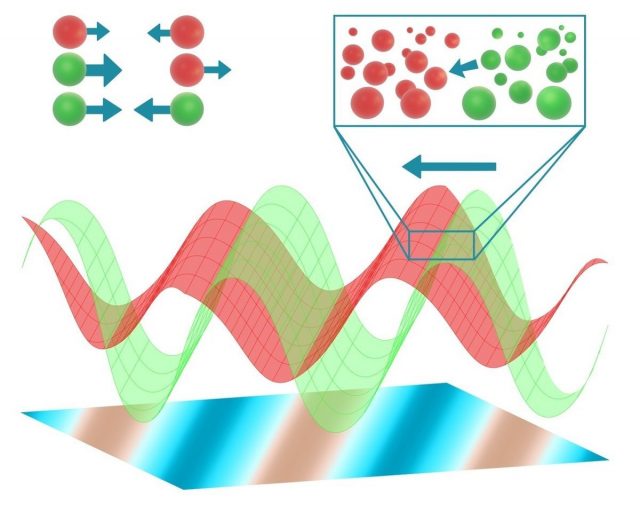
At first glance, a pack of wolves has little to do with a vinaigrette. However, a team led by Ramin Golestanian, Director at the Max Planck Institute for Dynamics and Self-Organization, has developed a model that establishes a link...

A limiting factor in modern physics experiments is the precision at which scientists can measure important values, such as the magnetic field within a detector. Scientists at the U.S. Department of Energy's (DOE) Argonne National Laboratory and their collaborators...


