


Researchers have found a way to protect highly fragile quantum systems from noise, which could aid in the design and development of new quantum devices, such as ultra-powerful quantum computers.
The researchers, from the University of Cambridge, have shown that...

Water vapor from ambient air will spontaneously condense inside porous materials or between touching surfaces. But with the liquid layer being only a few molecules thick, this phenomenon has lacked understanding, until now.
Researchers at the University of Manchester led...

One of the chief obstacles facing quantum computer designers—correcting the errors that creep into a processor's calculations—could be overcome with a new approach by physicists from the National Institute of Standards and Technology (NIST), the University of Maryland and...
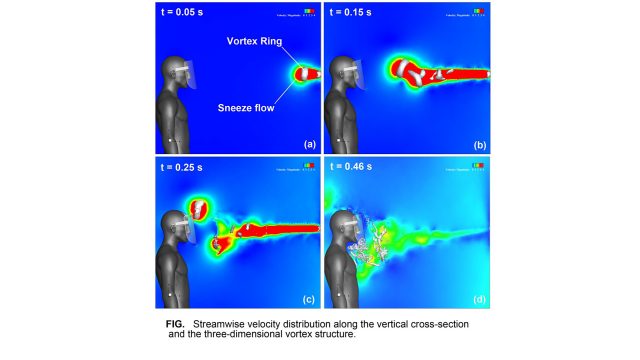
Do face shields provide enough protection to the wearers against COVID-19 if they don't also wear a mask? Spoiler alert: no. But researchers at Fukuoka University in Japan are working to create face shields safe enough to be worn...

Researchers at Oregon State University are making key advances with a new type of optical sensor that more closely mimics the human eye's ability to perceive changes in its visual field.
The sensor is a major breakthrough for fields such...

In groundbreaking new research, an international team of researchers led by the University of Minnesota Twin Cities has developed a unique process for producing a quantum state that is part light and part matter.
The discovery provides fundamental new insights...
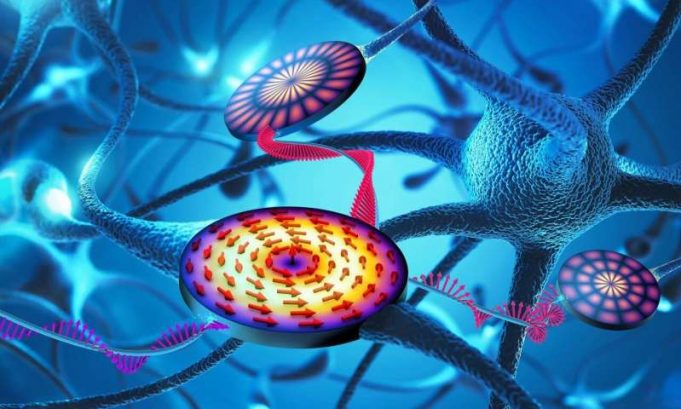
Neural networks are some of the most important tools in artificial intelligence (AI): they mimic the operation of the human brain and can reliably recognize texts, language and images, to name but a few. So far, they run on...

A new study of airflow patterns inside a car's passenger cabin offers some suggestions for potentially reducing the risk of COVID-19 transmission while sharing rides with others.
The study, by a team of Brown University researchers, used computer models to...

The DUNE collaboration has published their first scientific paper based on data collected with the ProtoDUNE single-phase detector located at CERN's Neutrino Platform. The results show that the detector is performing with greater than 99% efficiency, making it not...
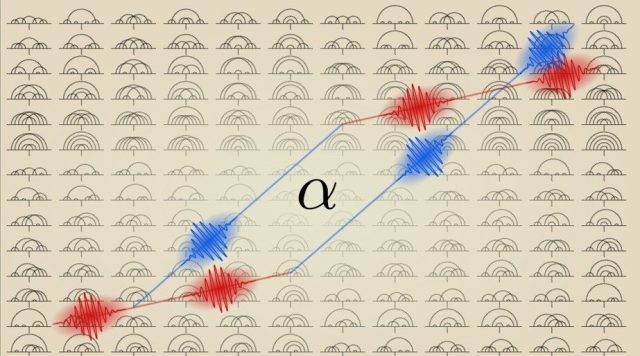
The validation and application of theories in physics require the measurement of universal values known as fundamental constants.
A team of French researchers has just conducted the most accurate measurement to date of the fine-structure constant, which characterizes the strength of interaction...

Computer simulations have struggled to capture the impact of elusive particles called neutrinos on the formation and growth of the large-scale structure of the Universe. But now, a research team from Japan has developed a method that overcomes this...


