



Researchers have identified a new form of magnetism in so-called magnetic graphene, which could point the way toward understanding superconductivity in this unusual type of material.
The researchers, led by the University of Cambridge, were able to control the conductivity...

Scientists from MIPT (Moscow Institute of Physics and Technology), Moscow Pedagogical State University and the University of Manchester have created a highly sensitive terahertz detector based on the effect of quantum-mechanical tunneling in graphene. The sensitivity of the device...

A new type of quantum holography which uses entangled photons to overcome the limitations of conventional holographic approaches could lead to improved medical imaging and speed the advance of quantum information science.
A team of physicists from the University of...

New study found that electrons can reach ultra-relativistic energies for very special conditions in the magnetosphere when space is devoid of plasma.
Recent measurements from NASA's Van Allen Probes spacecraft showed that electrons can reach ultra-relativistic energies flying at almost...
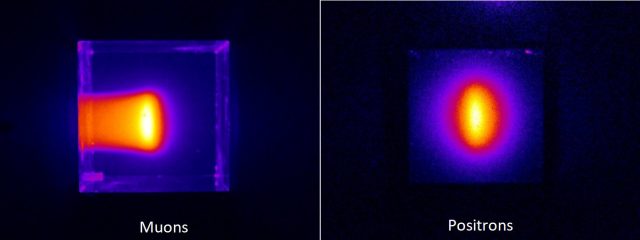
A new technique has taken the first images of muon particle beams. Nagoya University scientists designed the imaging technique with colleagues in Osaka University and KEK, Japan and describe it in the journal Scientific Reports. They plan to use it...

Scientists have revealed new insights into the behaviour of black holes with research that demonstrates how a phenomenon called backreaction can be simulated.
The team from the University of Nottingham have used their simulation of a black hole, involving a...

A calculation so complex that it takes twenty years to complete on a powerful desktop computer can now be done in one hour on a regular laptop. Physicist Andreas Ekström at Chalmers University of Technology, together with international research...

Scientists have given a fascinating new insight into the next steps to develop fast, energy-efficient, future computing systems that use light instead of electrons to process and store information—incorporating hardware inspired directly by the functioning of the human brain.
A...

Researchers at the University of Basel and Ruhr University Bochum have developed a source of single photons that can produce billions of these quantum particles per second. With its record-breaking efficiency, the photon source represents a new and powerful...

Carbon, the fourth most abundant element in the universe, is a building block for all known life and a material that sits in the interior of carbon-rich exoplanets.
Decades of intense investigation by scientists have shown that carbon's crystal structure...

Despite all the advances in consumer technology over the past decades, one component has remained frustratingly stagnant: the optical lens. Unlike electronic devices, which have gotten smaller and more efficient over the years, the design and underlying physics of...


