



An international team of scientists has discovered a new, exotic form of insulating material with a metallic surface that could enable more efficient electronics or even quantum computing. The researchers developed a new method for analyzing existing chemical compounds...

Swimming bacteria can reduce the viscosity of ordinary liquids like water and make them flow more easily, sometimes down to the point where the viscosity becomes zero: the flow is then frictionless.
Now researchers from the University of Bristol report...
Cyberattacks may become impossible with the creation of the first practical quantum random number generator.
Patented by Quantum Base and Lancaster University, it will provide 100% provable quantum security for authentication and communication when integrated in microelectronic products.
Chosen for inclusion...
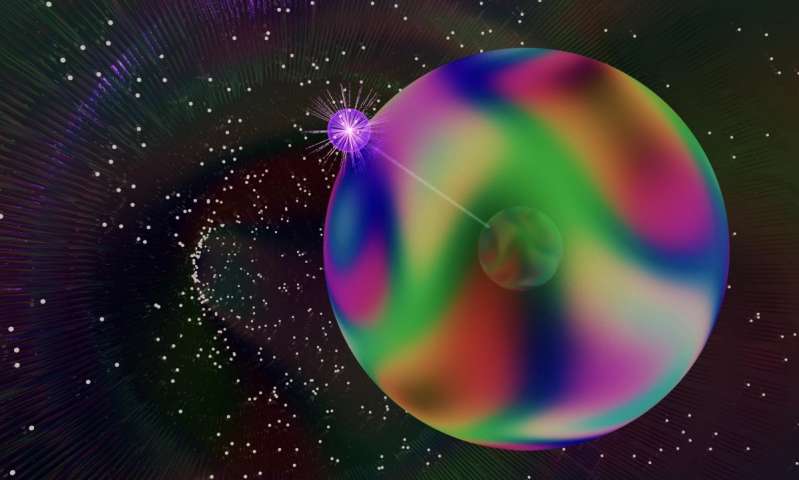
Magnets, whether in the form of a bar, horseshoe or electromagnet, always have two poles. If you break a magnet in half, you'll end up with two new magnets, each with its own magnetic north and south.
But some physics...

A discovery by scientists at the Department of Energy's Oak Ridge National Laboratory supports a century-old theory by Albert Einstein that explains how heat moves through everything from travel mugs to engine parts.
The transfer of heat is fundamental to...
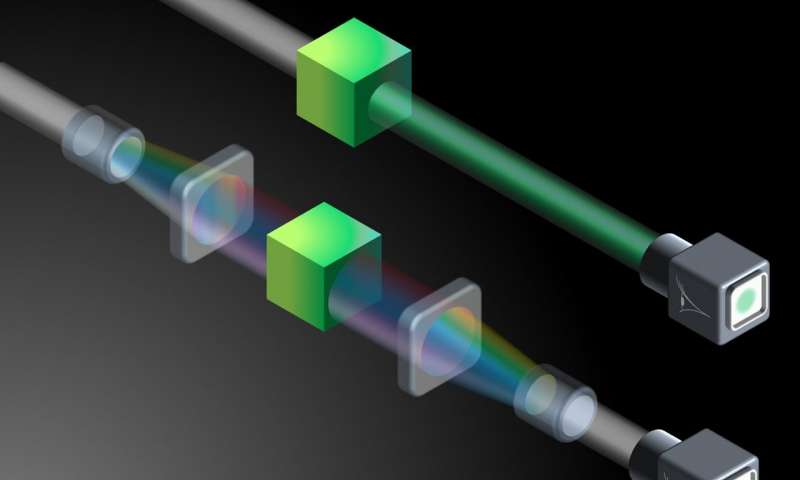
Researchers and engineers have long sought ways to conceal objects by manipulating how light interacts with them. A new study offers the first demonstration of invisibility cloaking based on the manipulation of the frequency (color) of light waves as...
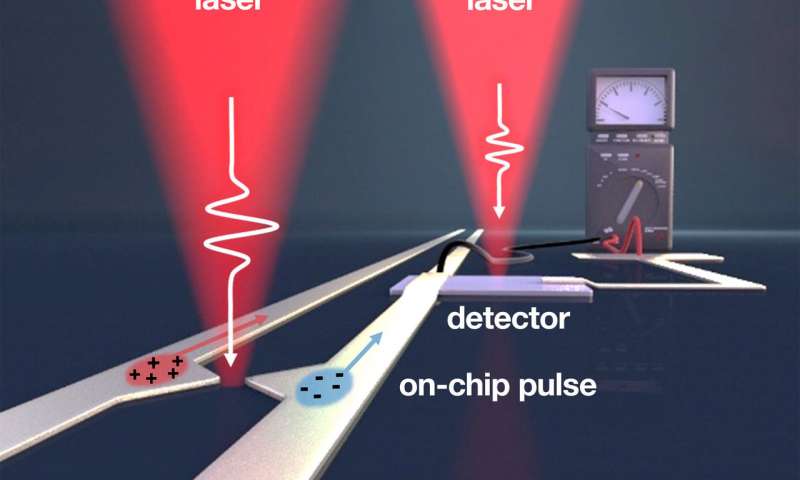
A team headed by the TUM physicists Alexander Holleitner and Reinhard Kienberger has succeeded for the first time in generating ultrashort electric pulses on a chip using metal antennas only a few nanometers in size, then running the signals...
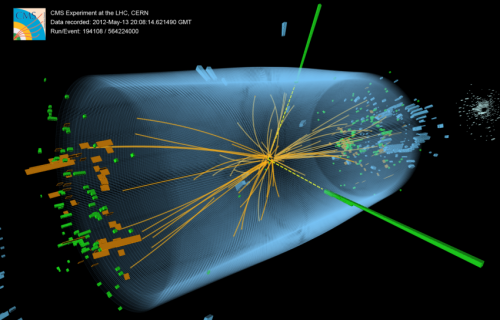
Physicists at the University of Bonn have succeeded in putting a superconducting gas into an exotic state. Their experiments allow new insights into the properties of the Higgs particle, but also into fundamental characteristics of superconductors. The publication, which...

Harvard University researchers are using physics to solve one of the biggest challenges in designing light-weight, long-lasting batteries: how to squeeze more energy into less space.
Researchers from the Harvard John A. Paulson School of Engineering and Applied Sciences (SEAS)...

It took nearly a century of trial and error for human scientists to organize the periodic table of elements, arguably one of the greatest scientific achievements in chemistry, into its current form.
A new artificial intelligence (AI) program developed by...

In the past experimentation round Wendelstein 7-X achieved higher temperatures and densities of the plasma, longer pulses and the stellarator world record for the fusion product. Moreover, first confirmation for the optimisation concept on which Wendelstein 7-X is based,...


