



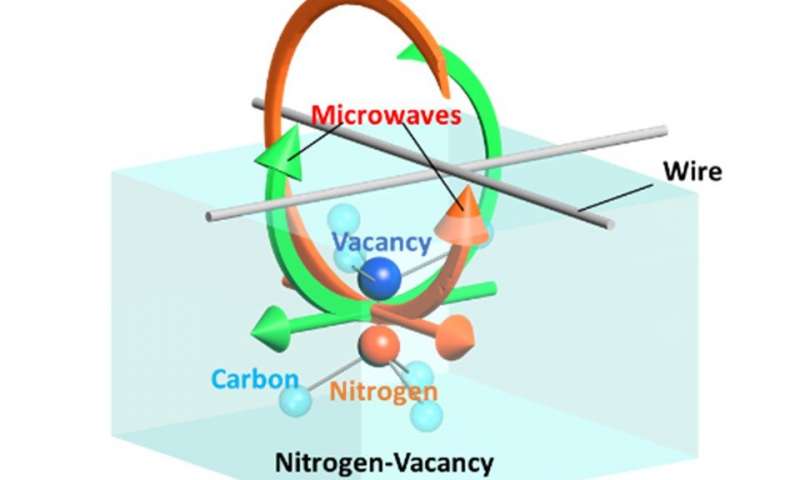
Researchers have demonstrated holonomic quantum gates under zero-magnetic field at room temperature, which could enable the realization of fast and fault-tolerant universal quantum computers.
A quantum computer is a theoretical machine with the potential to solve complex problems much faster...

Yale-NUS Associate Professor of Science (Physics) Shaffique Adam is the lead author of a recent work that describes a model for electron interaction in Dirac materials, a class of materials that includes graphene and topological insulators, solving a 65-year-old...
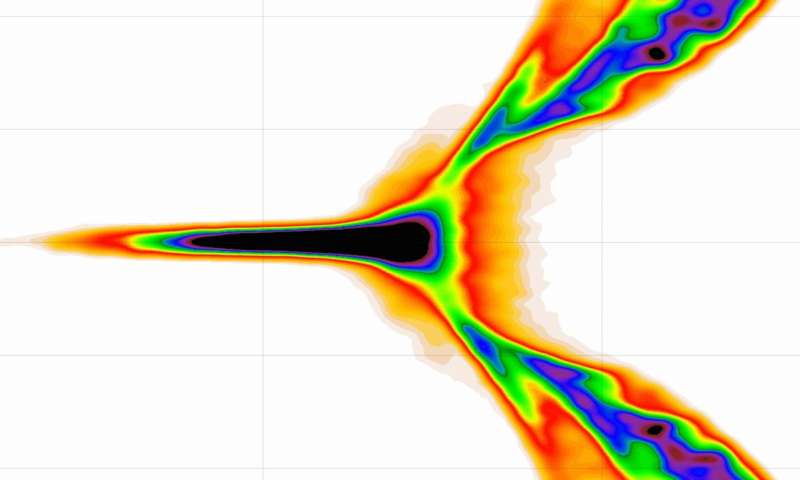
Researchers have found a way to accelerate antimatter in a 1000x smaller space than current accelerators, boosting the science of exotic particles.
The new method could be used to probe more mysteries of physics, like the properties of the Higgs...

An everyday occurrence spotted when we turn on the tap to brush our teeth has baffled engineers for centuries—why does the water splay when it hits the sink before it heads down the plughole?
Famous inventor and painter Leonardo da...

Relief may be on the horizon for anyone who has ever jumped around a room like a jack-in-the-box to get motion-sensing lights to turn back on, thanks to a new motion sensor based on metamaterials that is sensitive enough...

Topology is a global aspect of materials, leading to fundamental new properties for compounds with large relativistic effects. The incorporation of heavy elements gives rise to non-trivial topological phases of matter, such as topological insulators, Dirac and Weyl semimetals....
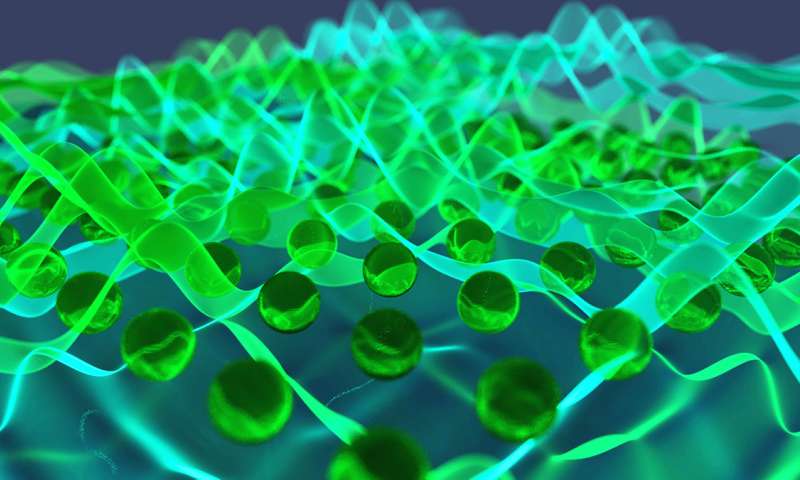
State-of-the-art quantum devices are not yet large enough to be called full-scale computers. The biggest comprise just a few dozen qubits—a meager count compared to the billions of bits in an ordinary computer's memory. But steady progress means that...
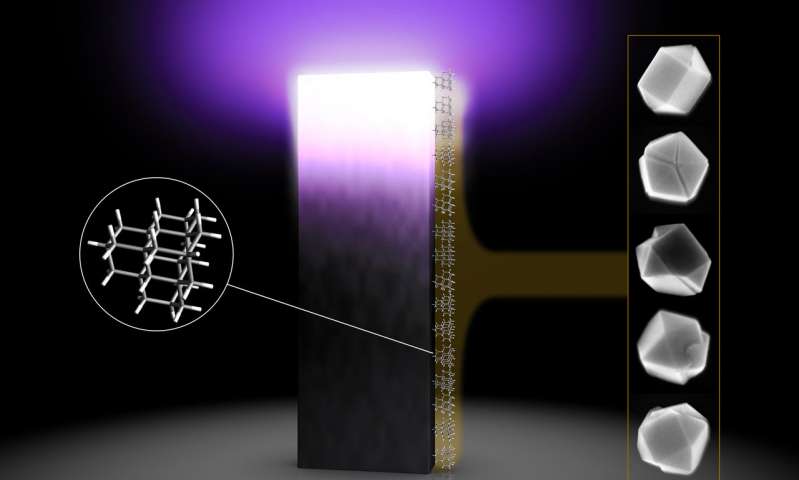
Natural diamond is forged by tremendous pressures and temperatures deep underground. But synthetic diamond can be grown by nucleation, where tiny bits of diamond "seed" the growth of bigger diamond crystals. The same thing happens in clouds, where particles...

Scientists at the Florida State University-headquartered National High Magnetic Field Laboratory have discovered a behavior in materials called cuprates that suggests they carry current in a way entirely different from conventional metals such as copper.
The research, published today in...

A research collaboration including theoretical physicists from the University of Bristol and Birmingham has found a new way of evaluating how light flows through space—by tying knots in it.
Laser light may appear to be a single, tightly focused beam....

A UCF physicist has discovered a new material that has the potential to become a building block in the new era of quantum materials, those that are composed of microscopically condensed matter and expected to change our development of...


