



Last year, physicists at MIT, the University of Vienna, and elsewhere provided strong support for quantum entanglement, the seemingly far-out idea that two particles, no matter how distant from each other in space and time, can be inextricably linked,...

The transition from light bulbs to LEDs has drastically cut the amount of electricity we use for lighting. Most of the electricity consumed by incandescent bulbs was, after all, dissipated as heat. We may now be on the verge...

How Einstein's equivalence principle extends to the quantum world has been puzzling physicists for decades, but a team including a University of Queensland researcher has found the key to this question.
UQ physicist, Dr. Magdalena Zych from the ARC Centre...

For ants and robots operating in confined spaces like tunnels, having more workers does not necessarily mean getting more work done. Just as too many cooks in a kitchen get in each other's way, having too many robots in...
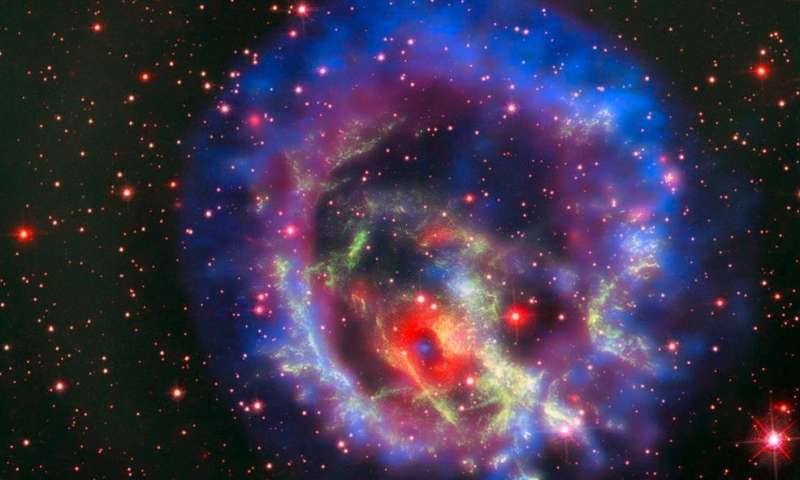
According to University of Illinois physicist Douglas H. Beck, "Neutrons play some unusual roles in our world. Free neutrons decay in about 900 s but, bound in nuclei, they are stable and make up somewhat more than half the...

Nanosized magnetic particles called skyrmions are considered highly promising candidates for new data storage and information technologies. Now, physicists have revealed new behavior involving the antiparticle equivalent of skyrmions in a ferromagnetic material. The researchers demonstrated their findings using...

A new uncertainty relation, linking the precision with which temperature can be measured and quantum mechanics, has been discovered at the University of Exeter.
If you measure the temperature of your coffee with a standard over-the counter thermometer you may...

A kiwi physicist has discovered the energy difference between two quantum states in the helium atom with unprecedented accuracy, a ground-breaking discovery that contributes to our understanding of the universe and space-time and rivals the work of the world's...

Neutron stars are the smallest, densest stars in the universe, born out of the gravitational collapse of extremely massive stars. True to their name, neutron stars are composed almost entirely of neutrons—neutral subatomic particles that have been compressed into...
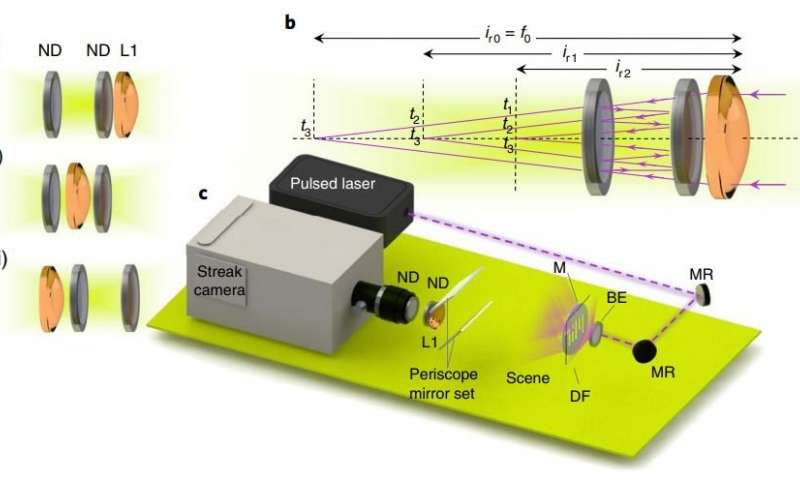
MIT researchers have developed novel photography optics that capture images based on the timing of reflecting light inside the optics, instead of the traditional approach that relies on the arrangement of optical components. These new principles, the researchers say,...

A study exploring the coupling between heat and particle currents in a gas of strongly interacting atoms highlights the fundamental role of quantum correlations in transport phenomena, breaks the Wiedemann-Franz law, and should open up an experimental route to...


