



The quantum computers of the future will be able to perform computations that cannot be done on today's computers. These may likely include the ability to crack the encryption that is currently used for secure electronic transactions, as well...

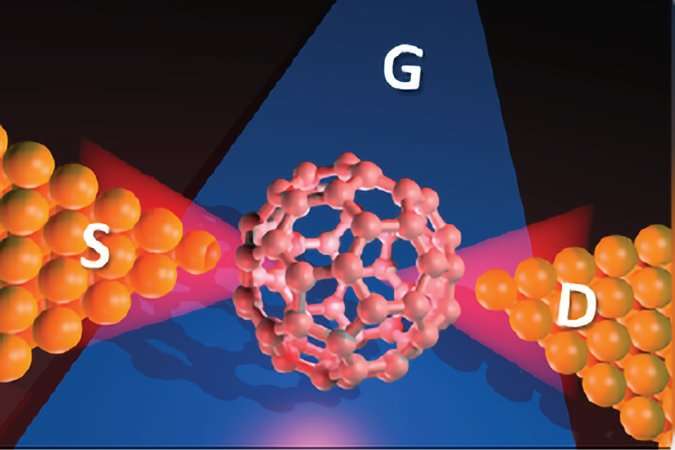
Rice University atomic physicists have verified a key prediction from a 55-year-old theory about one-dimensional electronics that is increasingly relevant thanks to Silicon Valley's inexorable quest for miniaturization.
"Chipmakers have been shrinking feature sizes on microchips for decades, and device...
The interaction of light with matter is the basis of spectroscopy, a set of techniques lying at the heart of physics and chemistry. From infrared light to X-rays, a broad sweep of wavelengths is used to stimulate vibrations, electron...

The "chicken or egg" paradox was first proposed by philosophers in Ancient Greece to describe the problem of determining cause-and-effect.
Now, a team of physicists from The University of Queensland and the NÉEL Institute has shown that, as far as...
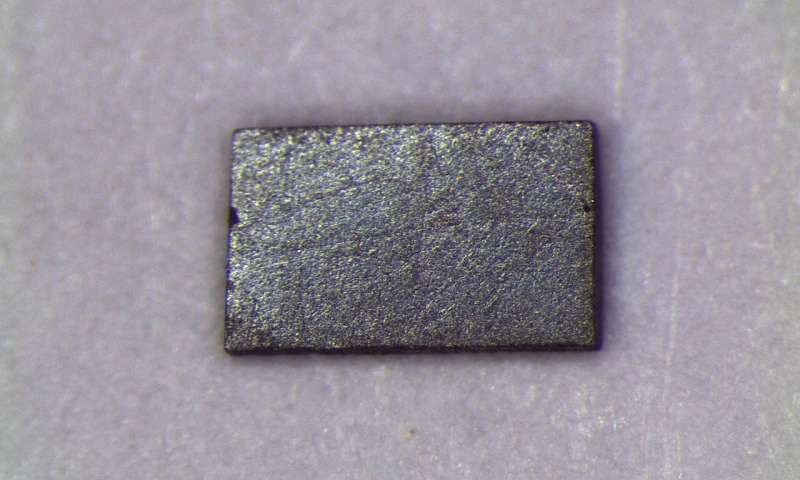
Quantum materials are a type of odd substance that could be many times more efficient at conducting electricity through our iPhones than the commonly used conductor silicon—if only physicists can crack how the stuff works.
A University of Michigan physicist...

A wearable energy-harvesting device could generate energy from the swing of an arm while walking or jogging, according to a team of researchers from Penn State's Materials Research Institute and the University of Utah. The device, about the size...

What is dark matter? How do supermassive black holes form? Primordial black holes might hold the answer to this longstanding question. Leiden and Chinese cosmologists have identified a new way in which these hypothetical objects could be produced immediately...

Early in the morning on Saturday, 26 May 2018, the AWAKE collaboration at CERN successfully accelerated electrons for the first time using a wakefield generated by protons zipping through a plasma. A paper describing this important result was published...

Six years after its discovery, the Higgs boson has at last been observed decaying to fundamental particles known as bottom quarks. The finding, presented today at CERN1 by the ATLAS and CMS collaborations at the Large Hadron Collider (LHC),...
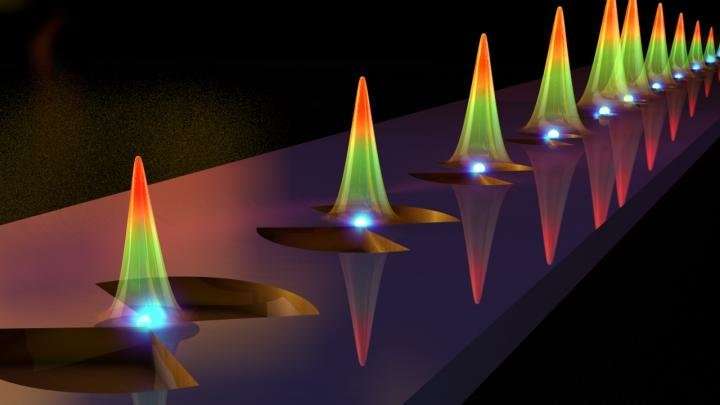
Running computers on virtually invisible beams of light rather than microelectronics would make them faster, lighter and more energy efficient. A version of that technology already exists in fiber optic cables, but they're much too large to be practical...
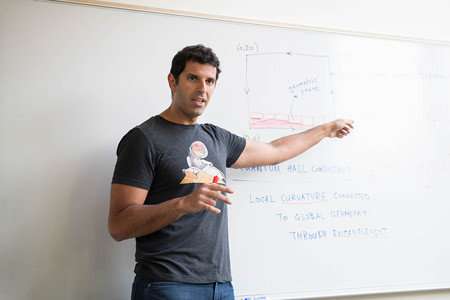
Spiros Michalakis, manager of outreach and staff researcher at Caltech's Institute for Quantum Information and Matter (IQIM), and Matthew Hastings, a researcher at Microsoft, have solved one of the world's most challenging open problems in the field of mathematical...


