



Quantum particles can be difficult to characterize, and almost impossible to control if they strongly interact with each other—until now.
An international team of researchers led by Princeton physicist Zahid Hasan has discovered a quantum state of matter that can...

A team of international scientists including Maia G. Vergniory, Ikerbasque researcher at DIPC and UPV/EHU associate, has discovered a new class of materials, higher-order topological insulators. Theoretical physicists first predicted the existence of these insulators, which have conducting properties...
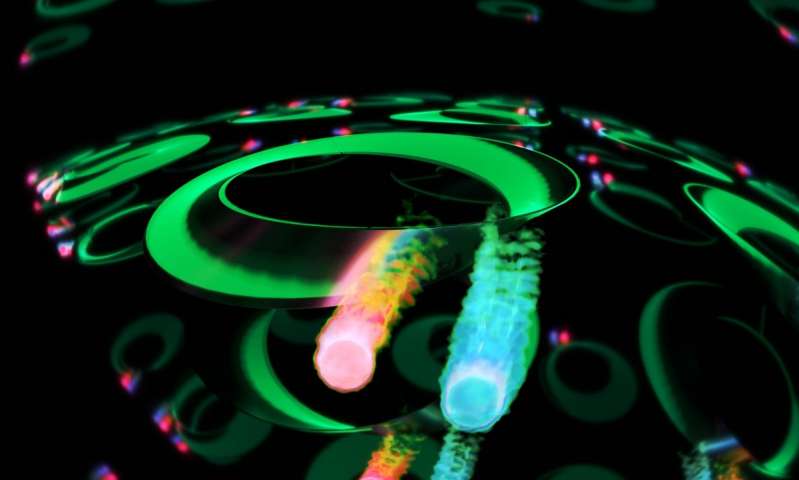
The smallest amount of light you can have is one photon, so dim that it's pretty much invisible to humans. While imperceptible, these tiny blips of energy are useful for carrying quantum information around. Ideally, every quantum courier would...

Fusion, the power that drives the sun and stars, produces massive amounts of energy. Scientists here on Earth seek to replicate this process, which merges light elements in the form of hot, charged plasma composed of free electrons and...

A system made of just a handful of particles acts just like larger systems, allowing scientists to study quantum behaviour more easily.
Most substances physicists study are made up of huge numbers of particles—so large that there is essentially no...
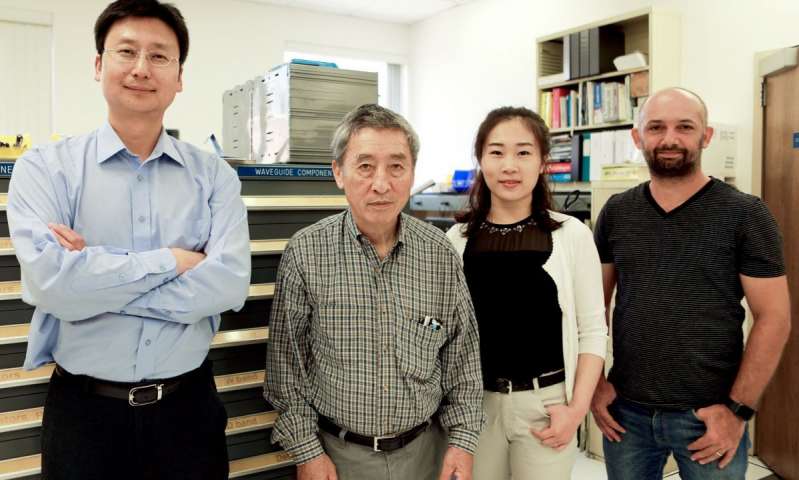
UCLA Samueli engineers have developed a new tool to model how magnetic materials, which are used in smartphones and other communications devices, interact with incoming radio signals that carry data. It accurately predicts these interactions down to the nanometer...

The seemingly random digits known as prime numbers are not nearly as scattershot as previously thought. A new analysis by Princeton University researchers has uncovered patterns in primes that are similar to those found in the positions of atoms...

Nearly 150 years ago, the physicist James Maxwell proposed that a circular lens that is thickest at its center, and that gradually thins out at its edges, should exhibit some fascinating optical behavior. Namely, when light is shone through...
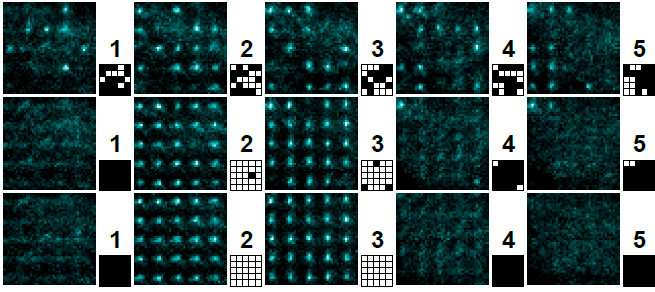
Reduced entropy in a three-dimensional lattice of super-cooled, laser-trapped atoms could help speed progress toward creating quantum computers. A team of researchers at Penn State can rearrange a randomly distributed array of atoms into neatly organized blocks, thus performing...

Yale University researchers have demonstrated one of the key steps in building the architecture for modular quantum computers: the "teleportation" of a quantum gate between two qubits, on demand.
The findings appear online Sept. 5 in the journal Nature.
The key...
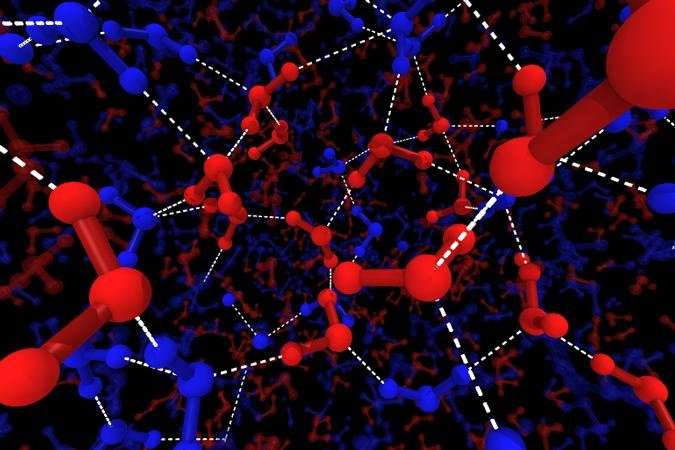
A Japanese research team led by The University of Tokyo investigated the fragile-to-strong transition of water. Unlike most liquids, when water is cooled, the rate of increase of its viscosity reaches a maximum at a certain low temperature. The...


