



A transistor based on the 2-D material tungsten ditelluride (WTe2) sandwiched between boron nitride can switch between two different electronic states—one that conducts current only along its edges, making it a topological insulator, and one that conducts current with...
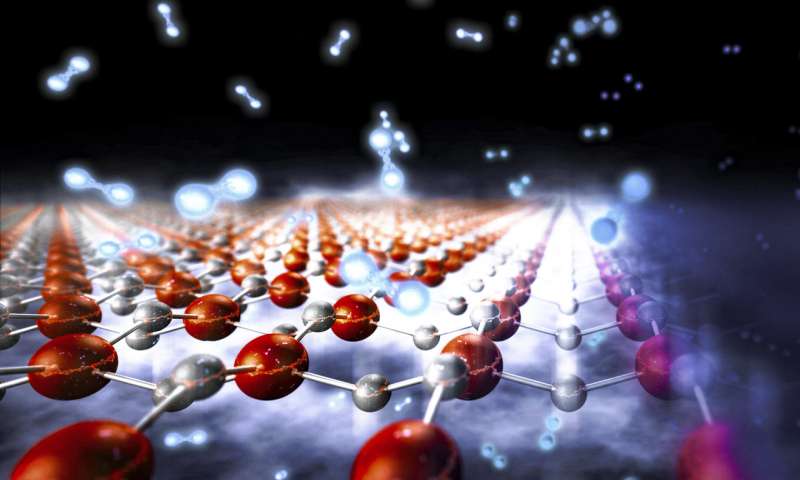
In superconducting materials, electrons pair up and condense into a quantum state that carries electrical current with no loss. This usually happens at very low temperatures. Scientists have mounted an all-out effort to develop new types of superconductors that...

The chips that drive everyday electronic gadgets such as personal computers and smartphones are made in semiconductor fabrication plants. These plants employ powerful transmission electron microscopes. While they can see physical structures smaller than a billionth of a meter,...

As multiple research groups around the world race to build a scalable quantum computer, questions remain about how the achievement of quantum supremacy will be verified.
Quantum supremacy is the term that describes a quantum computer's ability to solve a...

A theoretical concept to realize quantum information processing has been developed by Professor Guido Burkard and his team of physicists at the University of Konstanz. The researchers have found ways to shield electric and magnetic noise for a short...

Researchers from the Moscow Institute of Physics and Technology (MIPT), Aalto University in Finland, and ETH Zurich have demonstrated a prototype device that uses quantum effects and machine learning to measure magnetic fields more accurately than its classical analogues....

The DESY accelerator facility in Hamburg, Germany, goes on for miles to host a particle making kilometer-long laps at almost the speed of light. Now researchers have shrunk such a facility to the size of a computer chip.
A University...

A network metric called the K-core could predict structural collapse in mutualistic ecosystems, according to research by physicists at The City College of New York. The K-core appears able to forecast which species is likely to face extinction first,...

Gyroscopes are devices that help vehicles, drones, and wearable and handheld electronic devices know their orientation in three-dimensional space. They are commonplace in just about every bit of technology we rely on every day. Originally, gyroscopes were sets of...

About 99 percent of the Sun's energy emitted as neutrinos is produced through nuclear reaction sequences initiated by proton-proton (pp) fusion in which hydrogen is converted into helium, say scientists including physicist Andrea Pocar at the University of Massachusetts...

Broadband fiber-optics carry information on pulses of light, at the speed of light, through optical fibers. But the way the light is encoded at one end and processed at the other affects data speeds.
This world-first nanophotonic device, just unveiled...


