




Researchers at Tufts University School of Engineering have developed magnetic elastomeric composites that move in different ways when exposed to light, raising the possibility that these materials could enable a wide range of products that perform simple to complex...

Thermodynamics is one of the most human of scientific enterprises, according to Kater Murch, associate professor of physics in Arts & Sciences at Washington University in St. Louis.
"It has to do with our fascination of fire and our laziness,"...
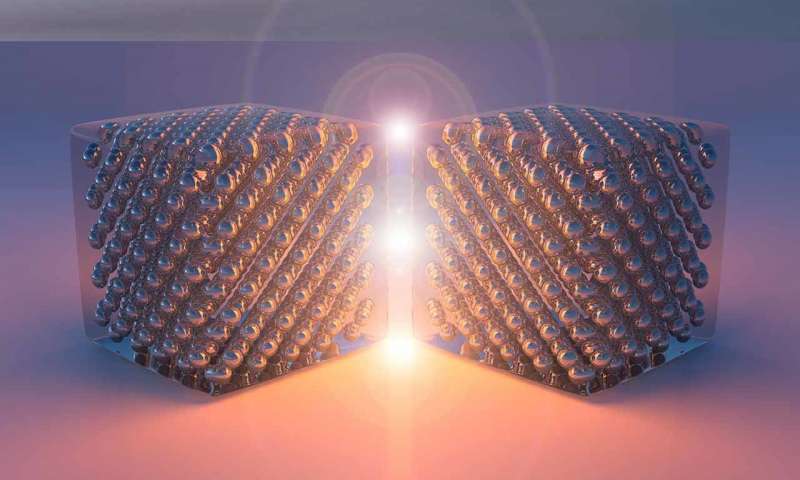
Using advanced fabrication techniques, engineers at the University of California San Diego have built a nanosized device out of silver crystals that can generate light by efficiently "tunneling" electrons through a tiny barrier. The work brings plasmonics research a...

Modern civilization relies on water's incompressibility—it's something we take for granted. Hydraulic systems harness the virtual non-compressibility of fluids like water or oil to multiply mechanical force. Bulldozers, cranes, and other heavy machinery exploit the physics of hydraulics, as...
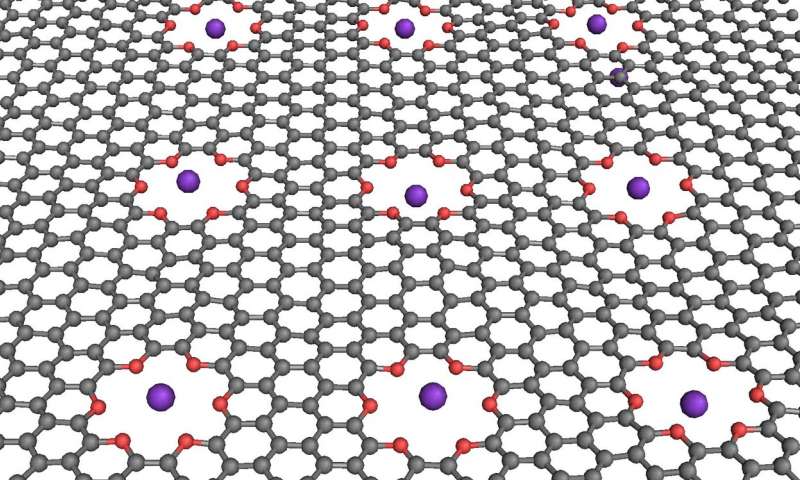
Invigorating the idea of computers based on fluids instead of silicon, researchers at the National Institute of Standards and Technology (NIST) have shown how computational logic operations could be performed in a liquid medium by simulating the trapping of...

Tiny magnetic vortex structures, so-called skyrmions, have been researched intensively for some time for future energy-efficient space-saving data storage devices. Scientists at Forschungszentrum Jülich have now discovered another class of particle-like magnetic object that could take the development of...

MIE Assistant Professor Sushant Anand and his research associates have had multiple breakthroughs with their work on oil-water mixtures or "emulsions." Now, the researchers have taken their research to a new level by creating ultra-small (100-400 nm in sizes)...

Researchers at Los Alamos and partners in France and Germany are exploring the enhanced potential of carbon nanotubes as single-photon emitters for quantum information processing. Their analysis of progress in the field is published in this week's edition of...

UCLA scientists and engineers have developed a new process for assembling semiconductor devices. The advance could lead to much more energy-efficient transistors for electronics and computer chips, diodes for solar cells and light-emitting diodes, and other semiconductor-based devices.
A paper...

Ever shrinking transistors are the key to faster and more efficient computer processing. Since the 1970s, advancements in electronics have largely been driven by the steady pace with which these tiny components have grown simultaneously smaller and more powerful—right...

Light detection and control lies at the heart of many modern device applications, such as smartphone cameras. Using graphene as a light-sensitive material for light detectors can offer significant improvements with respect to materials being used nowadays. For example,...


